THE CLASSIC COLLECTION✦An outlaw’s diary: the CommuneCLASSIC FREE BOOKS
An outlaw’s diary: the Commune
Cécile Tormay
THE CLASSIC COLLECTION · 1900
"The Maya Indians of Southern Yucatan and Northern British Honduras" by Thomas W. F. Gann is a scientific publication written in the early 20th century. This work provides an in-depth analysis of the customs, ceremonies, and way of life of the Maya Indians residing in the southern Yucatan and northern British Honduras regions. Gann explores various aspects of their culture, including social practices, agriculture, crafts, and traditional beliefs, aiming to document and preserve the knowledge of these indigenous communities. At the start of the book, Gann introduces the contemporary state of two Maya tribes—the Santa Cruz and the Icaichè—highlighting their declining populations due to historical pressures and government policies. He describes the geographical setting of these tribes, noting the environmental features that shape their daily lives. The opening also touches on the physical characteristics of the Maya people, their dresses, and introduces key aspects of their daily activities, such as agriculture and social behaviors, setting the stage for a comprehensive exploration of their culture. Ultimately, Gann's detailed observations and descriptions aim to provide a richer understanding of the Maya Indians and the challenges they face in preserving their traditions amidst external influences.
Introduction adapted from the source catalogue; source summaries may be automatically generated.
Free to read · English · 58,216 words · No account needed
MAKE TIME FOR A GOOD BOOK
On by default. Untick to stop anonymous reading totals. Each page counts after 10 seconds in view. How this works.
Anonymous counting is on unless you have switched it off.
The southern and eastern parts of Yucatan, from Tuluum in the north to the Rio Hondo in the south, are occupied to-day by two tribes of Maya Indians, the Santa Cruz and Icaichè or Chichanha. The number of Santa Cruz was estimated by Sapper in 1895 at about 8,000 to 10,000, but at the present day has probably been reduced to about 5,000. The Icaichè, the number of whom he estimated at 500, and is given by the Guia de Yucatan in 1900 as 803, now comprise not more than 200. This decrease is due to the policy of extermination carried out among the Santa Cruz for years by the Mexican Government, and the consequent emigration of many of the Indians to British Honduras, Guatemala, and northern Yucatan. The northern and western parts of British Honduras contain between 5,000 and 6,000 Indians; those in the north are partly indigenous and partly immigrants drawn from Yucatecan tribes who have left their homes after various political disturbances, especially after the occupancy of their towns of Bacalar and Santa Cruz by the Mexican Government. The Indians of the western part of the colony are also partly indigenous, but for the greater part Itzas, who have come in from Peten in Guatemala.
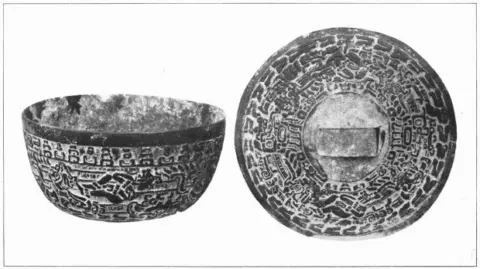
The objects shown in figures 16, 17, 18, 19, 21, 31, 35, 36, 47, 51, 52, 55, 56, 57, 59, 62, 63, 64, 65, 69, 70, 76, and 77, and in plates 8, 11, 12, 13, 14, 15, 16, 17, 18a, and 19 are in the Liverpool Museum; those shown in figures 15, 40, and 41 and in plate 9 are in the British Museum; those shown in figure 45 and in plates 23, 24, 25, 26, 27, and 28 are in the Bristol Museum; and those shown in figures 67 and 68 and in plates 20, 21, and 22 are in the Museum of the American Indian, Heye Foundation.
The northern-part of British Honduras, between the Rio Hondo and the Rio Nuevo, consists of an almost level plain, having an area of nearly 1,000 square miles. The soil is a vegetal humus; varying from a few inches to several feet in depth, the average depth being about 2 feet; beneath this is a stratum of marly limestone, outcrops of which are found in many places. The southern part of Yucatan, which, unlike the northern part, is comparatively well watered, is also flat, though a few small hills are found along the northern bank of the Rio Hondo, commencing about 50 miles from its mouth (fig. 1). Most of the land along the rivers is swampy, producing only reeds, coarse grasses, and mangrove trees. Beyond the swamp country are found "cuhun ridges," consisting of river valleys or depressions in the surface which have become filled with alluvium brought down by the rivers from the interior, forming an exceedingly rich soil suitable for the cultivation of maize and nearly every tropical product. It is upon these "cuhun ridges" that most of the mounds and other relics of the ancient inhabitants are found and that nearly all the villages of the modern Indians are built. Large tracts of what is known as "pine ridge" are scattered throughout this area; these are level or slightly undulating plains covered with gravel and coarse sand--exceedingly poor soil, producing only wiry grass, yellow pines, and small pimento palms. On these "pine ridges" Indian mounds are hardly ever found, nor do the Indians of to-day build villages upon them except in rare instances and for special local reasons. With the exception of the extreme northern part, nearly the whole of this area is well watered by rivers and streams, while scattered throughout it are numerous lagoons and lakes, the largest of which is the Bacalar Lagoon.
Your reading position is saved on this browser. Take it to another device with a library code. Reading pages adapt to text, rather than matching a printed edition.
BEHIND THE BOOK
This eBook is for the use of anyone anywhere in the United States and most other parts of the world at no cost and with almost no restrictions whatsoever. You may copy it, give it away or re-use it under the terms of the Project Gutenberg License included with this eBook or online at www.gutenberg.org. If you are not located in the United States, you will have to check the laws of the country where you are located before using this eBook. Read the source licence.
The original source file, including credits and licence, is retained by this library. Request an original-format copy at no charge. Please include the book title and Project Gutenberg identifier #46973.
KEEP YOUR CURIOSITY GOING
Cécile Tormay

Moritz Busch
John L. Ransom
Frances Wright
Cécile Tormay

Mabel Potter Daggett