THE CLASSIC COLLECTION✦An outlaw’s diary: the CommuneCLASSIC FREE BOOKS
An outlaw’s diary: the Commune
Cécile Tormay
THE CLASSIC COLLECTION · 1900
"The Maya Indians of Southern Yucatan and Northern British Honduras" by Thomas W. F. Gann is a scientific publication written in the early 20th century. This work provides an in-depth analysis of the customs, ceremonies, and way of life of the Maya Indians residing in the southern Yucatan and northern British Honduras regions. Gann explores various aspects of their culture, including social practices, agriculture, crafts, and traditional beliefs, aiming to document and preserve the knowledge of these indigenous communities. At the start of the book, Gann introduces the contemporary state of two Maya tribes—the Santa Cruz and the Icaichè—highlighting their declining populations due to historical pressures and government policies. He describes the geographical setting of these tribes, noting the environmental features that shape their daily lives. The opening also touches on the physical characteristics of the Maya people, their dresses, and introduces key aspects of their daily activities, such as agriculture and social behaviors, setting the stage for a comprehensive exploration of their culture. Ultimately, Gann's detailed observations and descriptions aim to provide a richer understanding of the Maya Indians and the challenges they face in preserving their traditions amidst external influences.
Introduction adapted from the source catalogue; source summaries may be automatically generated.
Free to read · English · 58,216 words · No account needed
MAKE TIME FOR A GOOD BOOK
On by default. Untick to stop anonymous reading totals. Each page counts after 10 seconds in view. How this works.
Anonymous counting is on unless you have switched it off.
Vague reports had been in circulation for some years as to the existence of a mound close to the headwaters of the Rio Hondo, where the Indians still practiced to some extent their ancient religion. It was said that the mound contained a stone chamber in which stood on a stone pedestal a life-sized image, painted in various colors, and that around the walls of the chamber were niches in which rested life-sized stone turtles, also painted; furthermore, that the bush Indians of the neighborhood were in the habit of coming to the mound for the purpose of burning incense before the idol.
The mound was found situated quite close to the bank of the Rio Hondo, buried in the bush which covers this part of Yucatan. It was 80 feet in height, 350 feet in circumference, conical in shape, and completely covered by high bush continuous with that of the surrounding forest. After clearing the underbrush from the mound an opening 3 feet square was discovered about 17 feet from the summit of the mound on its northern aspect, the walls of which were faced with cut stone. From this opening a low passage led to a small stone-faced chamber 8 feet high, 6 feet broad, and 10 feet long, the floor of which was composed of earth and lime well beaten down to form a hard, smooth surface. Projecting from the walls were eight small stone brackets, upon which nothing was found. No trace whatever was seen of a painted image or of turtles. The walls and ceiling of the room, especially the latter, were considerably blackened by smoke, possibly caused by burning incense.
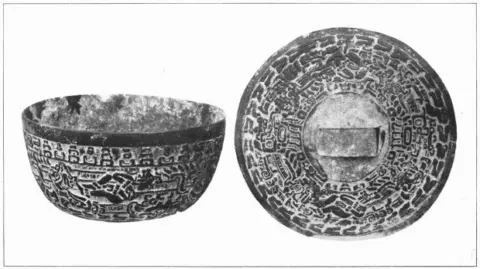
Excavation was commenced at once in the floor of the chamber. At a depth of 8 inches the hard floor gave place to soft brown sand, which was continuous to a depth of 2 feet, where several small deposits or pockets of lime were found inclosed within it, each of which contained a number of obsidian knives and small cores. The knives were deeply indented on each side of the base, as if to facilitate hafting. The cores, of which 20 were found, were slender and varied from 1 to 3 inches in length. On digging down through an additional 18 inches of the brown sand a layer of lime was exposed about 18 inches in thickness, filling the entire lumen of the chamber, in which were found irregularly scattered 60 cruciform objects, finely chipped in obsidian, each from 3 to 4 inches in length (fig. 31, a). These would have served as either arrowheads or small javelin heads, or possibly were intended for ceremonial purposes only. With them were a single pottery vase and two small triangular javelin heads of obsidian. The vase (fig. 31, b) was circular in shape, 6 inches in diameter, with a long piglike face protruding from one side. It was made of dark-brownish pottery, painted red and finely polished externally. It was filled with small mussel-like bivalve shells embedded in lime. A number of these shells were found also closely adjacent to the vase in the lime which surrounded it. Beneath the layer of lime lay a layer of brown sand, 3 feet thick, in which absolutely nothing was found. Below this appeared another layer of lime, mixed with sand, 4 feet thick, near the bottom of which were found 40 human skulls, neatly disposed in rows. These, when first uncovered, seemed to be in a moderately good state of preservation, but when removed from their bed of lime and sand they crumbled so easily that it was found impossible to preserve them. The skulls were all placed in the same horizontal plane, each one nearly in contact with its neighbor. No other bones were found with them, or in fact in any other part of this mound, with the exception of two small oblong objects of bone, about 2 inches in length, each still bearing traces of paint, which were discovered among the skulls. These skulls would seem to have been either the result of secondary interments or the remains of sacrificial victims whose bodies were either eaten or buried elsewhere. In favor of the first theory is the fact that the Maya did not practice human sacrifice to anything like the same extent that their neighbors, the Aztecs, did, and slaughter involving forty-odd victims must have been practically unknown among them. Furthermore, in one or two instances small shallow stone-lined graves, covered with large slabs of stone, have been found at and around the bases of large mounds, and it seems quite possible that these graves may have held the bodies of distinguished dead until their skulls were in a fit condition to be removed to the mound or until a sufficient number had accumulated to make it worth while opening the chamber for their reception. In favor of the second theory is the fact that, judging by what could be seen of the teeth and lower jaws, all the skulls were of individuals in the prime of life, no jaws of very young or of very old individuals being discovered. Immediately beneath the skulls were unearthed 12 objects of chert fashioned with great care. Seven of these were spearheads, the other five of eccentric form. The spearheads varied in length from 37 cm. (pl. 15, c) to 29 cm. (pl. 15, f); they were very well made, some from gray, others from brownish-yellow, chert. The eccentric flints comprised: (a) An animal form, possibly meant to represent a bush rabbit, 30 cm. in length from the forehead to the tip of the tail (pl. 15, a); (b) an animal form, evidently meant to represent a turtle or tortoise, 28 cm. in length from the head to the tip of the tail (pl. 15, g); (c) a halberd-shaped implement (pl. 15, b), exquisitely chipped from light-ocher-colored chert, 44 cm. in its greatest length by 19 cm. in breadth across the widest part of the head. This implement is furnished with two sharp-pointed cutting projections in front, separated by a groove; at the back is a larger triangular sharp projection. The whole implement is well balanced, for use in the hand, by a bulging or thickening of its body between these three projections; (d) an implement chipped from yellowish chert, 44 cm. in length, serrated on each side, pointed at one end and rounded at the other (pl. 15, d); (e) a crescentic implement, chipped from yellowish chert, 26 cm. in its greatest length, 17-1/2 cm. across the widest part of the crescent. From the convexity of the crescent project three spines, the central one long and serrated, the lateral ones merely pointed knobs. This object is more crudely chipped and less symmetrical than any of the others (pl. 15, e).
Your reading position is saved on this browser. Take it to another device with a library code. Reading pages adapt to text, rather than matching a printed edition.
BEHIND THE BOOK
This eBook is for the use of anyone anywhere in the United States and most other parts of the world at no cost and with almost no restrictions whatsoever. You may copy it, give it away or re-use it under the terms of the Project Gutenberg License included with this eBook or online at www.gutenberg.org. If you are not located in the United States, you will have to check the laws of the country where you are located before using this eBook. Read the source licence.
The original source file, including credits and licence, is retained by this library. Request an original-format copy at no charge. Please include the book title and Project Gutenberg identifier #46973.
KEEP YOUR CURIOSITY GOING
Cécile Tormay

Moritz Busch
John L. Ransom
Frances Wright
Cécile Tormay

Mabel Potter Daggett