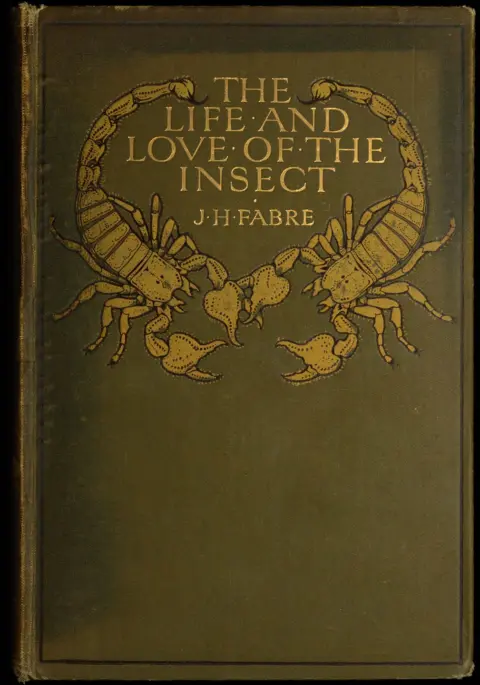
The Life and Love of the Insect
Jean-Henri Fabre
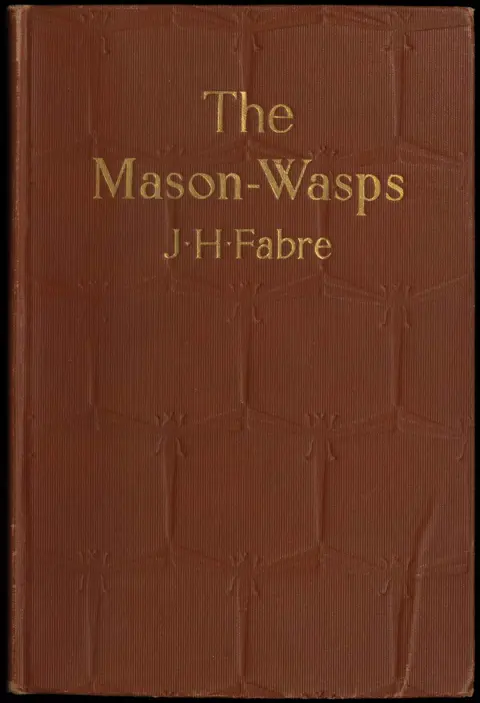
THE CLASSIC COLLECTION · 1919
"The Mason-Wasps" by Jean-Henri Fabre is a scientific publication written in the early 20th century. The book delves into the behavior and architecture of various types of wasps, particularly focusing on the Mason-wasps and their nesting habits. It aims to provide insights into their instinctual behavior and architectural prowess, blending entomology with natural history." The opening of "The Mason-Wasps" introduces readers to the Eumenes, a type of Mason-wasp known for its striking black and yellow appearance and remarkable building skills. Fabre describes these wasps' architectural talents, particularly their adeptness in constructing intricate nests using materials like dust and saliva. The narrative begins with a thorough examination of the different species of Eumenes, detailing their solitary habits, prey selection, and the specific habitats they prefer. Fabre’s meticulous observations set the stage for a deeper exploration of the intricacies of wasp behavior and the fascinating relationship between instinct and survival strategies in these remarkable insects.
Introduction adapted from the source catalogue; source summaries may be automatically generated.
Free to read · English · 63,730 words · No account needed
MAKE TIME FOR A GOOD BOOK
On by default. Untick to stop anonymous reading totals. Each page counts after 10 seconds in view. How this works.
Anonymous counting is on unless you have switched it off.
[45] The order of insects consisting of the Butterflies and
Moths.—Translator’s Note.
[46] Cf. The Life of the Caterpillar, by J. Henri Fabre, translated by Alexander Teixeira de Mattos: chap. xi.—Translator’s Note.
[47] Bombyx mori, the Moth of the Silkworm.—Translator’s Note.
[48] Charles Robert Darwin (1809–1882), the author of The Origin of Species, had the highest opinion of Fabre and spoke of him as “that incomparable observer.” Fabre, on the other hand, had no faith whatever in Darwinism, nor was he greatly struck by the views and the suggestions for experiments with which Darwin favoured him from time to time. Cf. The Mason-bees: chaps. iv. and v.—Translator’s Note.
[49] “The cheerful morn salutes Evander’s eyes;
And songs of chirping birds invite to rise.
He leaves his lowly bed.”
Æneid: book viii; Dryden’s translation.
[50] “Then underneath a lowly roof he led The weary prince and laid him on a bed; The stuffing leaves with hides of bears o’erspread.”
Æneid: book viii; Dryden’s translation.
[51] Also known as the House-swallow, or House-martin.—Translator’s
Note.
[52] Cf. The Life of the Fly: chap. xvii., in which the author describes his collection of water-colour drawings of mushrooms done by his own hand.—Translator’s Note.
[53] Or Leaf-cutters. Cf. Bramble-bees and Others: chap.
viii.—Translator’s Note.
[54] Cf. Bramble-bees and Others: passim.—Translator’s Note.
[55] Cf. Bramble-bees and Others: passim.—Translator’s Note.
[56] Cf. Bramble-bees and Others: chaps. iii. and iv.—Translator’s
Note.
[57] Cf. the essay on the Resin-bees in Bramble-bees and Others: chap.
x.—Translator’s Note.
[58] The Common Snail.—Translator’s Note.
[59] Cf. The Life and Love of the Insect: chap. xi.—Translator’s Note.
[60] Not yet published in English.—Translator’s Note.
[61] The Hunting Wasps: chaps. viii. to x. and xviii.—Translator’s
Note.
[62] Cf. The Sacred Beetle and Others, by J. Henri Fabre, translated by Alexander Teixeira de Mattos: chap. iv.—Translator’s Note.
[63] Sexually undeveloped females.—Translator’s Note.
[64] A widely-distributed genus of Pond-snails.—Translator’s Note.
[65] Cf. The Life of the Grasshopper: chaps. xiv. and xvi.—Translator’s
Note.
[66] John James Audubon (1780–1851), a noted American ornithologist of French descent, author of The Birds of America, which was published by subscription (1827–1830) at $1,000 a copy.—Translator’s Note.
[67] Cf. The Hunting Wasps: chap. vii.—Translator’s Note.
[68] Hylotoma rosæ, the Saw-fly of the Rose. Cf. Chapter XII. of the present volume.—Translator’s Note.
[69] A Beetle whose larva lives in the shoots of cherry- and walnut-trees, as well as in those of alder and elm. Cf. Chapter XII. of the present volume.—Translator’s Note.
[70] Or Greenbottles. Cf. The Life of the Fly: chap. ix.—Translator’s
Note.
Your reading position is saved on this browser. Take it to another device with a library code. Reading pages adapt to text, rather than matching a printed edition.
Jean-Henri Fabre
Jean-Henri Fabre
Jean-Henri Fabre
Jean-Henri Fabre
BEHIND THE BOOK
This eBook is for the use of anyone anywhere in the United States and most other parts of the world at no cost and with almost no restrictions whatsoever. You may copy it, give it away or re-use it under the terms of the Project Gutenberg License included with this eBook or online at www.gutenberg.org. If you are not located in the United States, you will have to check the laws of the country where you are located before using this eBook. Read the source licence.
The original source file, including credits and licence, is retained by this library. Request an original-format copy at no charge. Please include the book title and Project Gutenberg identifier #66854.
KEEP YOUR CURIOSITY GOING

John Muir

Asa Gray
Asa Gray

Florence Nightingale
Elizabeth Robins Pennell
Denison Olmsted