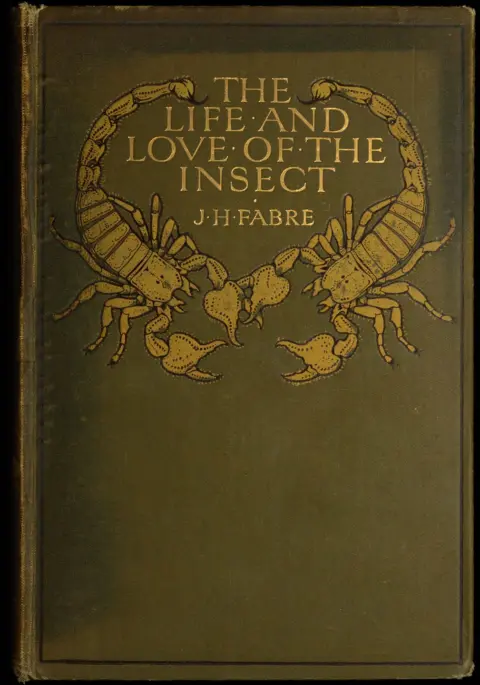
The Life and Love of the Insect
Jean-Henri Fabre
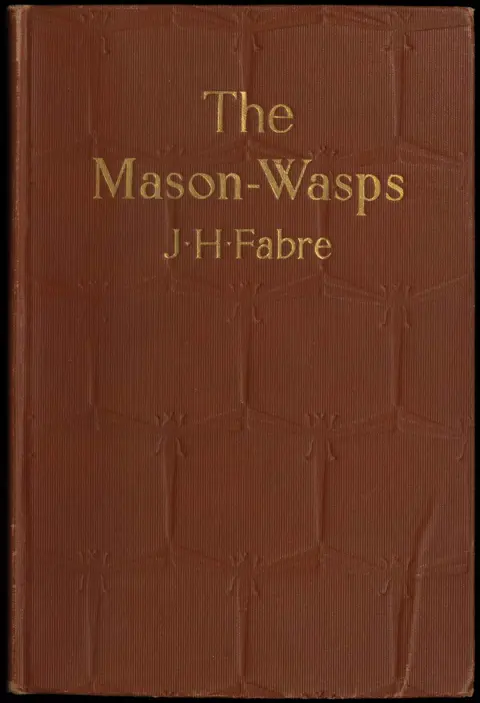
THE CLASSIC COLLECTION · 1919
"The Mason-Wasps" by Jean-Henri Fabre is a scientific publication written in the early 20th century. The book delves into the behavior and architecture of various types of wasps, particularly focusing on the Mason-wasps and their nesting habits. It aims to provide insights into their instinctual behavior and architectural prowess, blending entomology with natural history." The opening of "The Mason-Wasps" introduces readers to the Eumenes, a type of Mason-wasp known for its striking black and yellow appearance and remarkable building skills. Fabre describes these wasps' architectural talents, particularly their adeptness in constructing intricate nests using materials like dust and saliva. The narrative begins with a thorough examination of the different species of Eumenes, detailing their solitary habits, prey selection, and the specific habitats they prefer. Fabre’s meticulous observations set the stage for a deeper exploration of the intricacies of wasp behavior and the fascinating relationship between instinct and survival strategies in these remarkable insects.
Introduction adapted from the source catalogue; source summaries may be automatically generated.
Free to read · English · 63,730 words · No account needed
MAKE TIME FOR A GOOD BOOK
On by default. Untick to stop anonymous reading totals. Each page counts after 10 seconds in view. How this works.
Anonymous counting is on unless you have switched it off.
[25] The Iulus belongs to the Myriapod family, which includes the Centipedes, etc.—Translator’s Note.
[26] .156 inch.—Translator’s Note.
[27] .234 inch.—Translator’s Note.
[28] Cf. The Mason-bees: chap. x.—Translator’s Note.
[29] 1.17 inch.—Translator’s Note.
[30] .58 inch.—Translator’s Note.
[31] For the various species of Burrowing Bees known as the Anthophoræ, cf. Bramble-bee and others: chap. vii. et passim.—Translator’s Note.
[32] For the Cicada, or Cigale, cf. The Life of the Grasshopper, by J. Henri Fabre, translated by Alexander Teixeira de Mattos: chaps. i. to v.—Translator’s Note.
[33] The Pompilus, or Ringed Calicurgus, is a Hunting Wasp, feeding her young on Spiders. Cf. The Life and Love of the Insect: chap. xii.—Translator’s Note.
[34] For the Epeiræ, or Garden Spiders, cf. The Life of the Spider: chaps. ix. to xiv.—Translator’s Note.
[35] One of the Tube-weaving Spiders.—Translator’s Note.
[36] For Theridion lugubre and the Narbonne Lycosa, or Black-bellied Tarantula, cf. The Life of the Spider: chap. i.—Translator’s Note.
[37] Cf. The Life of the Spider: chaps. vi. and vii.—Translator’s Note.
[38] A family of Digger Wasps of whom the larger species burrow in the ground and the smaller in the pith of plants or in rotten wood.—Translator’s Note.
[39] Joseph Jérôme Le Français de Lalande (1732–1807), the astronomer. Even after he had achieved his reputation, he sought means, outside the domain of science, to make himself talked about and found these in the display partly of odd tastes, such as that for eating Spiders and caterpillars, and partly of atheistical opinions.—Translator’s Note.
[40] Or Pompilus: vide supra.—Translator’s Note.
[41] For the Scolia, cf. The Life and Love of the Insect: chap. xi.; for the Sphex, cf. The Hunting Wasps: chaps. iv. to x.—Translator’s Note.
[42] .177 by .039 inch.—Translator’s Note.
[43] For the Cerceris, cf. The Hunting Wasps: chaps. i. to iii; for the Philanthus, or Bee-eating Wasp, cf. Social Life in the Insect World: chap. xiii. Some of the other Wasps mentioned above will form the subject of chapters in a later volume of this series entitled More Hunting Wasps.—Translator’s Note.
[44] Étienne Bonnot de Condillac, Abbé de Mureaux (1715–1780), the leading exponent of sensual philosophy. His most important work is a Traité des sensations, in which he imagines a statue organized like a man and endows it with the senses one by one, beginning with that of smell. He argues by a process of imaginative reconstruction that all human faculties and all human knowledge are merely transformed sensations, to the exclusion of any other principle; in short, that everything has its source in sensation: man is nothing but what he has acquired.—Translator’s Note.
Your reading position is saved on this browser. Take it to another device with a library code. Reading pages adapt to text, rather than matching a printed edition.
Jean-Henri Fabre
Jean-Henri Fabre
Jean-Henri Fabre
Jean-Henri Fabre
BEHIND THE BOOK
This eBook is for the use of anyone anywhere in the United States and most other parts of the world at no cost and with almost no restrictions whatsoever. You may copy it, give it away or re-use it under the terms of the Project Gutenberg License included with this eBook or online at www.gutenberg.org. If you are not located in the United States, you will have to check the laws of the country where you are located before using this eBook. Read the source licence.
The original source file, including credits and licence, is retained by this library. Request an original-format copy at no charge. Please include the book title and Project Gutenberg identifier #66854.
KEEP YOUR CURIOSITY GOING

John Muir

Asa Gray
Asa Gray

Florence Nightingale
Elizabeth Robins Pennell
Denison Olmsted