
With Sword and Crucifix Being an Account of the Strange Adventures of Count Louis Sancerre, Companion of Sieur LaSalle, on the Lower Mississippi, in the Year of Grace 1682
Edward S. (Edward Sims) Van Zile
THE CLASSIC COLLECTION · 1895
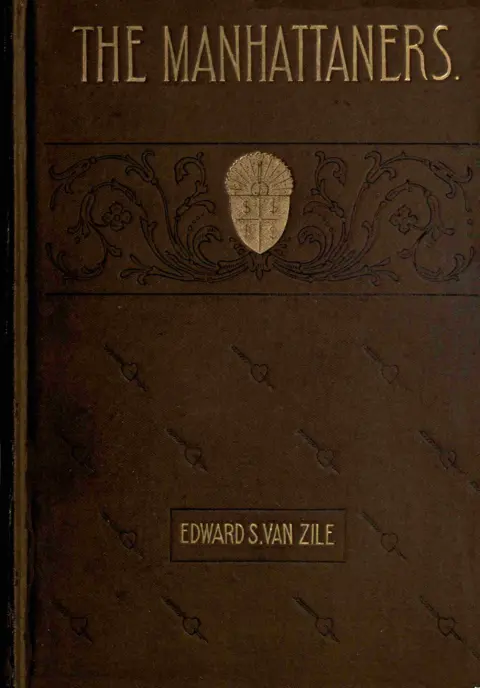
"The Manhattaners: A Story of the Hour" by Edward S. Van Zile is a novel written in the late 19th century. The story introduces us to two contrasting characters, John Fenton, a weary and cynical journalist in his forties, and Richard Stoughton, an enthusiastic young man embarking on his career in New York City’s newspaper industry. The narrative explores themes of ambition, societal norms, and the complexity of human relationships as Richard navigates his way through life and encounters characters who challenge and inspire him. At the start of the novel, the two men are engaged in a contemplative discussion in City Hall Park, reflecting on a statue of Nathan Hale. Fenton warns Richard about the perils of youthful ideals, suggesting that such enthusiasm can lead to ruin, drawing analogies to historical oppression and personal experience. Their conversation touches on deeper societal issues, contrasting Richard's optimistic outlook with Fenton’s disillusionment. As they continue their journey through the city, Fenton challenges Richard to learn from the realities of life, setting the stage for Richard's development and interpersonal relationships, particularly with the wealthy and artistically inclined Percy-Bartletts, whose world seems both alluring and fraught with complications.
Introduction adapted from the source catalogue; source summaries may be automatically generated.
Free to read · English · 42,171 words · No account needed
MAKE TIME FOR A GOOD BOOK
On by default. Untick to stop anonymous reading totals. Each page counts after 10 seconds in view. How this works.
Anonymous counting is on unless you have switched it off.
“I think, Mr. Budd, that Mr. Fenton can give you the advice and counsel that I have so wofully failed to furnish you,” remarked Gertrude, after her callers were seated. “You see, Mr. Fenton takes the new woman seriously.”
“Surely, Mr. Budd,” said John Fenton, “there is no great merit in that. We are obliged to, are we not?”
“I am disappointed in you, Mr. Fenton,” exclaimed Gertrude. “I thought you did it willingly, and now you hint at compulsion.”
Buchanan Budd grasped the opportunity for a flank movement.
“You have thrown yourself open to suspicion, Mr. Fenton. I fear your counsel and advice to one who is very glad to welcome woman to new privileges would not be as valuable as I had hoped it would be.”
Fenton saw that he had placed himself at a disadvantage.
“You both do me an injustice,” he explained. “Although there may be, as I have said, no possibility of retreat, we men still take pleasure in advancing with women, rather than against them.”
Budd saw at once that his opponent was a strategist worthy of his own
Napoleonic skill.
“You see,” said Budd, gazing earnestly at Gertrude, “that you find all men ready to capitulate. The burden now lies on your own shoulders. It is for you to direct your allies in the line that they should take.”
Gertrude smiled in apparent amusement; but she had a painful consciousness that her hand would tremble perceptibly if she held it out straight before her.
“It seems,” she remarked, looking at Fenton, “that everything has been turned around. As a guide and adviser to men, I fear that woman is not yet quite up in her part.”
“As my friend Richard Stoughton,--you met him at the musicale last evening, Miss Van Vleck,--as Stoughton puts it, woman has evoluted into a mentor from a tormentor,” remarked Fenton, proving that he was no longer a young man, by quoting the witticism of a friend and giving credit to the author.
“I have been told that Mr. Stoughton is clever,” remarked Gertrude. “He is on a newspaper, is he not?”
A slight flush mounted to Fenton’s cheek.
“Yes,” he answered, looking at Budd steadily; “he is one of my colleagues on the Trumpet.”
“Ah,” commented Budd, with what he doubtless considered an effectively Napoleonic drawl, “you are--ah--in journalism, Mr. Fenton?”
Your reading position is saved on this browser. Take it to another device with a library code. Reading pages adapt to text, rather than matching a printed edition.
Edward S. (Edward Sims) Van Zile
Edward S. (Edward Sims) Van Zile
BEHIND THE BOOK
This eBook is for the use of anyone anywhere in the United States and most other parts of the world at no cost and with almost no restrictions whatsoever. You may copy it, give it away or re-use it under the terms of the Project Gutenberg License included with this eBook or online at www.gutenberg.org. If you are not located in the United States, you will have to check the laws of the country where you are located before using this eBook. Read the source licence.
The original source file, including credits and licence, is retained by this library. Request an original-format copy at no charge. Please include the book title and Project Gutenberg identifier #64467.
KEEP YOUR CURIOSITY GOING
Coulson Kernahan

Maurice Baring
Frances Wright
Cécile Tormay

Frederic Jesup Stimson

W. H. P. (William Henry Pope) Jarvis