
With Sword and Crucifix Being an Account of the Strange Adventures of Count Louis Sancerre, Companion of Sieur LaSalle, on the Lower Mississippi, in the Year of Grace 1682
Edward S. (Edward Sims) Van Zile
THE CLASSIC COLLECTION · 1895
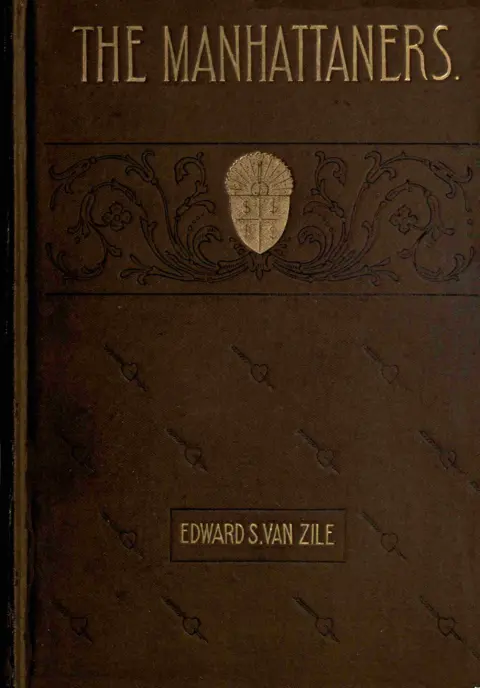
"The Manhattaners: A Story of the Hour" by Edward S. Van Zile is a novel written in the late 19th century. The story introduces us to two contrasting characters, John Fenton, a weary and cynical journalist in his forties, and Richard Stoughton, an enthusiastic young man embarking on his career in New York City’s newspaper industry. The narrative explores themes of ambition, societal norms, and the complexity of human relationships as Richard navigates his way through life and encounters characters who challenge and inspire him. At the start of the novel, the two men are engaged in a contemplative discussion in City Hall Park, reflecting on a statue of Nathan Hale. Fenton warns Richard about the perils of youthful ideals, suggesting that such enthusiasm can lead to ruin, drawing analogies to historical oppression and personal experience. Their conversation touches on deeper societal issues, contrasting Richard's optimistic outlook with Fenton’s disillusionment. As they continue their journey through the city, Fenton challenges Richard to learn from the realities of life, setting the stage for Richard's development and interpersonal relationships, particularly with the wealthy and artistically inclined Percy-Bartletts, whose world seems both alluring and fraught with complications.
Introduction adapted from the source catalogue; source summaries may be automatically generated.
Free to read · English · 42,171 words · No account needed
MAKE TIME FOR A GOOD BOOK
On by default. Untick to stop anonymous reading totals. Each page counts after 10 seconds in view. How this works.
Anonymous counting is on unless you have switched it off.
“Do you know,” she began playfully, after they were seated, “I have begun to feel a good deal awed in your presence. A man who can perform miracles, you know”--
“Well?” exclaimed Richard, as she hesitated a moment.
“A man who can perform miracles is to be avoided. Just think of poor
Trilby and Svengali.”
Richard laughed outright.
“That is a most complimentary remark! If I follow you, you mean that I hypnotized John Fenton. I certainly feel flattered. But, do you know, I begin to suspect that your friend, Miss Van Vleck, will prove a much more successful medium than I?”
They both glanced at Gertrude and John Fenton, who were deep in conversation in the opposite corner of the drawing-room.
“I am very glad that all responsibility for the man’s future has been taken off of my hands,” said Richard. “The fact is, I feel that I have all that I can do to take care of myself.”
He looked into her eyes with an expression in his own that was hardly allowable--even at a musicale.
“How selfish a man is,” Mrs. Percy-Bartlett murmured musingly. “It is almost impossible for him to be a consistent friend to another man. How much less is he able to be a true friend to a woman.”
“The basis of all friendship is affection,” argued Richard, lowering his voice as the music of a ’cello crept softly through the room. “And affection is a very hard thing to hold in check.”
She looked up at him with a smile on her lips, but an expression of sadness in her eloquent brown eyes.
“It is, indeed!” she almost whispered. Then, as if regretting the admission, she leaned back in her chair, and seemed to listen to the soft, throbbing harmonies that the piano and the ’cello begot as their tones met and mingled, as though they caressed each other.
Richard bent forward, and their eyes met again.
“Do you reject my--my friendship?” he whispered.
Suddenly he felt her hand in his; and she smiled as he pressed it, while her eyes brightened, and her cheeks flushed. Withdrawing her hand, she said, her voice hardly audible even as he bent his face close to hers:--
“Remember that there is another foundation-stone to friendship: it is
unselfishness.”
The words, and the pleading tone in which they were uttered, combined to make her remark sound more like a prayer to his generosity than a statement founded on a time-worn truth.
“I will try,” whispered Richard earnestly, “I will try to be an ideal friend to you. I would rather have your friendship than the love of any other woman in the world.”
Your reading position is saved on this browser. Take it to another device with a library code. Reading pages adapt to text, rather than matching a printed edition.
Edward S. (Edward Sims) Van Zile
Edward S. (Edward Sims) Van Zile
BEHIND THE BOOK
This eBook is for the use of anyone anywhere in the United States and most other parts of the world at no cost and with almost no restrictions whatsoever. You may copy it, give it away or re-use it under the terms of the Project Gutenberg License included with this eBook or online at www.gutenberg.org. If you are not located in the United States, you will have to check the laws of the country where you are located before using this eBook. Read the source licence.
The original source file, including credits and licence, is retained by this library. Request an original-format copy at no charge. Please include the book title and Project Gutenberg identifier #64467.
KEEP YOUR CURIOSITY GOING
Coulson Kernahan

Maurice Baring
Frances Wright
Cécile Tormay

Frederic Jesup Stimson

W. H. P. (William Henry Pope) Jarvis