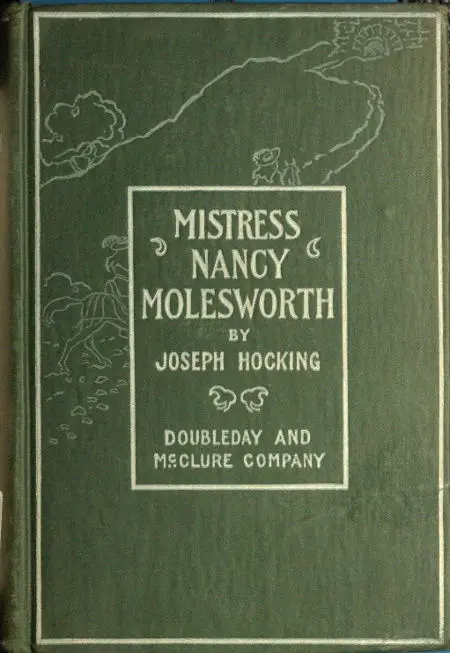
Mistress Nancy Molesworth: A Tale of Adventure
Joseph Hocking
THE CLASSIC COLLECTION · 1906
"The Man Who Rose Again" by Joseph Hocking is a novel written in the early 20th century. The story revolves around Radford Leicester, a cynical, heavy-drinking young politician who, after a night of introspection and conversation with friends in a London club, accepts a wager to prove that a virtuous woman would overlook his moral failings if he offers her a chance at social prominence. His challenge raises ethical questions about the intentions behind relationships and the value of personal integrity versus ambition. The opening of the story introduces a dialogue among four young men in a smoking-room discussing politics and personal matters late into the night. Leicester, characterized by his striking presence, is engaged in a bitter challenge about his worthiness to court the most sought-after heiress in London, Olive Castlemaine, despite his acknowledged flaws. Amidst conversations laden with sarcasm and a sense of foreboding, Leicester expresses a desperate determination to prove his theory—that women are primarily motivated by social standing—by courting Olive, ostensibly for a wager. This sets the stage for a psychological exploration of his character and the complexities of human relationships.
Introduction adapted from the source catalogue; source summaries may be automatically generated.
Free to read · English · 112,956 words · No account needed
MAKE TIME FOR A GOOD BOOK
On by default. Untick to stop anonymous reading totals. Each page counts after 10 seconds in view. How this works.
Anonymous counting is on unless you have switched it off.
"I am glad to meet you chaps," he said, as he came up to them, "and I think myself lucky in finding you all together. I want to speak to you."
Purvis and Sprague exchanged glances, and from the eyes of the latter an evil look shone. He had not forgiven Leicester for the many times he had held him up to ridicule, neither did he forgive him for being successful where he, Sprague, had failed.
"When last we were all together in this clubroom," said Leicester, speaking with an effort, for as may be imagined the thoughts in his mind were far from pleasant, "we--well, as you know, a kind of wager was made."
They waited for him to go on.
"As you know," he continued presently; "I--I--have----"
"Won the wager," said Sprague. "That being so, I shall be prepared to give my cheque to--what was it? Guy's Hospital. All the same, I think it is time that this farce should cease. It was unworthy of us all and for my own part I regret having had anything to do with it."
Sprague's tones, rather than his words, angered Leicester. The thought of the woman he loved more than all on earth being associated with a wager maddened him.
"To whom shall I send my cheque, Leicester?" went on Sprague. "Purvis also wants to know. Having fulfilled our part of the business, you will, of course, also finish yours. It reflects no credit upon any of us."
"No," said Leicester, speaking very quietly. "If any cheque is sent, I
will send it myself."
"You mean then that all we have heard is false, and that the young lady
has refused you."
"What I mean does not affect you, providing I send the cheque," replied Leicester, still speaking quietly.
"Leicester has been converted at a drawing-room meeting, after all," said Sprague, with a sneer. "I hear he has adopted quite a different tone in his speeches. We shall see him addressing mothers' meetings yet."
Still Leicester kept himself under control, although Sprague tried him
sorely.
"Come, Leicester," want on Sprague, "if you are converted, you ought to give up this unworthy business; if you are not, then you have no right to ruin a woman's life."
"I think I can mind my own business," said Leicester.
"But the question is, are you converted from the error of your ways?
Have you turned moral reformer, temperance lecturer, and the rest of
it?"
"And if I have?"
"Oh, nothing--only I think it ought to be duly reported in the religious
papers."
Leicester still kept himself under control, nevertheless Sprague's
sneers were telling on him.
Your reading position is saved on this browser. Take it to another device with a library code. Reading pages adapt to text, rather than matching a printed edition.
Joseph Hocking
Joseph Hocking
Joseph Hocking
Joseph Hocking
BEHIND THE BOOK
This eBook is for the use of anyone anywhere in the United States and most other parts of the world at no cost and with almost no restrictions whatsoever. You may copy it, give it away or re-use it under the terms of the Project Gutenberg License included with this eBook or online at www.gutenberg.org. If you are not located in the United States, you will have to check the laws of the country where you are located before using this eBook. Read the source licence.
The original source file, including credits and licence, is retained by this library. Request an original-format copy at no charge. Please include the book title and Project Gutenberg identifier #33964.
KEEP YOUR CURIOSITY GOING
Coulson Kernahan

Maurice Baring
Frances Wright
Cécile Tormay

Frederic Jesup Stimson

W. H. P. (William Henry Pope) Jarvis