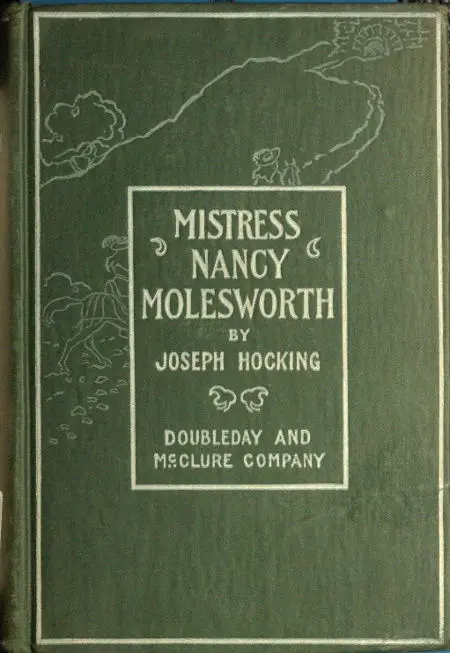
Mistress Nancy Molesworth: A Tale of Adventure
Joseph Hocking
THE CLASSIC COLLECTION · 1906
"The Man Who Rose Again" by Joseph Hocking is a novel written in the early 20th century. The story revolves around Radford Leicester, a cynical, heavy-drinking young politician who, after a night of introspection and conversation with friends in a London club, accepts a wager to prove that a virtuous woman would overlook his moral failings if he offers her a chance at social prominence. His challenge raises ethical questions about the intentions behind relationships and the value of personal integrity versus ambition. The opening of the story introduces a dialogue among four young men in a smoking-room discussing politics and personal matters late into the night. Leicester, characterized by his striking presence, is engaged in a bitter challenge about his worthiness to court the most sought-after heiress in London, Olive Castlemaine, despite his acknowledged flaws. Amidst conversations laden with sarcasm and a sense of foreboding, Leicester expresses a desperate determination to prove his theory—that women are primarily motivated by social standing—by courting Olive, ostensibly for a wager. This sets the stage for a psychological exploration of his character and the complexities of human relationships.
Introduction adapted from the source catalogue; source summaries may be automatically generated.
Free to read · English · 112,956 words · No account needed
MAKE TIME FOR A GOOD BOOK
On by default. Untick to stop anonymous reading totals. Each page counts after 10 seconds in view. How this works.
Anonymous counting is on unless you have switched it off.
"Not in the slightest, I assure you," replied Leicester. "I believe that hosts of these men sacrifice themselves a great deal. If you ask me who they sacrifice themselves for, I should say--themselves."
"Then the candidate for Taviton sacrifices his leisure for----"
"The candidate for Taviton, exactly. My dear Sprague, you have hit off the situation with your usual felicity."
"I don't think Mr. Leicester is fair to himself," remarked Olive Castlemaine, looking questioningly into Leicester's face.
"I assure you I am," replied Leicester. "Indeed, I am inclined to think that the people who are called self-sacrificing are very undesirable people to associate with."
"Come, come now, Leicester, you don't believe that," said Purvis.
"I assure you I do most sincerely," replied Leicester quietly. "The other day I was at a house where there were six people present, and they were waiting to play some game where only four could take part. Well, four of them were self-sacrificing people, and wanted to give way to the others. Two were selfish, and desired to engage in the game. Well, neither of these four would give way in their unselfishness--with the result that the game was never played at all. The evening was spoiled by unselfish people."
He looked so serious as he spoke that Olive Castlemaine laughed
outright.
"Many an evening which might have been pleasant," went on Leicester, "has been spoiled for me by these unselfish people making themselves and everybody else uncomfortable, under the pretence that they were trying to make us comfortable. Of this I am sure, if people were really and truly honest, and were openly selfish, then each man would seek his own enjoyment and find it."
"And be miserable when he had found it," remarked Olive quietly.
"I assure you that is a fallacy," said Leicester, "else why is it that the so-called moral and unselfish people are the most disagreeable to deal with? This I can say truly, the most morose and unhappy people I have ever met are these moral reformers."
"Then what would you suggest?"
"A good healthy paganism. I know this is an awful heresy, but can any reasonable man say that the English, with all their religious institutions, are as happy as the old Greeks were?"
"We can't accuse Leicester of hiding his light under a bushel," said Sprague to Purvis, after dinner, during which Leicester continued to talk in the same strain.
"No, but I have yet to see that Miss Castlemaine is repelled by him."
"That's because she believes he is playing a part."
"You believe that she thinks he's been joking?"
"Exactly."
Your reading position is saved on this browser. Take it to another device with a library code. Reading pages adapt to text, rather than matching a printed edition.
Joseph Hocking
Joseph Hocking
Joseph Hocking
Joseph Hocking
BEHIND THE BOOK
This eBook is for the use of anyone anywhere in the United States and most other parts of the world at no cost and with almost no restrictions whatsoever. You may copy it, give it away or re-use it under the terms of the Project Gutenberg License included with this eBook or online at www.gutenberg.org. If you are not located in the United States, you will have to check the laws of the country where you are located before using this eBook. Read the source licence.
The original source file, including credits and licence, is retained by this library. Request an original-format copy at no charge. Please include the book title and Project Gutenberg identifier #33964.
KEEP YOUR CURIOSITY GOING
Coulson Kernahan

Maurice Baring
Frances Wright
Cécile Tormay

Frederic Jesup Stimson

W. H. P. (William Henry Pope) Jarvis