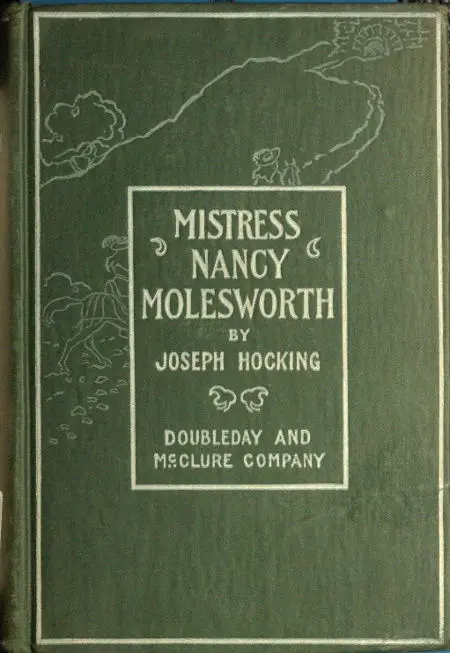
Mistress Nancy Molesworth: A Tale of Adventure
Joseph Hocking
THE CLASSIC COLLECTION · 1906
"The Man Who Rose Again" by Joseph Hocking is a novel written in the early 20th century. The story revolves around Radford Leicester, a cynical, heavy-drinking young politician who, after a night of introspection and conversation with friends in a London club, accepts a wager to prove that a virtuous woman would overlook his moral failings if he offers her a chance at social prominence. His challenge raises ethical questions about the intentions behind relationships and the value of personal integrity versus ambition. The opening of the story introduces a dialogue among four young men in a smoking-room discussing politics and personal matters late into the night. Leicester, characterized by his striking presence, is engaged in a bitter challenge about his worthiness to court the most sought-after heiress in London, Olive Castlemaine, despite his acknowledged flaws. Amidst conversations laden with sarcasm and a sense of foreboding, Leicester expresses a desperate determination to prove his theory—that women are primarily motivated by social standing—by courting Olive, ostensibly for a wager. This sets the stage for a psychological exploration of his character and the complexities of human relationships.
Introduction adapted from the source catalogue; source summaries may be automatically generated.
Free to read · English · 112,956 words · No account needed
MAKE TIME FOR A GOOD BOOK
On by default. Untick to stop anonymous reading totals. Each page counts after 10 seconds in view. How this works.
Anonymous counting is on unless you have switched it off.
Purvis looked angrily at Leicester as he heard John Castlemaine say this, but he said nothing; he was a little afraid.
"Are you going back to London, Purvis?" asked Leicester. "If you are, I'm sure Mr. Lowry will be glad to give you a lift."
"Thank you," said Purvis; then, as an afterthought, he added, "I should like a word with Mr. Castlemaine before I go. We have all been so interested in Mr. Leicester's opinions that I had almost forgotten the errand on which I came."
For a minute Leicester was alone with Olive.
"I have to thank you for a pleasant evening, Miss Castlemaine," he said, "one of the few pleasant evenings of my life."
She looked up at him inquiringly.
"I mean what I say," he said. "While we were at dinner I told you that I had found life very interesting. I told you a lie. Why I told it I don't know. It slipped from my tongue before I realised what I was saying. I have not found life interesting, I have found it anything but that--anything. But this evening has been an oasis in the desert, and I thank you."
"I am glad you have had a pleasant evening," said Olive quietly; nevertheless she wondered how much truth there was in his words.
"You do not believe me," he said, "but what I say is perfectly true. I do not find the stage of life very interesting to act on."
"Then it is best not to act," said Olive.
"That is not a matter of choice."
"I think it is. One can choose to play a part, or he can choose to live
a life."
"The same thing," he replied.
"Pardon me, I do not think so."
"All the same, I thank you for a pleasant evening. When one has very few of them, it is a great deal to be thankful for."
There was something in the tones of his voice that convinced her that he meant what he said. She reflected that his face was sad, and that there was no joy in his eyes.
"Forgive me, a stranger, asking a question," he went on. "Do you find
life happy?"
"Exceedingly."
"That is interesting. I wish I knew your secret."
"By ceasing to play a part."
She had not meant to say this; but the words escaped her before she
realised them.
"How can one do that?"
"By seeking to serve the spectators, instead of pleasing them."
He laughed almost bitterly.
"If the spectators were only worth it," he said. He held out his hand. "Good-night, Miss Castlemaine," he said; "thank you again very much."
Your reading position is saved on this browser. Take it to another device with a library code. Reading pages adapt to text, rather than matching a printed edition.
Joseph Hocking
Joseph Hocking
Joseph Hocking
Joseph Hocking
BEHIND THE BOOK
This eBook is for the use of anyone anywhere in the United States and most other parts of the world at no cost and with almost no restrictions whatsoever. You may copy it, give it away or re-use it under the terms of the Project Gutenberg License included with this eBook or online at www.gutenberg.org. If you are not located in the United States, you will have to check the laws of the country where you are located before using this eBook. Read the source licence.
The original source file, including credits and licence, is retained by this library. Request an original-format copy at no charge. Please include the book title and Project Gutenberg identifier #33964.
KEEP YOUR CURIOSITY GOING
Coulson Kernahan

Maurice Baring
Frances Wright
Cécile Tormay

Frederic Jesup Stimson

W. H. P. (William Henry Pope) Jarvis