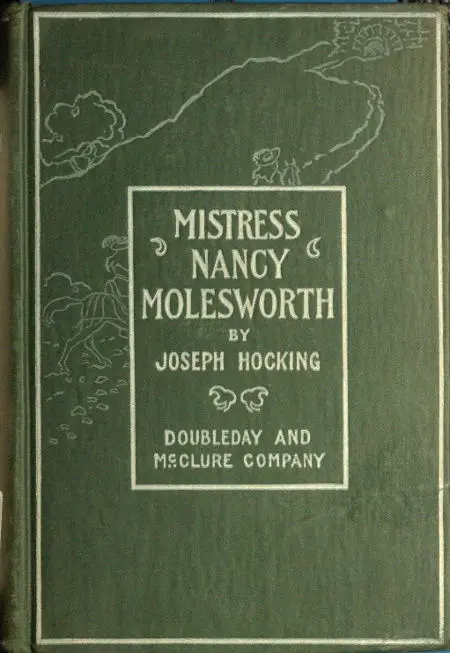
Mistress Nancy Molesworth: A Tale of Adventure
Joseph Hocking
THE CLASSIC COLLECTION · 1906
"The Man Who Rose Again" by Joseph Hocking is a novel written in the early 20th century. The story revolves around Radford Leicester, a cynical, heavy-drinking young politician who, after a night of introspection and conversation with friends in a London club, accepts a wager to prove that a virtuous woman would overlook his moral failings if he offers her a chance at social prominence. His challenge raises ethical questions about the intentions behind relationships and the value of personal integrity versus ambition. The opening of the story introduces a dialogue among four young men in a smoking-room discussing politics and personal matters late into the night. Leicester, characterized by his striking presence, is engaged in a bitter challenge about his worthiness to court the most sought-after heiress in London, Olive Castlemaine, despite his acknowledged flaws. Amidst conversations laden with sarcasm and a sense of foreboding, Leicester expresses a desperate determination to prove his theory—that women are primarily motivated by social standing—by courting Olive, ostensibly for a wager. This sets the stage for a psychological exploration of his character and the complexities of human relationships.
Introduction adapted from the source catalogue; source summaries may be automatically generated.
Free to read · English · 112,956 words · No account needed
MAKE TIME FOR A GOOD BOOK
On by default. Untick to stop anonymous reading totals. Each page counts after 10 seconds in view. How this works.
Anonymous counting is on unless you have switched it off.
"You say that because of his picture," she replied. "An artist friend of ours knows the family. He paid a visit to Tolstoi's home, and the Count consented to sit for his picture. I believe it is very good."
"But you admire him?"
"Why do you think so?"
"Because you allow his picture to hang on your wall."
"You forget that my father would naturally govern such matters."
"I should not imagine that your father would elect to give honour to a
man of Tolstoi's views."
"My father greatly admires the artist's work."
"But not this one. You are quite right, Mr. Leicester," said Mr. Castlemaine, who had overheard their conversation. "I am not an admirer of this Russian's revolutionary ideas. My daughter and I had quite an argument about this picture."
"And Miss Castlemaine had the best of it."
"What man was ever equal to a woman in argument?" said Mr. Castlemaine good-humouredly. "Yes, what were you saying, Mr. Lowry?"
"Why do you admire him?" asked Radford Leicester, turning to Olive.
"A woman always admires strength, courage, honesty," replied Olive.
"And which most?"
"Honesty."
"That is interesting. Might one ask why?"
"Because the other two do not exist without it."
Radford Leicester did not repress the answer that rose to his lips. He could not be altogether a hypocrite, even to carry out his plans.
"That is a very respectable tradition," he said.
"You do not believe it?"
"I would not try to destroy it for worlds," he said. "I can feel the whole constitution rattling about my ears at the very thought of its destruction."
"But you do not believe it?"
"What would you say if I told you I did not?"
"I should say that Tolstoi's life would prove you in the wrong."
"Have you ever considered what a complex thing humanity is, Miss Castlemaine? I have known honest men--that is, as honest men go--as timid as rabbits, and I have known scoundrels who have been as brave as lions. Is not human nature constantly laughing at us?"
"That is because our judgments are so shallow. We do not look beneath
the surface."
"Yes, doubtless you are right. But my main objection to the so-called honest man is that he is so frightfully dull."
"To say the least of him, Tolstoi is not dull."
"Therefore he is not honest."
"Surely a sweeping conclusion from a very uncertain premiss."
"No, not uncertain."
"No? May I ask how you can prove it true?"
"By constantly meeting with men--and women."
"You mean that all the honest people you have met with are dull?"
Your reading position is saved on this browser. Take it to another device with a library code. Reading pages adapt to text, rather than matching a printed edition.
Joseph Hocking
Joseph Hocking
Joseph Hocking
Joseph Hocking
BEHIND THE BOOK
This eBook is for the use of anyone anywhere in the United States and most other parts of the world at no cost and with almost no restrictions whatsoever. You may copy it, give it away or re-use it under the terms of the Project Gutenberg License included with this eBook or online at www.gutenberg.org. If you are not located in the United States, you will have to check the laws of the country where you are located before using this eBook. Read the source licence.
The original source file, including credits and licence, is retained by this library. Request an original-format copy at no charge. Please include the book title and Project Gutenberg identifier #33964.
KEEP YOUR CURIOSITY GOING
Coulson Kernahan

Maurice Baring
Frances Wright
Cécile Tormay

Frederic Jesup Stimson

W. H. P. (William Henry Pope) Jarvis