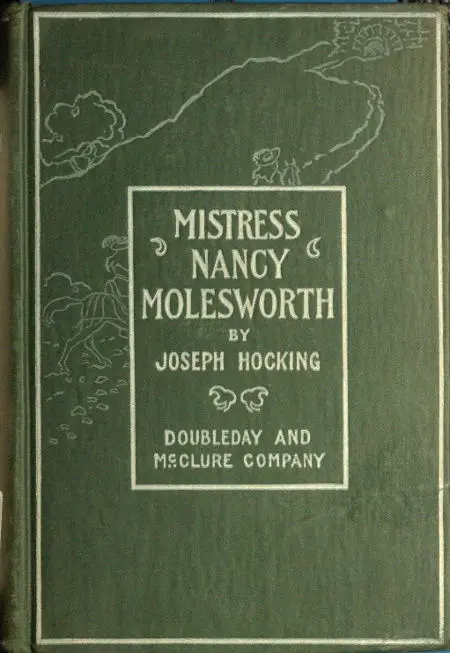
Mistress Nancy Molesworth: A Tale of Adventure
Joseph Hocking
THE CLASSIC COLLECTION · 1906
"The Man Who Rose Again" by Joseph Hocking is a novel written in the early 20th century. The story revolves around Radford Leicester, a cynical, heavy-drinking young politician who, after a night of introspection and conversation with friends in a London club, accepts a wager to prove that a virtuous woman would overlook his moral failings if he offers her a chance at social prominence. His challenge raises ethical questions about the intentions behind relationships and the value of personal integrity versus ambition. The opening of the story introduces a dialogue among four young men in a smoking-room discussing politics and personal matters late into the night. Leicester, characterized by his striking presence, is engaged in a bitter challenge about his worthiness to court the most sought-after heiress in London, Olive Castlemaine, despite his acknowledged flaws. Amidst conversations laden with sarcasm and a sense of foreboding, Leicester expresses a desperate determination to prove his theory—that women are primarily motivated by social standing—by courting Olive, ostensibly for a wager. This sets the stage for a psychological exploration of his character and the complexities of human relationships.
Introduction adapted from the source catalogue; source summaries may be automatically generated.
Free to read · English · 112,956 words · No account needed
MAKE TIME FOR A GOOD BOOK
On by default. Untick to stop anonymous reading totals. Each page counts after 10 seconds in view. How this works.
Anonymous counting is on unless you have switched it off.
"Are you not judging without sufficient reason?" asked Herbert Briarfield warmly. "You have never seen Miss Castlemaine."
"I am no longer a boy," said the other, with a sigh.
"What might that mean?"
"That I have seen women--in Paris, in Berlin, in Vienna, in Damascus, Constantinople, Cairo, Bagdad, Calcutta. Yes, I have seen them--women of all tongues, all nationalities. And everywhere they are the same."
"Well, and what is the sum total of your experience?"
"I would rather not tell you."
"Why? It is always well to know the truth."
"Mr. Briarfield, if there is one thing I am afraid of it is the truth. For many years I have made it my business to keep my eyes from beholding the truth; nevertheless, it always keeps thrusting itself upon me--always. That is why I am a sad man."
"Perhaps you have only seen one side of life."
Again a look suggesting pain shot across the stranger's face, but he
still spoke quietly.
"Mr. Briarfield," he said, "I have even read the book which is to the English people a text-book of religion. I fancy I am somewhat of an exception, but I have. Well, the part of that book which interests me most is the Book of Ecclesiastes. Perhaps that is because the experience of its writer is my own experience. In all essential features, Solomon, or whoever was the author, wrote my experience. I have tried everything, Mr. Briarfield."
"And your conclusion?"
"Solomon's."
"If that were my creed," said Briarfield, "I should commit suicide."
"Of course I have thought of that--without fear. But I came to the conclusion that it wasn't worth while. 'For in that sleep of death what dreams may come! Ay, there's the rub.' Besides, I've something to live for."
"According to your creed I do not see what," said Briarfield. "It would
be interesting to know."
"Ah, but I have something to live for, Mr. Briarfield."
"I suppose I might be intruding on your privacy if I sought to know what
it was?"
"It's not love, and it's not money," said Ricordo. "Ah, Herr Truebner, I apologise. I have monopolised your guest completely, and that is unforgivable. You have a great gift, my friend--all the Germans have--and it makes them a great people."
"What gift is that, signore?"
"The gift of listening."
After this the conversation drifted into general subjects, and a little later Herbert Briarfield took his leave.
Your reading position is saved on this browser. Take it to another device with a library code. Reading pages adapt to text, rather than matching a printed edition.
Joseph Hocking
Joseph Hocking
Joseph Hocking
Joseph Hocking
BEHIND THE BOOK
This eBook is for the use of anyone anywhere in the United States and most other parts of the world at no cost and with almost no restrictions whatsoever. You may copy it, give it away or re-use it under the terms of the Project Gutenberg License included with this eBook or online at www.gutenberg.org. If you are not located in the United States, you will have to check the laws of the country where you are located before using this eBook. Read the source licence.
The original source file, including credits and licence, is retained by this library. Request an original-format copy at no charge. Please include the book title and Project Gutenberg identifier #33964.
KEEP YOUR CURIOSITY GOING
Coulson Kernahan

Maurice Baring
Frances Wright
Cécile Tormay

Frederic Jesup Stimson

W. H. P. (William Henry Pope) Jarvis