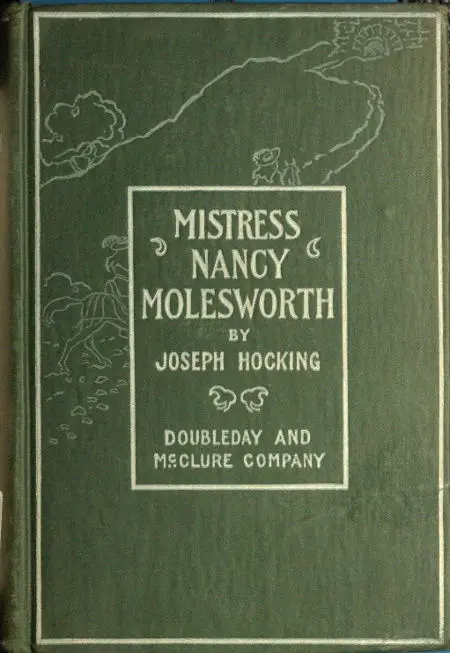
Mistress Nancy Molesworth: A Tale of Adventure
Joseph Hocking
THE CLASSIC COLLECTION · 1906
"The Man Who Rose Again" by Joseph Hocking is a novel written in the early 20th century. The story revolves around Radford Leicester, a cynical, heavy-drinking young politician who, after a night of introspection and conversation with friends in a London club, accepts a wager to prove that a virtuous woman would overlook his moral failings if he offers her a chance at social prominence. His challenge raises ethical questions about the intentions behind relationships and the value of personal integrity versus ambition. The opening of the story introduces a dialogue among four young men in a smoking-room discussing politics and personal matters late into the night. Leicester, characterized by his striking presence, is engaged in a bitter challenge about his worthiness to court the most sought-after heiress in London, Olive Castlemaine, despite his acknowledged flaws. Amidst conversations laden with sarcasm and a sense of foreboding, Leicester expresses a desperate determination to prove his theory—that women are primarily motivated by social standing—by courting Olive, ostensibly for a wager. This sets the stage for a psychological exploration of his character and the complexities of human relationships.
Introduction adapted from the source catalogue; source summaries may be automatically generated.
Free to read · English · 112,956 words · No account needed
MAKE TIME FOR A GOOD BOOK
On by default. Untick to stop anonymous reading totals. Each page counts after 10 seconds in view. How this works.
Anonymous counting is on unless you have switched it off.
"It gave me a sort of faith in human nature, in the simplicity of the people who send the actors there. It proves that the people of England are more fools than knaves. But it amused me vastly. No, Mr. Briarfield, your Dr. Johnson was right. If one must live in England, I should say London is the best place in the summer; while in the winter there is no place else."
"One wonders, what led you to this out-of-the-way place, then?"
"I wanted to be quiet. London is a maelstrom, from which I got out with difficulty, but I did get out. Then I said, 'Let me be quiet, let me think.' Then I met a man who had been here, and who said it was the most beautiful place in England. Moreover, he told me a romantic story about the lady who reigns here. And we Easterns love romance. So I came. I have not seen the beautiful lady yet. Do you know her?"
"Yes. I know her."
"Ah, I should like to hear about her. Will you tell me what she is
like?"
"I am afraid I have not your gift of description, Signor Ricordo."
The man with the fez looked at Briarfield steadily out of his half-opened eyes, but not a muscle of his face moved. What he thought, it was impossible to tell, but that he drew his own conclusions was evident.
"I have been told that she is very gifted, very beautiful, very pious,"
he said.
"You speak our language well," said Briarfield; "but for a slight foreign intonation, I should take you for an Englishman."
"Allah forbid!" he cried, lifting his hands beseechingly.
"You would not like to be an Englishman?"
"If I must be of one country, yes. But I am of no country. If you have a country, you have responsibilities, duties, prejudices."
"And you are without these?"
"Would you have me assume them?"
"Without them no man lives his full life."
"With them he becomes narrow, insular, and what your poet calls 'cribbed, cabined, and confined.'"
"They are the necessary limitations of our humanity."
"Does not that depend on the purpose for which a man lives, signore? Besides, there are things which happen to some men which say to them, 'Messieurs, you are without country, without father, mother, friends, and responsibilities, and therefore without prejudices; live your lives in your own way.'"
"That is impossible, Signor Ricordo."
"And why?"
"A man is always responsible to the humanity of which he forms a part, he is responsible to the God who made him."
"Always to the latter, not always to the former."
"You believe in God, then?"
Your reading position is saved on this browser. Take it to another device with a library code. Reading pages adapt to text, rather than matching a printed edition.
Joseph Hocking
Joseph Hocking
Joseph Hocking
Joseph Hocking
BEHIND THE BOOK
This eBook is for the use of anyone anywhere in the United States and most other parts of the world at no cost and with almost no restrictions whatsoever. You may copy it, give it away or re-use it under the terms of the Project Gutenberg License included with this eBook or online at www.gutenberg.org. If you are not located in the United States, you will have to check the laws of the country where you are located before using this eBook. Read the source licence.
The original source file, including credits and licence, is retained by this library. Request an original-format copy at no charge. Please include the book title and Project Gutenberg identifier #33964.
KEEP YOUR CURIOSITY GOING
Coulson Kernahan

Maurice Baring
Frances Wright
Cécile Tormay

Frederic Jesup Stimson

W. H. P. (William Henry Pope) Jarvis