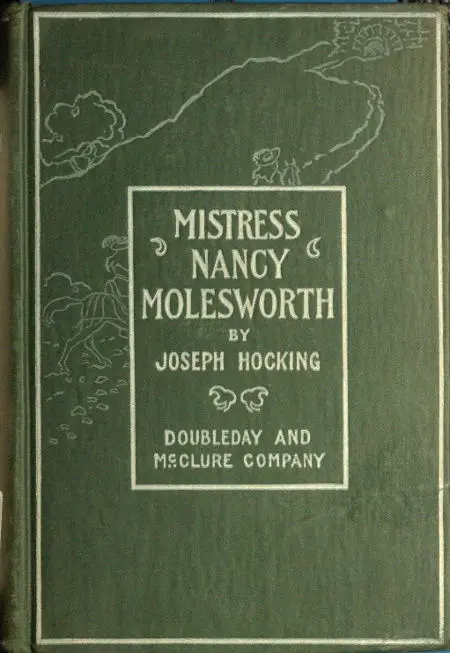
Mistress Nancy Molesworth: A Tale of Adventure
Joseph Hocking
THE CLASSIC COLLECTION · 1906
"The Man Who Rose Again" by Joseph Hocking is a novel written in the early 20th century. The story revolves around Radford Leicester, a cynical, heavy-drinking young politician who, after a night of introspection and conversation with friends in a London club, accepts a wager to prove that a virtuous woman would overlook his moral failings if he offers her a chance at social prominence. His challenge raises ethical questions about the intentions behind relationships and the value of personal integrity versus ambition. The opening of the story introduces a dialogue among four young men in a smoking-room discussing politics and personal matters late into the night. Leicester, characterized by his striking presence, is engaged in a bitter challenge about his worthiness to court the most sought-after heiress in London, Olive Castlemaine, despite his acknowledged flaws. Amidst conversations laden with sarcasm and a sense of foreboding, Leicester expresses a desperate determination to prove his theory—that women are primarily motivated by social standing—by courting Olive, ostensibly for a wager. This sets the stage for a psychological exploration of his character and the complexities of human relationships.
Introduction adapted from the source catalogue; source summaries may be automatically generated.
Free to read · English · 112,956 words · No account needed
MAKE TIME FOR A GOOD BOOK
On by default. Untick to stop anonymous reading totals. Each page counts after 10 seconds in view. How this works.
Anonymous counting is on unless you have switched it off.
"Ah, but that is because of pure chagrin, I imagine. Besides, Mr. Lestrange is noted for his bigotry, and is not therefore a fair sample."
"Of course there is an utterly different atmosphere here," said Olive. "Not that it troubles me. The people whose intellectual outlook is so limited that the question of religious opinion influences social courtesies, are not very desirable companions. Still, we will have to bear it in mind in considering our future. As for--by the way, are you very rich, father?"
"Yes," said John Castlemaine quietly; "I suppose I am."
"That question will be inquired into, no doubt," said Olive, "and it may be that in time the minor county families will overlook our other failings on account of your being a wealthy man."
"Aren't you a bit cynical, Olive?"
"I was only wondering whether these people were worth considering, father. As you know, I don't care a little bit about what is called society, and I have been thinking about other plans for the future."
"What plans?"
"I have been trying to think what I shall do with my life."
"Yes?" said John Castlemaine eagerly.
"Yes. We cannot live here for ever idly; at least, I cannot. Besides, it would not be right. Even if we were to take part in the social life of the county, I could not content myself to be a mere butterfly. Following the hounds, going to dances, paying calls, and the rest of it, is not a very interesting programme."
"No, it is not," John Castlemaine assented.
"I love the country," said Olive, "far more than I love the city, and--and I want to live in the country. Besides, there is as much work to do here as there is in the city. Of another kind, perhaps, but just as important."
"I think so, too; but what do you propose doing?"
"We have some responsibility towards the people here. Especially those on the estate you have bought. As it is very large, that will involve a great deal of work."
John Castlemaine nodded.
"But that is not all. I should like the house to be--well, a kind of
centre of life."
"That sounds very well; but tell me what you mean in greater detail. Would you invite the villagers to it? Would you give them dinners, and dances?"
"Perhaps so, but I was not thinking of that so much. As a rule, people build great houses for purely selfish purposes. They invite people whose presence will give them pleasure. They give dinners to those who live in a land of plenty, they offer pleasure to those who are satiated with it."
"Exactly," said John Castlemaine; "what then?"
Your reading position is saved on this browser. Take it to another device with a library code. Reading pages adapt to text, rather than matching a printed edition.
Joseph Hocking
Joseph Hocking
Joseph Hocking
Joseph Hocking
BEHIND THE BOOK
This eBook is for the use of anyone anywhere in the United States and most other parts of the world at no cost and with almost no restrictions whatsoever. You may copy it, give it away or re-use it under the terms of the Project Gutenberg License included with this eBook or online at www.gutenberg.org. If you are not located in the United States, you will have to check the laws of the country where you are located before using this eBook. Read the source licence.
The original source file, including credits and licence, is retained by this library. Request an original-format copy at no charge. Please include the book title and Project Gutenberg identifier #33964.
KEEP YOUR CURIOSITY GOING
Coulson Kernahan

Maurice Baring
Frances Wright
Cécile Tormay

Frederic Jesup Stimson

W. H. P. (William Henry Pope) Jarvis