
Essay on the Life and Institutions of Offa, King of Mercia, A.D. 755-794
Henry Mackenzie
THE CLASSIC COLLECTION · 1771
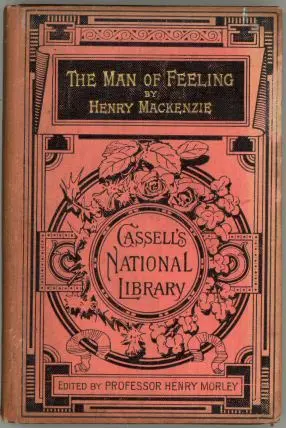
"The Man of Feeling" by Henry Mackenzie is a sentimental novel published in 1771. Through a fragmented manuscript discovered by chance, readers follow the naïve Harley through a series of moral encounters—with beggars, con men, a prostitute, and fellow travelers. His journey from home to London and back reveals a hero whose extreme sensitivity and compassion set him apart in an increasingly cynical world. As Harley weeps for strangers and gives freely to those in need, his tender heart leads toward an inevitable, poignant conclusion involving his beloved Miss Walton.
Introduction adapted from the source catalogue; source summaries may be automatically generated.
Free to read · English · 37,408 words · No account needed
MAKE TIME FOR A GOOD BOOK
On by default. Untick to stop anonymous reading totals. Each page counts after 10 seconds in view. How this works.
Anonymous counting is on unless you have switched it off.
HARLEY was one of those few friends whom the malevolence of fortune had yet left me; I could not therefore but be sensibly concerned for his present indisposition; there seldom passed a day on which I did not make inquiry about him.
The physician who attended him had informed me the evening before, that he thought him considerably better than he had been for some time past. I called next morning to be confirmed in a piece of intelligence so welcome to me.
When I entered his apartment, I found him sitting on a couch, leaning on his hand, with his eye turned upwards in the attitude of thoughtful inspiration. His look had always an open benignity, which commanded esteem; there was now something more—a gentle triumph in it.
He rose, and met me with his usual kindness. When I gave him the good accounts I had had from his physician, “I am foolish enough,” said he, “to rely but little, in this instance, upon physic: my presentiment may be false; but I think I feel myself approaching to my end, by steps so easy, that they woo me to approach it.
“There is a certain dignity in retiring from life at a time, when the infirmities of age have not sapped our faculties. This world, my dear Charles, was a scene in which I never much delighted. I was not formed for the bustle of the busy, nor the dissipation of the gay; a thousand things occurred, where I blushed for the impropriety of my conduct when I thought on the world, though my reason told me I should have blushed to have done otherwise.—It was a scene of dissimulation, of restraint, of disappointment. I leave it to enter on that state which I have learned to believe is replete with the genuine happiness attendant upon virtue. I look back on the tenor of my life, with the consciousness of few great offences to account for. There are blemishes, I confess, which deform in some degree the picture. But I know the benignity of the Supreme Being, and rejoice at the thoughts of its exertion in my favour. My mind expands at the thought I shall enter into the society of the blessed, wise as angels, with the simplicity of children.” He had by this time clasped my hand, and found it wet by a tear which had just fallen upon it.—His eye began to moisten too—we sat for some time silent.—At last, with an attempt to a look of more composure, “There are some remembrances,” said Harley, “which rise involuntary on my heart, and make me almost wish to live. I have been blessed with a few friends, who redeem my opinion of mankind. I recollect, with the tenderest emotion, the scenes of pleasure I have passed among them; but we shall meet again, my friend, never to be separated. There are some feelings which perhaps are too tender to be suffered by the world.—The world is in general selfish, interested, and unthinking, and throws the imputation of romance or melancholy on every temper more susceptible than its own. I cannot think but in those regions which I contemplate, if there is any thing of mortality left about us, that these feelings will subsist;—they are called,—perhaps they are—weaknesses here;—but there may be some better modifications of them in heaven, which may deserve the name of virtues.” He sighed as he spoke these last words. He had scarcely finished them, when the door opened, and his aunt appeared, leading in Miss Walton. “My dear,” said she, “here is Miss Walton, who has been so kind as to come and inquire for you herself.” I could observe a transient glow upon his face. He rose from his seat—“If to know Miss Walton’s goodness,” said he, “be a title to deserve it, I have some claim.” She begged him to resume his seat, and placed herself on the sofa beside him. I took my leave. Mrs. Margery accompanied me to the door. He was left with Miss Walton alone. She inquired anxiously about his health. “I believe,” said he, “from the accounts which my physicians unwillingly give me, that they have no great hopes of my recovery.”—She started as he spoke; but recollecting herself immediately, endeavoured to flatter him into a belief that his apprehensions were groundless. “I know,” said he, “that it is usual with persons at my time of life to have these hopes, which your kindness suggests; but I would not wish to be deceived. To meet death as becomes a man, is a privilege bestowed on few.—I would endeavour to make it mine;—nor do I think that I can ever be better prepared for it than now:—It is that chiefly which determines the fitness of its approach.” “Those sentiments,” answered Miss Walton, “are just; but your good sense, Mr. Harley, will own, that life has its proper value.—As the province of virtue, life is ennobled; as such, it is to be desired.—To virtue has the Supreme Director of all things assigned rewards enough even here to fix its attachment.”
Your reading position is saved on this browser. Take it to another device with a library code. Reading pages adapt to text, rather than matching a printed edition.
BEHIND THE BOOK
This eBook is for the use of anyone anywhere in the United States and most other parts of the world at no cost and with almost no restrictions whatsoever. You may copy it, give it away or re-use it under the terms of the Project Gutenberg License included with this eBook or online at www.gutenberg.org. If you are not located in the United States, you will have to check the laws of the country where you are located before using this eBook. Read the source licence.
The original source file, including credits and licence, is retained by this library. Request an original-format copy at no charge. Please include the book title and Project Gutenberg identifier #5083.
KEEP YOUR CURIOSITY GOING
Coulson Kernahan

Maurice Baring
Frances Wright
Cécile Tormay

Frederic Jesup Stimson

W. H. P. (William Henry Pope) Jarvis