THE CLASSIC COLLECTION✦A dead man’s diaryCLASSIC FREE BOOKS
A dead man’s diary
Coulson Kernahan
THE CLASSIC COLLECTION · 1909
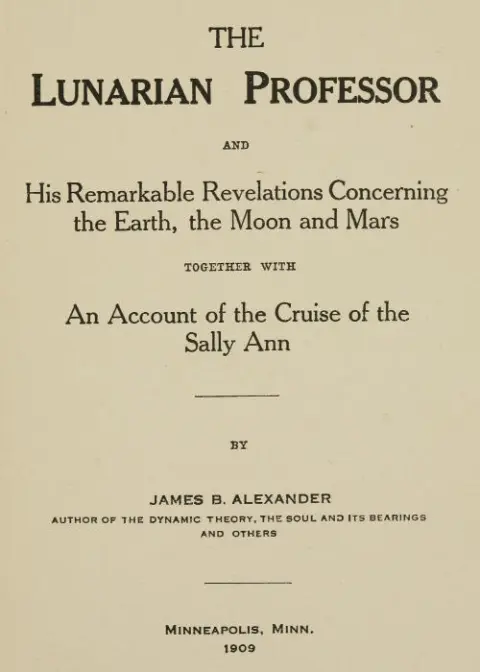
"The Lunarian Professor and His Remarkable Revelations Concerning the Earth, the Moon and Mars" by James B. Alexander is a science fiction novel written in the early 20th century. The narrative is centered around a professor from the Moon who shares intriguing insights about life on various celestial bodies, focusing particularly on Earth and its inhabitants. Through a blend of humor and philosophical reflection, the book sets the stage for an exploration of advanced alien civilizations and their perspectives on humanity. At the start of the novel, the narrator reflects on his long-overdue outing to Lake Minnetonka, where he plans to unwind and enjoy solitude. As he embarks on the cruise of his boat, the Sally Ann, he unexpectedly encounters Allan Ocheltree, a close friend from his past. Their reunion is marked by nostalgic conversations, and soon after, the professor from the Moon makes his entrance, initiating a dialogue about his home and the remarkable differences between it and Earth. The opening sets a tone of whimsical adventure infused with speculative science, hinting at discussions on societal evolution, technology, and the nature of life beyond our planet.
Introduction adapted from the source catalogue; source summaries may be automatically generated.
Free to read · English · 80,068 words · No account needed
MAKE TIME FOR A GOOD BOOK
On by default. Untick to stop anonymous reading totals. Each page counts after 10 seconds in view. How this works.
Anonymous counting is on unless you have switched it off.
“They did, and those of the $1,000 denomination were used as the basis of paper currency. But now at the close of the twentieth century over half of these bonds have been retired and the currency based upon them withdrawn. The railroad, telegraph, transportation, express, and car companies have all disappeared and the entire business is conducted by the general government. All of the roads will soon have been entirely paid for and the rates for the transportation of passengers, goods and messages are reduced almost to actual cost of the service including wear and tear. You would doubtless be surprised by the schedule of prices. For example, passenger rates for ten miles or under three cents, 20 miles five cents, 50 miles ten cents, 100 miles fifteen cents, 200 miles 25 cents, 500 miles 50 cents and greater distances at the same rate provided it is a continuous ride in the same train.”
“In my time,” said I, “electricity was being introduced as the motive power on railways. Did it prove successful?”
“It did, eminently so, and entirely superseded steam locomotion, although steam stationary engines were used principally, throughout the century. But when we come to look forward into the twenty-first century, we shall find some remarkable changes. But we have not reached that yet.”
“I am curious to know how the currency question was settled. After the retirement of the railway consols, I suppose they fell back on gold or paper based on it, did they?”
“The use of gold and silver money was never discontinued entirely, and both were coined. Near the close of last century, the free coinage of silver was strongly demanded by the people and strongly opposed by the financiers. Finally they compromised. The government gave up the task of maintaining the parity of the metals at any ratio, but coined both.
“The silver “dollar” with its fractions, half quarter and dime was coined in quantities to accommodate the business. Silver was made a legal tender for limited amounts. This gave silver the character of “fiat money,” or money that is legal and current at inflated values. They made gold the standard of value. In this they were right. There could logically be only one unit of value. But the debtor class strenuously opposed the plan. They said it worked great injustice to them, because their debts were contracted at times when money bore inflated values; when for example silver was intrinsically worth only half as much as gold. These debts were therefore now payable in money twice as valuable and twice as hard to get as that for which they had gone into debt. In other words they paid back twice as much as they fairly owed and the creditor received twice as much as he fairly loaned. There can be no doubt this is true of debts of long standing. But most debts were not affected materially by the rise in the value of gold, because they were not contracted at its bottom value, but at various grades of value while it was on the ascending movement. However as long as it was rising the creditor class was reaping an unjust advantage over the debtors. The government issued bank notes; some based on silver and some on gold; each kind redeemable in the metal on which it was based. The quantity of this paper money was regulated by the national legislature so as to insure a circulation in proportion to the volume of business. The extended use of bank checks has furnished a substitute for or supplement to the currency. When the currency question was finally felt to be settled, the conditions were practically accepted and the producing class was set to work, and in an incredibly short time, replaced the wealth that had been abstracted from them and more. Then came an era of speculation and the scattering of wealth. Obligations rashly incurred in flush times, had to be met when times became tight. This led to panics and the whole routine had to be repeated about so often. But panics could not be entirely eliminated by doctoring the currency, because currency is not the only factor. No matter how much currency a man has, he is not likely to buy articles he does not want. If mechanics have spent their time in the production of something the public do not require or a surplus of what they do ordinarily require, there will be difficulty in disposing of the product. If two classes of mechanics each make things with the expectation of selling them to the other class, and they turn out to be such things as are not wanted in either case, there is sure to be stagnation of exchange and consequent suffering. Where all are working in ignorance of the requirements of others there are sure to be produced many things for which there will be no demand. This had been partially recognized by the government in your day and commissioners were appointed to collect statistics and make estimates in regard to the production of and probable demand for certain farm products. As the government became more intimately the servant of the people its services in this direction were greatly extended and inquiries covered many other departments beside that of farming. The government itself became a large consumer in operating its railroads, telegraphs, etc. Additional mileage had to be constructed to meet the growing business besides the renewals on account of wear and tear. By the publication in advance of the probable demands on the various sorts of industry it became possible to estimate approximately what amount of and what kind of product could be disposed of. A still more fruitful source of financial trouble was to be found in the spirit of recklessness and extravagance with which people spent their money when times were prosperous or booming. It seemed so easy then to get money and to pay debts that many thought it hardly worth while to do it, if there appeared a chance for a profitable speculation, and so instead of paying old debts they were very likely to incur fresh ones. But as the state became more and more involved in business affairs, it was able to advise what products would be in demand, when it was advisable to use caution and economy and when activity would be rewarded. The functions of the state as a medium of exchange between the producer and the consumer became rapidly extended, and before the close of the century it became the chief and in many things the only buyer and seller of the products in most common use, as well as the sole factor in all monopolies and in banking, insurance, and public amusements. It had not yet gone into manufacturing or farming except to the extent necessary to prevent combinations and private monopolies.”
Your reading position is saved on this browser. Take it to another device with a library code. Reading pages adapt to text, rather than matching a printed edition.
BEHIND THE BOOK
This eBook is for the use of anyone anywhere in the United States and most other parts of the world at no cost and with almost no restrictions whatsoever. You may copy it, give it away or re-use it under the terms of the Project Gutenberg License included with this eBook or online at www.gutenberg.org. If you are not located in the United States, you will have to check the laws of the country where you are located before using this eBook. Read the source licence.
The original source file, including credits and licence, is retained by this library. Request an original-format copy at no charge. Please include the book title and Project Gutenberg identifier #60059.
KEEP YOUR CURIOSITY GOING
Coulson Kernahan

Maurice Baring
Frances Wright
Cécile Tormay
Francis Greenleaf Allinson & Anne C. E. (Anne Crosby Emery) Allinson

Frederic Jesup Stimson