THE CLASSIC COLLECTION✦A dead man’s diaryCLASSIC FREE BOOKS
A dead man’s diary
Coulson Kernahan
THE CLASSIC COLLECTION · 1909
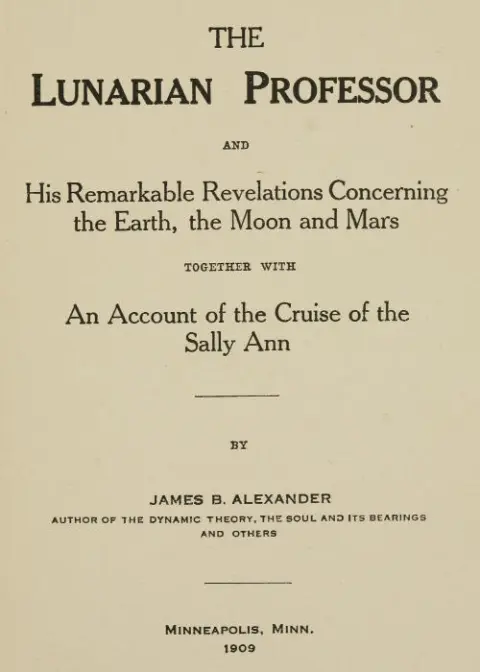
"The Lunarian Professor and His Remarkable Revelations Concerning the Earth, the Moon and Mars" by James B. Alexander is a science fiction novel written in the early 20th century. The narrative is centered around a professor from the Moon who shares intriguing insights about life on various celestial bodies, focusing particularly on Earth and its inhabitants. Through a blend of humor and philosophical reflection, the book sets the stage for an exploration of advanced alien civilizations and their perspectives on humanity. At the start of the novel, the narrator reflects on his long-overdue outing to Lake Minnetonka, where he plans to unwind and enjoy solitude. As he embarks on the cruise of his boat, the Sally Ann, he unexpectedly encounters Allan Ocheltree, a close friend from his past. Their reunion is marked by nostalgic conversations, and soon after, the professor from the Moon makes his entrance, initiating a dialogue about his home and the remarkable differences between it and Earth. The opening sets a tone of whimsical adventure infused with speculative science, hinting at discussions on societal evolution, technology, and the nature of life beyond our planet.
Introduction adapted from the source catalogue; source summaries may be automatically generated.
Free to read · English · 80,068 words · No account needed
MAKE TIME FOR A GOOD BOOK
On by default. Untick to stop anonymous reading totals. Each page counts after 10 seconds in view. How this works.
Anonymous counting is on unless you have switched it off.
“A few roads held out for a short time, but after the ice was broken they all at once became eager to transfer their properties to the government. The railway consols at once became popular and were rated above par, the government guaranty making them in reality national bonds. A new cabinet office—secretary of transportation—was created. All the employes on the roads from the superintendents of transportation down, held their places under civil service rules, and this branch of the administration never came under political conditions, but was managed upon strictly business principles like the post office. The income from the roads, from the very first year not only paid the interest on the railroad consols, but yielded a handsome surplus that was annually laid aside in safe investments to serve as a sinking fund for the redemption and cancellation of the bonds as they should mature. Before the end of the twentieth century one-half of these bonds had been retired and great reductions had been made in passenger and freight rates and the service had vastly improved over what it was in your day. Strikes, freight and passenger rate wars with their terrific waste and demoralization of business were things of the long past. Many other leaks of railway earnings were stopped when the roads became the property of the government. Many small pieces of road became consolidated under one superintendence; hordes of directors, presidents, vice presidents, general managers, general agents, solicitors of business and other officials were dispensed with; many of whom under the former regime, not only drew salaries for supposed services, but absorbed besides in various mysterious ways, vast wealth that of right should have gone to the stockholders.
The total mileage of the railroads of the U. S. in 1893 was 173,370
Total capital stock $5,021,576,551
Total bonds 5,510,225,528
Total actual cost $45,000 per mile 7,801,650,000
Total earnings, one year 1,208,641,498
Total net earnings 358,648,918
Amount of the railroad consols to be issued in payment of the R. R. 8,160,300,000
Annual interest on same at three per cent 244,809,000
Surplus of railway income after paying interest on railroad consols to be applied to sinking fund 113,839,918
Amount of sinking fund after twenty years to be used in the extinction of one-fifth of the consols 1,632,060,000
Net income of roads increased to 400,000,000
Surplus to be used in betterments 41,351,082
(The above figures I have worked out to accord with the Professor’s suggestions—as he did not give details. I have put the average value of the roads at $45,000 per mile which is much more than it would cost to replace them.)
“I suppose,” said I, “that these bonds, especially those of the lower denominations would circulate to some extent as currency.”
Your reading position is saved on this browser. Take it to another device with a library code. Reading pages adapt to text, rather than matching a printed edition.
BEHIND THE BOOK
This eBook is for the use of anyone anywhere in the United States and most other parts of the world at no cost and with almost no restrictions whatsoever. You may copy it, give it away or re-use it under the terms of the Project Gutenberg License included with this eBook or online at www.gutenberg.org. If you are not located in the United States, you will have to check the laws of the country where you are located before using this eBook. Read the source licence.
The original source file, including credits and licence, is retained by this library. Request an original-format copy at no charge. Please include the book title and Project Gutenberg identifier #60059.
KEEP YOUR CURIOSITY GOING
Coulson Kernahan

Maurice Baring
Frances Wright
Cécile Tormay
Francis Greenleaf Allinson & Anne C. E. (Anne Crosby Emery) Allinson

Frederic Jesup Stimson