Peter Jameson: A Modern Romance
Gilbert Frankau
THE CLASSIC COLLECTION · 1922
"The Love-Story of Aliette Brunton" by Gilbert Frankau is a novel written in the early 20th century. The narrative centers on Aliette Brunton, a woman navigating the complexities of love, loss, and self-sacrifice against a backdrop of societal expectations and personal turmoil. The story explores themes of loyalty, the consequences of infidelity, and the passage from innocence to a more complicated emotional landscape. The opening of the novel introduces Aliette and her world, immediately establishing the theme that love is both essential and demanding. Through vivid descriptions, we learn about her struggles in a marriage defined by her husband Hector's betrayals. Aliette’s character is fleshed out as she yearns for the joys of motherhood and a true connection, all while engaging in a hunt that reflects her inner emotions and desires. The burgeoning relationship with Ronald Cavendish, another key character, hints at the possibility of deeper connection and complicates her existing commitments, setting the stage for the unfolding love story and potential conflict.
Introduction adapted from the source catalogue; source summaries may be automatically generated.
Free to read · English · 148,185 words · No account needed
MAKE TIME FOR A GOOD BOOK
On by default. Untick to stop anonymous reading totals. Each page counts after 10 seconds in view. How this works.
Anonymous counting is on unless you have switched it off.
When Aliette looks back on the three days that followed her lover's first avowal, she can only see herself moving in a strange, rapt exhilaration from room to room of Hector's great house in Lancaster Gate.
Hector, she realized thankfully, would be away till Monday evening: the other inmates of the house--Mollie, Caroline Staley, Lennard the butler, and his female satellites--seemed as though they had been screen-folk, flat phantoms, alive only to the eye.
Vaguely, among those phantoms, she can remember Jimmy Wilberforce, very correct in his evening-clothes, sitting between her and Mollie in the big cream-paneled dining-room.
Dinner over--Aliette remembers--she invented some pretext to leave the pair unchaperoned, and withdrew to the balcony.
It was good to be alone, alone with one's dreams--dreams that made even Bayswater Road beautiful. The road seemed a pathway of radiance. High silver edged it either side; between, the hasting car lights streamed their fans of luminous crystal. Here and there among the trees beyond, her eyes caught the orange flicker of matches, the red of kindled cigarettes.
"Under those trees," she thought, "Ronnie whispered, 'Aliette, don't
hate me for loving you.'"
As though she could ever hate him!
A little breeze, blowing cool across London, ruffled her hair. Patting a scarcely displaced curl, she thought: "He kissed these fingers of mine. Another time he will kiss me on the lips. My lips shall answer his kisses."
And all those three days and nights, thought went no further. For the moment it sufficed to know one's self adored and adoring, to dream the impossible, to vision oneself untrammeled as Mollie, a virgin in bridal white standing meek-eyed before one's chosen.
But Hyde Park, of a crowded Sunday morning, is no place for dreams: rather is it an epitome of actual London. Here, all along with brown men, yellow men, black men, swathed Arabs, Poles, Czecho-Slovakians, Turks, Spaniards, 5 per cent. Americans, and even (such is the bland insouciance of London) a Bolshevik or so, foregather representatives of all the thousand castes between peer and proletarian which people Democropolis.
Not that these castes commingle! Each, as though disciplined, has its assembly-place. Aliette and Mollie, for instance, taking the diagonal path from Victoria Gate, would no more have let themselves intrude upon the communistic sanctum near Marble Arch, than the fulminating prophets of social equality and unlimited class-warfare would have dared invade the stretch of turf and gravel by the Achilles statue which custom reserves for "church-parade."
"We really ought to have gone to church first," said Mollie.
"Ought we?" answered an absent-minded sister.
Your reading position is saved on this browser. Take it to another device with a library code. Reading pages adapt to text, rather than matching a printed edition.
Gilbert Frankau
Gilbert Frankau
Gilbert Frankau
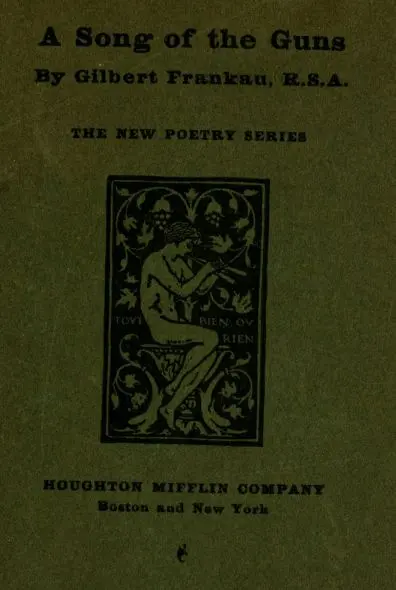
Gilbert Frankau
BEHIND THE BOOK
This eBook is for the use of anyone anywhere in the United States and most other parts of the world at no cost and with almost no restrictions whatsoever. You may copy it, give it away or re-use it under the terms of the Project Gutenberg License included with this eBook or online at www.gutenberg.org. If you are not located in the United States, you will have to check the laws of the country where you are located before using this eBook. Read the source licence.
The original source file, including credits and licence, is retained by this library. Request an original-format copy at no charge. Please include the book title and Project Gutenberg identifier #59931.
KEEP YOUR CURIOSITY GOING
Coulson Kernahan

Maurice Baring
Frances Wright
Cécile Tormay

Frederic Jesup Stimson

W. H. P. (William Henry Pope) Jarvis