Peter Jameson: A Modern Romance
Gilbert Frankau
THE CLASSIC COLLECTION · 1922
"The Love-Story of Aliette Brunton" by Gilbert Frankau is a novel written in the early 20th century. The narrative centers on Aliette Brunton, a woman navigating the complexities of love, loss, and self-sacrifice against a backdrop of societal expectations and personal turmoil. The story explores themes of loyalty, the consequences of infidelity, and the passage from innocence to a more complicated emotional landscape. The opening of the novel introduces Aliette and her world, immediately establishing the theme that love is both essential and demanding. Through vivid descriptions, we learn about her struggles in a marriage defined by her husband Hector's betrayals. Aliette’s character is fleshed out as she yearns for the joys of motherhood and a true connection, all while engaging in a hunt that reflects her inner emotions and desires. The burgeoning relationship with Ronald Cavendish, another key character, hints at the possibility of deeper connection and complicates her existing commitments, setting the stage for the unfolding love story and potential conflict.
Introduction adapted from the source catalogue; source summaries may be automatically generated.
Free to read · English · 148,185 words · No account needed
MAKE TIME FOR A GOOD BOOK
On by default. Untick to stop anonymous reading totals. Each page counts after 10 seconds in view. How this works.
Anonymous counting is on unless you have switched it off.
"Two five, I lead," announced Mrs. Needham--a hard-featured, soft-hearted woman with a mop of unruly black hair, an eye like a hawk, and the hands of a mechanic. "Why don't you give up that overhand service?"
"It'll come back in time."
Aliette went to her own base-line, and took two balls from the boy. Mrs. Needham crouched in her favorite position on the other side of the net. Aliette tossed up a ball, swung up her racket, served.
The service, railroading down the center-chalk, defeated Mrs. Needham. The server crossed to the left-hand court; stood to serve--and saw Ronnie.
For a fraction of a second they looked at each other through the high side-netting. He plucked off his soft hat, and stood watching. Aliette served; faulted; faulted again.
"Fifteen all," announced Mrs. Needham.
And suddenly, Aliette's game came back to her. Once more her first service struck chalk from the center-line. But this time Mrs. Needham got back a swingeing shot. Aliette ran--back-handed--flew to the net, killed the return.
"Thirty fifteen," she announced.
She knew, as she crossed, that Ronnie was still watching; that she must not look at him; that if she looked at him she would double-fault again; that she mustn't double-fault; that she must win.
But now Mrs. Needham was all out for the set. Aliette's service came back like white lightning down the side-line. She struck--ran for the net--guessed Mrs. Needham's lob-stroke--got back to it--slammed it across the court--got to the net again--won her point after a tremendous rally.
"Forty fifteen," announced Aliette; and abruptly, preparing to serve, she knew that Ronnie was no longer watching. Concentration failed her: the game didn't seem to matter: the sooner she lost the game, the sooner she would be able to talk with him.
"Why, there is Mr. Cavendish," said Mollie Fullerford. "And that's Hugh Spillcroft with him. I haven't seen Hugh for years."
She ran down the steps; and Wilberforce followed--a little jealously.
The four stood chatting.
"Yes," said Ronnie. "Spillcroft had insisted on his playing 'patters.' Spillcroft had promised to lend him a racket."
"Cavendish used to play a pretty fair game at the House," interjected Hugh--a clean-shaven monocled young man, who looked, once divested of wig and gown, a bit of a blood.
To Ronald the ensuing conversation was almost meaningless. He took part in it automatically. He didn't want to talk with these people; he wanted to watch that white embodiment of graceful strength, Aliette. He could hear her voice, "Forty thirty," followed by the swish of two balls along netting, and Mrs. Needham's "Deuce." She had lost two points since he turned away.
Your reading position is saved on this browser. Take it to another device with a library code. Reading pages adapt to text, rather than matching a printed edition.
Gilbert Frankau
Gilbert Frankau
Gilbert Frankau
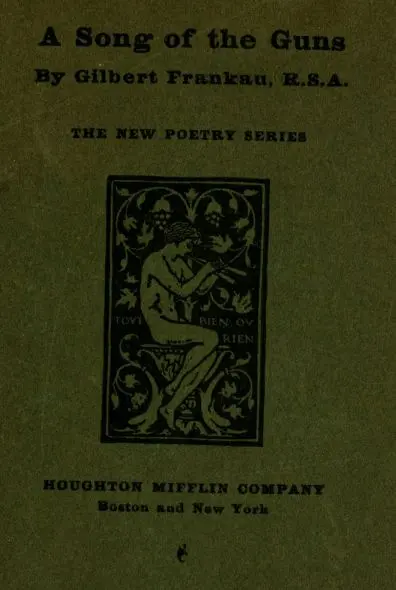
Gilbert Frankau
BEHIND THE BOOK
This eBook is for the use of anyone anywhere in the United States and most other parts of the world at no cost and with almost no restrictions whatsoever. You may copy it, give it away or re-use it under the terms of the Project Gutenberg License included with this eBook or online at www.gutenberg.org. If you are not located in the United States, you will have to check the laws of the country where you are located before using this eBook. Read the source licence.
The original source file, including credits and licence, is retained by this library. Request an original-format copy at no charge. Please include the book title and Project Gutenberg identifier #59931.
KEEP YOUR CURIOSITY GOING
Coulson Kernahan

Maurice Baring
Frances Wright
Cécile Tormay

Frederic Jesup Stimson

W. H. P. (William Henry Pope) Jarvis