Peter Jameson: A Modern Romance
Gilbert Frankau
THE CLASSIC COLLECTION · 1922
"The Love-Story of Aliette Brunton" by Gilbert Frankau is a novel written in the early 20th century. The narrative centers on Aliette Brunton, a woman navigating the complexities of love, loss, and self-sacrifice against a backdrop of societal expectations and personal turmoil. The story explores themes of loyalty, the consequences of infidelity, and the passage from innocence to a more complicated emotional landscape. The opening of the novel introduces Aliette and her world, immediately establishing the theme that love is both essential and demanding. Through vivid descriptions, we learn about her struggles in a marriage defined by her husband Hector's betrayals. Aliette’s character is fleshed out as she yearns for the joys of motherhood and a true connection, all while engaging in a hunt that reflects her inner emotions and desires. The burgeoning relationship with Ronald Cavendish, another key character, hints at the possibility of deeper connection and complicates her existing commitments, setting the stage for the unfolding love story and potential conflict.
Introduction adapted from the source catalogue; source summaries may be automatically generated.
Free to read · English · 148,185 words · No account needed
MAKE TIME FOR A GOOD BOOK
On by default. Untick to stop anonymous reading totals. Each page counts after 10 seconds in view. How this works.
Anonymous counting is on unless you have switched it off.
How silly she had been about him. How calm he was! How calm they both were! Naturally! He hardly knew her. They hardly knew one another.
Hector Brunton's wife realized suddenly that her left glove had split in the clenched palm, that she had forgotten to take off her gloves before entering the drawing-room.
"My dear child, how are you? En beauté, as always. A credit to the family." She found herself, among a mob of people, shaking hands with Simeon.
The craftswoman in Julia Cavendish, the literary memory and sense of "copy" which make her books such exact social pictures, functioned quite independently from the rest of her personality. No one, watching her as she talked international politics with her host, would have guessed that, behind the calm, dignified face, the novelist's brain was busy. Kodak-like, that brain registered its impressions, rolling them away for development at leisure.
First impression: an oblong room--paneled--Venetian bracket-lights--brocaded French windows either end--low scarlet flowers on a long gold-decked table, narrowing as you looked down it--many faces either side, two faces at each end--hum of subdued conversation--servants' white-gloved hands and dark-coated arms proffering bottles, plates, dishes.
The camera in the brain clicks, rolls away the picture.
Second impression: Sir Simeon, sixty-eight, a little man, white-haired, blue-eyed, mustache floppy, charming, not very efficient, presumably the weaker matrimonial vessel--his wife ought never to wear pink--Sir Simeon's three daughters, obviously by his first marriage, two with wedding-rings, thirty-eight, thirty-six, nonentities--their partners ditto--an ugly one, younger, rather interesting.
"My sympathies are entirely with the Jugo-Slavs, Sir Simeon. Italy is not entitled to a yard of territory more than we guaranteed her by the Treaty of London," says Julia Cavendish, society-woman.
The camera continues its work.
Third impression: the secretary of the Spanish embassy would look exactly like a bull-fighter if he wore the national costume instead of civilized evening-dress--General Fellowes has aged since the War Office inquiry--a fine type--the big woman he has taken in to dinner would look like a cantaloup melon if you cut her in two--the pretty girl flirting with the young soldier (Guards?) must be her daughter.
"Aren't you rather hard on our allies, Mrs. Cavendish?" chips in Hector
Brunton.
"I have no patience with d'Annunzio."
"But at least you will admit that he is a patriot," protests Sir Simeon.
"No bombastic person is really patriotic. Patriotism is a dumb virtue."
"But is patriotism a virtue?" asks the K.C.
"Almost the greatest."
Julia's mental camera snaps again.
Impression of Hector Brunton: a would-be cave-man--not as strong as he imagines himself--putty in the hands of a sexful woman--rather a difficult problem for a fastidious wife--obstinate--capable of cruelty.
Your reading position is saved on this browser. Take it to another device with a library code. Reading pages adapt to text, rather than matching a printed edition.
Gilbert Frankau
Gilbert Frankau
Gilbert Frankau
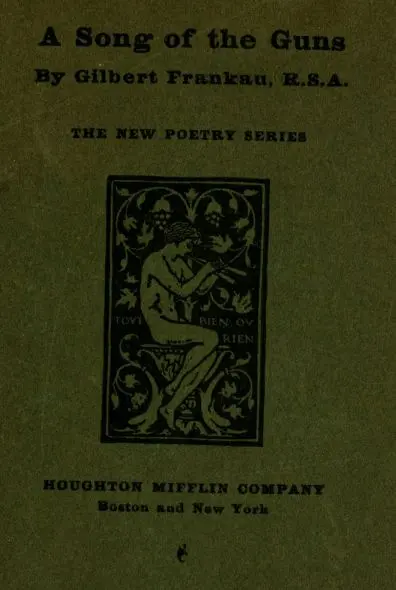
Gilbert Frankau
BEHIND THE BOOK
This eBook is for the use of anyone anywhere in the United States and most other parts of the world at no cost and with almost no restrictions whatsoever. You may copy it, give it away or re-use it under the terms of the Project Gutenberg License included with this eBook or online at www.gutenberg.org. If you are not located in the United States, you will have to check the laws of the country where you are located before using this eBook. Read the source licence.
The original source file, including credits and licence, is retained by this library. Request an original-format copy at no charge. Please include the book title and Project Gutenberg identifier #59931.
KEEP YOUR CURIOSITY GOING
Coulson Kernahan

Maurice Baring
Frances Wright
Cécile Tormay

Frederic Jesup Stimson

W. H. P. (William Henry Pope) Jarvis