Peter Jameson: A Modern Romance
Gilbert Frankau
THE CLASSIC COLLECTION · 1922
"The Love-Story of Aliette Brunton" by Gilbert Frankau is a novel written in the early 20th century. The narrative centers on Aliette Brunton, a woman navigating the complexities of love, loss, and self-sacrifice against a backdrop of societal expectations and personal turmoil. The story explores themes of loyalty, the consequences of infidelity, and the passage from innocence to a more complicated emotional landscape. The opening of the novel introduces Aliette and her world, immediately establishing the theme that love is both essential and demanding. Through vivid descriptions, we learn about her struggles in a marriage defined by her husband Hector's betrayals. Aliette’s character is fleshed out as she yearns for the joys of motherhood and a true connection, all while engaging in a hunt that reflects her inner emotions and desires. The burgeoning relationship with Ronald Cavendish, another key character, hints at the possibility of deeper connection and complicates her existing commitments, setting the stage for the unfolding love story and potential conflict.
Introduction adapted from the source catalogue; source summaries may be automatically generated.
Free to read · English · 148,185 words · No account needed
MAKE TIME FOR A GOOD BOOK
On by default. Untick to stop anonymous reading totals. Each page counts after 10 seconds in view. How this works.
Anonymous counting is on unless you have switched it off.
Fleetingly, Aliette thought, "Shall I tell them ... about myself? Does it make any difference?" Her intuition, suddenly active, remembered two hints dropped--purposefully perhaps--by Ronnie's mother. "Public judgment is usually inaccurate because the public is not told the whole truth"; "My dear, if only the whole world realized, as I realize, your story, they would not misjudge you."
"My views----" she parried aloud, playing for time.
"Publicity," she thought. "The flaunting policy once more. Dear God, that too." And, revisualizing the ordeal at Patrick O'Riordan's first night, her nerve frayed. Why couldn't these three men leave her in peace--in peace? Looking at Ronnie, she saw his eyes very resolute. He said:
"My decision is that the book must be published."
"Please let me finish, Cavendish," broke in Sir Peter; and to Aliette: "There are other points besides the publication of this book to be decided." Then he read to her, always in the same soft purr, the codicil; and explained, in tense, reasoned sentences, the consequences of its publication in the press, ending: "It means, to use a rather old-fashioned phrase, social ruin."
For a long while Aliette sat silent, her eyes wide, her pale hands clutching the black folds of her dress. Womanlike, she tried to put herself into the mind of the dead. Why had Julia Cavendish done this thing? Why? Could Julia have guessed that---- Womanlike, Aliette looked into the future, and her cheeks grew hot.
Ronnie said: "He can't bring an action for libel without bringing one for divorce"; Sir Peter, "Let's stick to our point; the publication of this codicil means disaster--for all three of you." "It means Aliette's freedom," retorted Ronnie.
The words of the codicil stood out in fire on the screen of Aliette's mind. She saw those words published, saw the book published, saw scandal follow scandal. Sir Peter was right. This thing meant ruin, social ruin for herself, for Ronnie, for Hector. And yet, and yet--it meant freedom. But would freedom come in time?
She glanced at the three men: at Ronnie and James, on their feet, motionless; at Sir Peter, seated at the desk, his hand fidgeting the ivory paper-knife. Swiftly, as a shuttle through the warp, her mind threaded the skeins of the future. The future would hold more than Ronnie.
"Before you take any decision," Jimmy spoke, "read this." He laid a letter before her. She read the letter through twice, her mind fighting for self-control, before asking:
"And is there no other method by which Mrs. Cavendish's 'main object' can be achieved, Sir Peter?"
Your reading position is saved on this browser. Take it to another device with a library code. Reading pages adapt to text, rather than matching a printed edition.
Gilbert Frankau
Gilbert Frankau
Gilbert Frankau
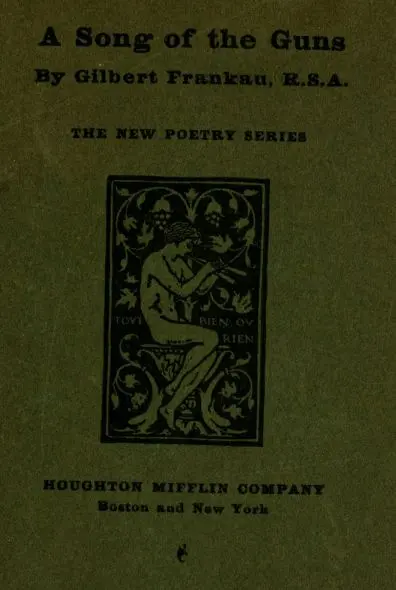
Gilbert Frankau
BEHIND THE BOOK
This eBook is for the use of anyone anywhere in the United States and most other parts of the world at no cost and with almost no restrictions whatsoever. You may copy it, give it away or re-use it under the terms of the Project Gutenberg License included with this eBook or online at www.gutenberg.org. If you are not located in the United States, you will have to check the laws of the country where you are located before using this eBook. Read the source licence.
The original source file, including credits and licence, is retained by this library. Request an original-format copy at no charge. Please include the book title and Project Gutenberg identifier #59931.
KEEP YOUR CURIOSITY GOING
Coulson Kernahan

Maurice Baring
Frances Wright
Cécile Tormay

Frederic Jesup Stimson

W. H. P. (William Henry Pope) Jarvis