Peter Jameson: A Modern Romance
Gilbert Frankau
THE CLASSIC COLLECTION · 1922
"The Love-Story of Aliette Brunton" by Gilbert Frankau is a novel written in the early 20th century. The narrative centers on Aliette Brunton, a woman navigating the complexities of love, loss, and self-sacrifice against a backdrop of societal expectations and personal turmoil. The story explores themes of loyalty, the consequences of infidelity, and the passage from innocence to a more complicated emotional landscape. The opening of the novel introduces Aliette and her world, immediately establishing the theme that love is both essential and demanding. Through vivid descriptions, we learn about her struggles in a marriage defined by her husband Hector's betrayals. Aliette’s character is fleshed out as she yearns for the joys of motherhood and a true connection, all while engaging in a hunt that reflects her inner emotions and desires. The burgeoning relationship with Ronald Cavendish, another key character, hints at the possibility of deeper connection and complicates her existing commitments, setting the stage for the unfolding love story and potential conflict.
Introduction adapted from the source catalogue; source summaries may be automatically generated.
Free to read · English · 148,185 words · No account needed
MAKE TIME FOR A GOOD BOOK
On by default. Untick to stop anonymous reading totals. Each page counts after 10 seconds in view. How this works.
Anonymous counting is on unless you have switched it off.
But the dream and the fear of the dream still haunted his mind. Vainly, rubbing his eyes, he strove for courage. Always, his imagination saw the darkness gathering about Daffadillies; always, out of the gathering darkness, he heard his mother's voice--calling--calling. Till, fear-haunted, he sprang to his feet.
His feet moved under him. They moved very slowly, as the feet of a sleep-walker. He said to his feet, "This is foolishness, foolishness." He said to his feet, "Be still."
He found himself in the corridor. He found himself at the telephone. He said to himself, "I might just make certain that she's all right."
Then, startlingly, the telephone-bell rang; and, startled, he picked the receiver from the clip. Ages seemed to pass before he heard the operator's: "City double-four two eight? Don't go away. I want you."
Followed, very distinct at that hour of the night, "Horsham, you're through"; and after a pause, "Is that Mr. Cavendish? Mr. Ronald Cavendish? This is Mrs. Sanderson speaking. I rang up Embankment House, but the porter said you weren't back yet." Already Ronnie's ears, acute, apprehensive, knew the worst. "Can you get through to Dr. Baynet? Can you bring him down at once? Your mother has had another hemorrhage."
"A bad one?" Ronnie tried to smooth the fear from his voice.
"I'm afraid so. Your wife's upstairs with Dr. Thompson. Would you like
to speak to her?"
"No. Tell her that I'll get on to Sir Heron at once. Tell her, please," the words snapped decision, "that I'll bring him down to Daffadillies to-night. Do you understand? To-night! Tell the lodge-keeper to wait up for us, to have the gates open. Is that quite clear?"
"Quite clear." The automaton's answer sounded irritatingly calm. "Quite
clear, thank you."
"Then good night." With a click of decision, Ronnie replaced the receiver. Danger, ousting fear, galvanized him to action. He looked at the clock. The hands pointed to 9:15. The last train for West Water left at nine! He snatched up the telephone-book; found the doctor's number; called it.
A man-servant answered. "Sir Heron's engaged. Can I take any message?"
"No. I want to speak to him personally."
"Sir Heron is giving a dinner-party, sir."
"Tell him the matter is urgent ... Yes ... Cavendish ... Ronald
Cavendish."
The man left the instrument. Waiting, Ronnie grew apprehensive. Suppose Sir Heron refused to come.... Then he heard, "Is that you, Cavendish? No bad news, I hope?"
"Very bad, I'm afraid. I've just spoken to Daffadillies on the
telephone. My mother's had another hemorrhage. Can you come down
to-night?"
"To-night?"
"Yes. With me. The last train's gone. I'm going down by taxi."
Your reading position is saved on this browser. Take it to another device with a library code. Reading pages adapt to text, rather than matching a printed edition.
Gilbert Frankau
Gilbert Frankau
Gilbert Frankau
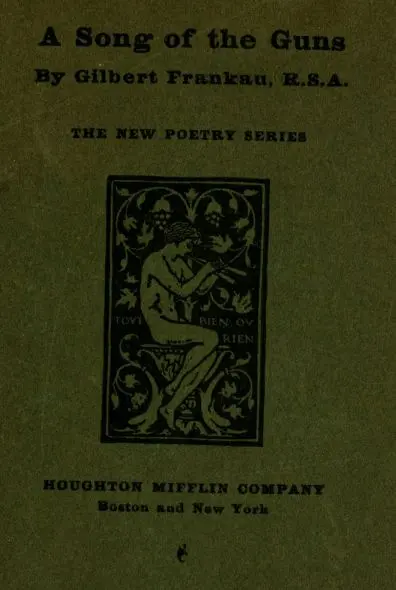
Gilbert Frankau
BEHIND THE BOOK
This eBook is for the use of anyone anywhere in the United States and most other parts of the world at no cost and with almost no restrictions whatsoever. You may copy it, give it away or re-use it under the terms of the Project Gutenberg License included with this eBook or online at www.gutenberg.org. If you are not located in the United States, you will have to check the laws of the country where you are located before using this eBook. Read the source licence.
The original source file, including credits and licence, is retained by this library. Request an original-format copy at no charge. Please include the book title and Project Gutenberg identifier #59931.
KEEP YOUR CURIOSITY GOING
Coulson Kernahan

Maurice Baring
Frances Wright
Cécile Tormay

Frederic Jesup Stimson

W. H. P. (William Henry Pope) Jarvis