Peter Jameson: A Modern Romance
Gilbert Frankau
THE CLASSIC COLLECTION · 1922
"The Love-Story of Aliette Brunton" by Gilbert Frankau is a novel written in the early 20th century. The narrative centers on Aliette Brunton, a woman navigating the complexities of love, loss, and self-sacrifice against a backdrop of societal expectations and personal turmoil. The story explores themes of loyalty, the consequences of infidelity, and the passage from innocence to a more complicated emotional landscape. The opening of the novel introduces Aliette and her world, immediately establishing the theme that love is both essential and demanding. Through vivid descriptions, we learn about her struggles in a marriage defined by her husband Hector's betrayals. Aliette’s character is fleshed out as she yearns for the joys of motherhood and a true connection, all while engaging in a hunt that reflects her inner emotions and desires. The burgeoning relationship with Ronald Cavendish, another key character, hints at the possibility of deeper connection and complicates her existing commitments, setting the stage for the unfolding love story and potential conflict.
Introduction adapted from the source catalogue; source summaries may be automatically generated.
Free to read · English · 148,185 words · No account needed
MAKE TIME FOR A GOOD BOOK
On by default. Untick to stop anonymous reading totals. Each page counts after 10 seconds in view. How this works.
Anonymous counting is on unless you have switched it off.
The police produced Bob Fielding's revolver, the blood-stained bullet, the empty cartridge-case, a plan of the room where the crime had been committed, Bob Fielding's navy record. The black-mustached solicitor called witnesses who had heard the shot, witnesses who had seen the body, one witness, even, who was prepared to swear the crime premeditated.
"More than once I've heard her say," swore Maggie Peterson, a frowzy, blowzy creature whose hands showed like collops of raw meat against her blowzy skirt, "that she wished Bill was dead. And there's others as heard her besides me."
In the case of Lucy Towers, the weak-kneed unimposing solicitor for the defense reserved his cross-examination, but for Fielding, to Ronnie's surprise, he put up a most spirited fight; and despite the prosecution's every effort to implicate the sailor as accessory to the shooting, the jury refused to give a verdict against him. "As if," decided the unimaginative jury, "armless men could fire pistols."
But Lucy Towers they found guilty of murder. "And quite rightly," said John Cartwright, as the woman--with a faint smile in the direction of her released cousin--was led from the room.
"All the same, mater, I'll swear that--in intention--Lucy Towers is
innocent."
It was Sunday afternoon at Daffadillies, and ever since his arrival Ronnie had been harping on the same topic. But Ronnie found his womenfolk hard to convince. In their eyes, as in the eyes of the public, Fleet Street's report of the inquest, and more particularly Maggie Peterson's evidence, branded Lucy Towers irrevocably murderess.
"Rubbish!" said Julia--it was one of her "good" days--"Rubbish! She's guilty, and she'll either hang or go to jail for life."
"That would be an outrage," answered Ronnie gravely.
"Why?" The novelist laughed. "Lucy Towers shot her husband. She'll never get over that point. Not in England, anyway. In France it's just possible that a sentimental jury would give her their verdict. We, thank heaven, do not indulge in that sort of perverted justice."
Aliette reluctantly sided with Julia.
"But, of course, man," said Aliette, "of course, I'm sorry for the poor creature. Still, whatever her husband did, she had no right to shoot him."
"Not even in self-defense?"
"No, not even in self-defense."
"In defense of an armless man, then?" countered Ronnie; and, so countering, saw in one vivid flash of insight his one and only chance of victory should Cartwright give him the brief.
Your reading position is saved on this browser. Take it to another device with a library code. Reading pages adapt to text, rather than matching a printed edition.
Gilbert Frankau
Gilbert Frankau
Gilbert Frankau
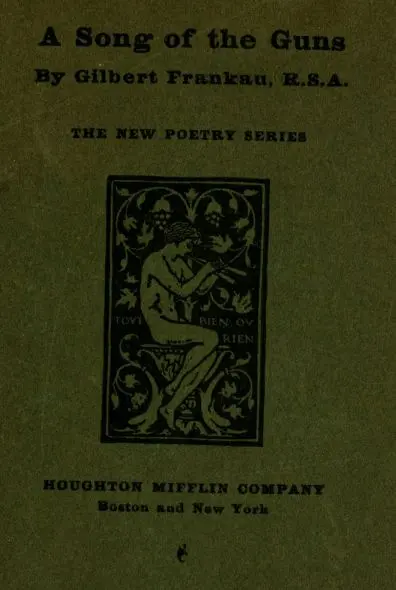
Gilbert Frankau
BEHIND THE BOOK
This eBook is for the use of anyone anywhere in the United States and most other parts of the world at no cost and with almost no restrictions whatsoever. You may copy it, give it away or re-use it under the terms of the Project Gutenberg License included with this eBook or online at www.gutenberg.org. If you are not located in the United States, you will have to check the laws of the country where you are located before using this eBook. Read the source licence.
The original source file, including credits and licence, is retained by this library. Request an original-format copy at no charge. Please include the book title and Project Gutenberg identifier #59931.
KEEP YOUR CURIOSITY GOING
Coulson Kernahan

Maurice Baring
Frances Wright
Cécile Tormay

Frederic Jesup Stimson

W. H. P. (William Henry Pope) Jarvis