Peter Jameson: A Modern Romance
Gilbert Frankau
THE CLASSIC COLLECTION · 1922
"The Love-Story of Aliette Brunton" by Gilbert Frankau is a novel written in the early 20th century. The narrative centers on Aliette Brunton, a woman navigating the complexities of love, loss, and self-sacrifice against a backdrop of societal expectations and personal turmoil. The story explores themes of loyalty, the consequences of infidelity, and the passage from innocence to a more complicated emotional landscape. The opening of the novel introduces Aliette and her world, immediately establishing the theme that love is both essential and demanding. Through vivid descriptions, we learn about her struggles in a marriage defined by her husband Hector's betrayals. Aliette’s character is fleshed out as she yearns for the joys of motherhood and a true connection, all while engaging in a hunt that reflects her inner emotions and desires. The burgeoning relationship with Ronald Cavendish, another key character, hints at the possibility of deeper connection and complicates her existing commitments, setting the stage for the unfolding love story and potential conflict.
Introduction adapted from the source catalogue; source summaries may be automatically generated.
Free to read · English · 148,185 words · No account needed
MAKE TIME FOR A GOOD BOOK
On by default. Untick to stop anonymous reading totals. Each page counts after 10 seconds in view. How this works.
Anonymous counting is on unless you have switched it off.
But at that, illusions burst as bubbles in the breeze. Once more the tension of the past days strung Aliette's mind to misery. She was an outlaw, a woman apart--a woman ostracized--worse, a woman who had failed her mate. Memory, killing illusions, cast itself back, remembering and exaggerating her every little unloving word, her every little unloving gesture, blaming her for them. "My fault," thought Aliette, "mine and mine only. I have been selfish to him. Utterly selfish. I've been--like I used to be with Hector."
Thought threw up its line, horrified at the comparison; and, abruptly conscious of every-day life, Aliette found herself in Berkeley Square. Automatically she turned down Bruton Street.
The mere name of the street--newly-painted in black block letters on gray stone--reminded her again of Billy, of Billy's visit to Julia Cavendish. At whose instigation, his own or hers, had the admiral visited Ronnie's mother? Hope rose again; but now, with hope, mingled despair. Had she so far failed Ronnie as to have forfeited his confidence?
Still walking automatically, Aliette found herself facing the mahogany door of Julia's house, and rang the bell.
"Yes," said Kate, "Mrs. Cavendish was at home, and alone. Would Mrs. Ronnie" (it was an understood thing in the basement of Bruton Street that Aliette should be referred to as "Mrs. Ronnie") "like some tea?"
"Thank you, Kate. That would be very nice." Aliette, unannounced, went slowly up the print-hung staircase; tapped on the drawing-room door; heard a faint "Come in"; and turned the handle.
Ronnie's mother lay on the sofa. She looked white, exhausted; but her lips framed themselves to a smile.
"I may come in, mayn't I?" Aliette's misery increased at the sight of her hostess's pallor. "Kate's promised to bring me some tea. I'm not disturbing you, am I?"
"My dear, you're always welcome. Come and sit here by me." Julia made place on the sofa, and Aliette sat down.
"I wonder why she came this afternoon," mused the elder woman. "I wonder if, by any chance, she can have found out. Awkward, if she has found it. Very awkward." But there was no tremor of guilt in her, "How's Ronnie?"
"Quite well, thank you."
"And you?"
"Oh, I'm all right. A little worried, that's all."
"Worried? What about?"
"Oh, various things."
Kate, bringing the tea, interrupted their conversation. Watching Aliette as she drank, Julia saw that the hands, usually so steady, trembled. "Can't you tell me about the worries?" she said kindly.
"There's nothing--really." Aliette's voice trembled as her hands. "Only I--I--met Hector's father just now. And somehow--it rather made me realize--my position."
Your reading position is saved on this browser. Take it to another device with a library code. Reading pages adapt to text, rather than matching a printed edition.
Gilbert Frankau
Gilbert Frankau
Gilbert Frankau
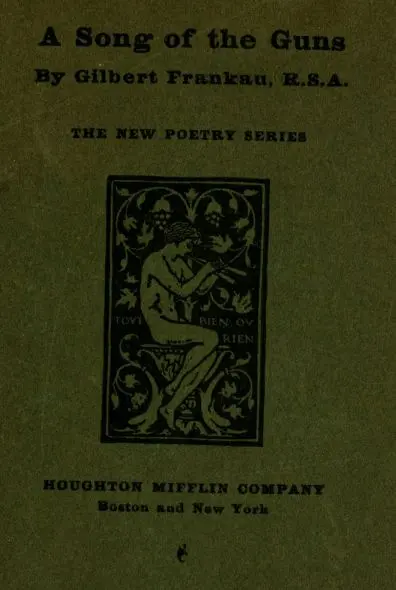
Gilbert Frankau
BEHIND THE BOOK
This eBook is for the use of anyone anywhere in the United States and most other parts of the world at no cost and with almost no restrictions whatsoever. You may copy it, give it away or re-use it under the terms of the Project Gutenberg License included with this eBook or online at www.gutenberg.org. If you are not located in the United States, you will have to check the laws of the country where you are located before using this eBook. Read the source licence.
The original source file, including credits and licence, is retained by this library. Request an original-format copy at no charge. Please include the book title and Project Gutenberg identifier #59931.
KEEP YOUR CURIOSITY GOING
Coulson Kernahan

Maurice Baring
Frances Wright
Cécile Tormay

Frederic Jesup Stimson

W. H. P. (William Henry Pope) Jarvis