Peter Jameson: A Modern Romance
Gilbert Frankau
THE CLASSIC COLLECTION · 1922
"The Love-Story of Aliette Brunton" by Gilbert Frankau is a novel written in the early 20th century. The narrative centers on Aliette Brunton, a woman navigating the complexities of love, loss, and self-sacrifice against a backdrop of societal expectations and personal turmoil. The story explores themes of loyalty, the consequences of infidelity, and the passage from innocence to a more complicated emotional landscape. The opening of the novel introduces Aliette and her world, immediately establishing the theme that love is both essential and demanding. Through vivid descriptions, we learn about her struggles in a marriage defined by her husband Hector's betrayals. Aliette’s character is fleshed out as she yearns for the joys of motherhood and a true connection, all while engaging in a hunt that reflects her inner emotions and desires. The burgeoning relationship with Ronald Cavendish, another key character, hints at the possibility of deeper connection and complicates her existing commitments, setting the stage for the unfolding love story and potential conflict.
Introduction adapted from the source catalogue; source summaries may be automatically generated.
Free to read · English · 148,185 words · No account needed
MAKE TIME FOR A GOOD BOOK
On by default. Untick to stop anonymous reading totals. Each page counts after 10 seconds in view. How this works.
Anonymous counting is on unless you have switched it off.
And suddenly Aliette's lover realized that Jimmy's common sense had told him nothing, that Jimmy's very common sense prevented him from understanding the peculiar relationship between Aliette and her legal owner. He wanted to tell Jimmy the truth about that relationship; but his training, the code of decent reticence, every tradition of public schooldom restrained him. Decency suggested that neither then to James Wilberforce, nor eventually in court, could he make public the matrimonial position between Aliette and Hector. "Tongue-tied!" he thought. "Even if I were an orator, in her defense I should always be tongue-tied."
Nevertheless, his anger relented.
"Except yourself, Jimmy," he went on, "there's no mutual friend who could act for us; and I can't ask you to act because of your firm's relations with him. Therefore, I'm going to do the job myself."
There was almost admiration in the other's "You always were a plucky
devil."
"Plucky! I don't see anything plucky in it."
"Supposing H. B. cuts up rough?"
"Why should he? He's in the wrong, and he knows it."
"All the more reason." Wilberforce, too, rose. Watching his friend carefully, he saw that their conversation had aroused him to fighting-pitch; and Ronnie at fighting-pitch--as Jimmy remembered from their Oxford days--was capable of being a rather desperate person.
"Don't you cut up rough, old man," he continued. "There'll be quite enough trouble without a police-court case into the bargain."
"You needn't be afraid, Jimmy." Ronnie controlled himself. "I'll manage to keep my temper with the fellow. By the way, you don't feel there's any chance of his refusing to file his petition, do you?"
"Hardly. H. B. isn't a religious chap, or anything of that sort. He might go for damages, of course."
"We could settle that before we went into court."
They simmered down; sat down; relit cigars; and began to discuss the legal aspect of the case which each felt sure that Brunton must eventually bring; finally deciding that Wilberforce, Wilberforce & Cartwright could not, under the special circumstances, act for either party.
"J. J. W. would be your best man," said James.
So interested did they become in the professional issue that it was nearly midnight before Ronnie said, "By the way, I'd almost forgotten to ask you for Mollie Fullerford's address"; and Wilberforce, "Do you really think it's advisable for you to go and see her?"
"Advisable! How do you mean?"
The two friends faced one another in silence, each constrained by the peculiar diffidence of their class, the diffidence which makes the discussion of women, and especially of their own women, so terribly difficult to decent Englishmen.
Your reading position is saved on this browser. Take it to another device with a library code. Reading pages adapt to text, rather than matching a printed edition.
Gilbert Frankau
Gilbert Frankau
Gilbert Frankau
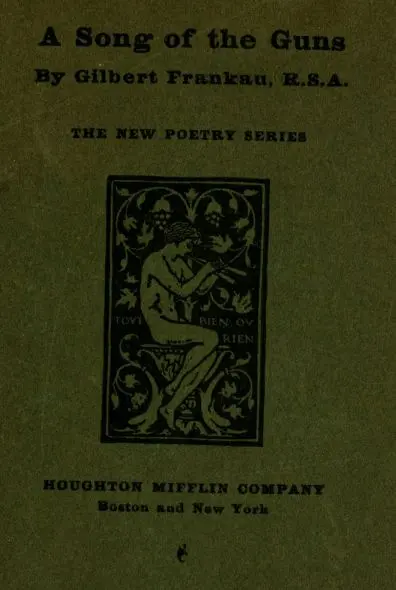
Gilbert Frankau
BEHIND THE BOOK
This eBook is for the use of anyone anywhere in the United States and most other parts of the world at no cost and with almost no restrictions whatsoever. You may copy it, give it away or re-use it under the terms of the Project Gutenberg License included with this eBook or online at www.gutenberg.org. If you are not located in the United States, you will have to check the laws of the country where you are located before using this eBook. Read the source licence.
The original source file, including credits and licence, is retained by this library. Request an original-format copy at no charge. Please include the book title and Project Gutenberg identifier #59931.
KEEP YOUR CURIOSITY GOING
Coulson Kernahan

Maurice Baring
Frances Wright
Cécile Tormay

Frederic Jesup Stimson

W. H. P. (William Henry Pope) Jarvis