
The diary of Delia : Being a veracious chronicle of the kitchen, with some side-lights on the parlour
Onoto Watanna

THE CLASSIC COLLECTION · 1904
"The Love of Azalea" by Onoto Watanna is a novel written in the early 20th century." The story revolves around Azalea, a young Japanese girl caught in the throes of cultural conflict, personal tragedy, and romantic turmoil as she navigates life under the strictures of her stepmother and the demands of societal expectations. Her journey leads her to encounter Richard Verley, a missionary who changes the course of her life. "At the start of the narrative, readers are introduced to a mission church in a small Japanese village, where the congregation is disinterested in the sermons of the foreign priest, Richard Verley." Amidst this backdrop, Azalea is depicted as a young girl longing for escape from her unkind home life with a stepmother who treats her cruelly. Dressed in rags, Azalea finds herself smitten with the notion of earning money through singing, just like the choir boys who are treated kindly by Verley. This initial longing evolves when she decides to approach the minister, pretending to seek conversion in the hopes of receiving assistance. The opening chapters set the stage for her transformative journey, revealing her desires for freedom and love against the struggles of her impoverished circumstances and the rigid expectations of her society.
Introduction adapted from the source catalogue; source summaries may be automatically generated.
Free to read · English · 23,842 words · No account needed
MAKE TIME FOR A GOOD BOOK
On by default. Untick to stop anonymous reading totals. Each page counts after 10 seconds in view. How this works.
Anonymous counting is on unless you have switched it off.
Meanwhile Azalea continued to look out dreamily through the opened shoji toward the hill, upon whose slope stood the little peaked mission house. The words of the minister kept repeating themselves in her head.
“There is only one true God. He it was who created the world—and you. He loves you, and will watch over and care for you always.”
Ah, if it were only true, thought Azalea. If this new God would only be kinder than those she had known, then she might even close the eyes of her heart to the words of the priests of Kwannon, and forget they had told her the God of the barbarians was an evil spirit. She would prove Him. If He proved unkind to her she would believe it, but if it were otherwise, why how could the evil one be kind? It was not possible.
“Answer when you are spoken to,” broke in her step-mother’s sharp voice.
Azalea started.
“I did not hear you speak, honorable step-mother.”
“Your ears are accommodatingly dull. You did not care to hear.”
Azalea sighed, then pressed her lips together, as if to prevent the retort that might have escaped them.
Madame Yamada bent toward her.
“Do you wish to marry?”
Azalea reflected.
“No-o,” she said softly, and then, “perhaps, yes. It would be a solution of my troubles, step-mother, would it not?”
“Would you marry any one who asked you, then? You appear to lack the common qualities of maiden modesty.”
“I did not say I would marry any one,” said the girl, flushing, “but almost anyone would be kinder than you.”
They were daring words, and she anticipated their effect upon her step-mother, for, after having spoken them she made a frightened motion from the older woman, who had seized her arm and was cruelly pinching it. Tears of pain came into the girl’s eyes, but she made no outcry. Suddenly Madame Yamada flung the girl’s arm from her.
“Did my touch hurt, then?” she inquired.
“Yes,” said Azalea briefly, her arm still sore, though released.
“Yet,” said her step-mother, “the pain inflicted by a woman, who is weak, is nothing to that inflicted by a man. What will you do when your husband beats you?”
“I do not know,” said Azalea mechanically, and then added slowly, “but I should not weep, mother-in-law. I would not give him that pleasure. But—” she paused; “all husbands do not beat their wives. Perhaps the gods will favor me with a kind one. I should not marry him otherwise.”
“How will you test his kindness?” asked her mother scornfully.
Your reading position is saved on this browser. Take it to another device with a library code. Reading pages adapt to text, rather than matching a printed edition.
Onoto Watanna

Onoto Watanna
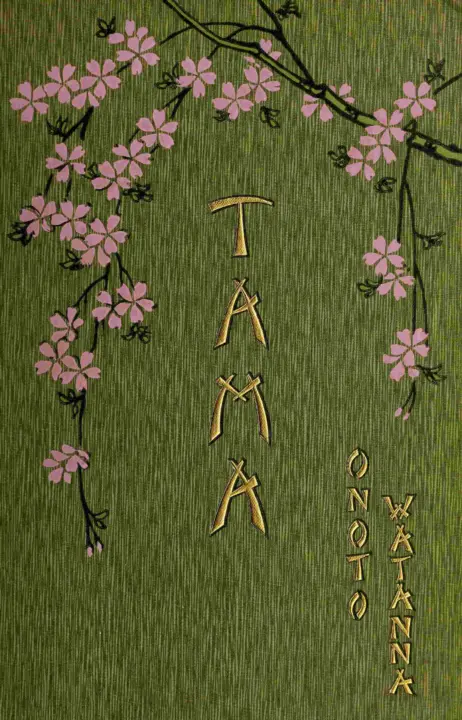
Onoto Watanna
Onoto Watanna
BEHIND THE BOOK
This eBook is for the use of anyone anywhere in the United States and most other parts of the world at no cost and with almost no restrictions whatsoever. You may copy it, give it away or re-use it under the terms of the Project Gutenberg License included with this eBook or online at www.gutenberg.org. If you are not located in the United States, you will have to check the laws of the country where you are located before using this eBook. Read the source licence.
The original source file, including credits and licence, is retained by this library. Request an original-format copy at no charge. Please include the book title and Project Gutenberg identifier #64861.
KEEP YOUR CURIOSITY GOING
Coulson Kernahan

Maurice Baring
Frances Wright
Cécile Tormay

Frederic Jesup Stimson

W. H. P. (William Henry Pope) Jarvis