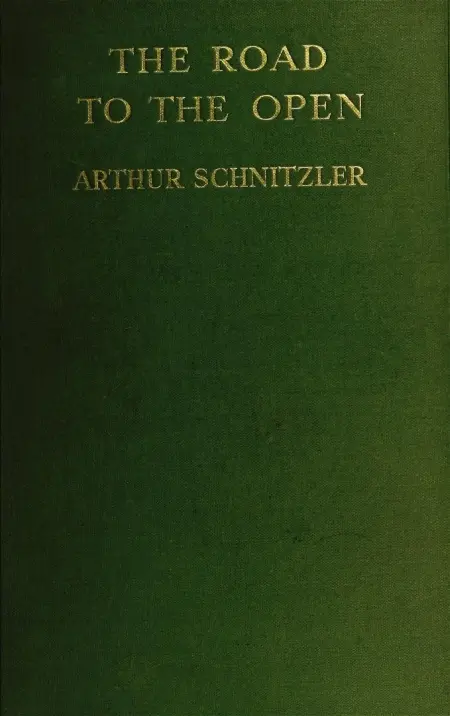
The Road to the Open
Arthur Schnitzler
THE CLASSIC COLLECTION · 1915
"The Lonely Way—Intermezzo—Countess Mizzie" by Arthur Schnitzler is a collection of three plays written in the early 20th century. The works delve into themes of love, personal struggle, and the complexities of human relationships, set against the backdrop of early modern Vienna. The characters in Schnitzler's plays often embody the tensions between societal expectations and individual desires, making the collection a poignant exploration of human intimacy and existential themes. The opening of the first play, "The Lonely Way," introduces a family dynamic within the garden of Professor Wegrat's house, highlighting his interactions with his wife and children, as well as their acquaintances. As the characters converse, they navigate the weight of familial expectations, personal aspirations, and the looming presence of illness, which adds an undercurrent of melancholy. The dialogue reveals deep-seated fears and desires, particularly through the character of Johanna, who grapples with her mother's illness and the implications of their growing distance. This opening sets the stage for the unfolding emotional conflicts, inviting readers into the intricate webs of relationships that Schnitzler masterfully explores.
Introduction adapted from the source catalogue; source summaries may be automatically generated.
Free to read · English · 70,089 words · No account needed
MAKE TIME FOR A GOOD BOOK
On by default. Untick to stop anonymous reading totals. Each page counts after 10 seconds in view. How this works.
Anonymous counting is on unless you have switched it off.
That depends on several circumstances.
I have to report myself at the regiment on the first of October.
And it's possible that I may go farther south after that.
Well, that's news. Where?
PRINCE (with a glance at Mizzie)
Egypt, and the Sudan maybe--for a little hunting.
MIZZIE (to Lolo)
Let me show you the park.
It's a marvel. Ours isn't a patch on it, of course. (She and Mizzie
come forward)
Have you a garden at your place, too?
Certainly. As well as an ancestral palace--at Ottakring.[7] The great-grandfather of Wasner was in the cab business in his days already.--My, but that's beautiful! The way those flowers are hanging down. I must have something just like it.
[7] One of the factory districts of Vienna, known chiefly because of the big insane asylum located there.
COUNT (disturbed)
Why are the ladies leaving us?
Never mind, papa, I'm merely explaining the architecture of our facade.
Do you often get visits of theatrical ladies, Count?
No, this is merely an accident.
[The men stroll off toward those parts of the garden that are not
visible.
It seems strange that I have never before had a chance of meeting you. I am very glad to see you.
LOLO (with a grateful glance)
And so I am. Of course, I have known you by sight these many years. Often and often have I looked up at your box.
But not at me.
Oh, that's all over now.
Do you know, I really feel a little offended--on his behalf.
Offended, you say...?
It will be a hard blow for him. Nobody knows better than I how deeply he has been attached to you. Although he has never said a word to me about it.
Do you think it's so very easy for me either, Countess? But tell me. Countess, what else could I do? I am no longer a spring chicken, you know. And one can't help hankering for something more settled. As long as I had a profession of my own, I could allow myself--what do they call it now?--to entertain liberal ideas. It goes in a way with the position I have held. But how would that look now, when I am retiring to private life?
Oh, I can see that perfectly. But what is he going to do now?
Why shouldn't he marry, too? I assure you, Countess, that there are many who would give all their five fingers.... Don't you realize, Countess, that I, too, have found it a hard step to take?
Your reading position is saved on this browser. Take it to another device with a library code. Reading pages adapt to text, rather than matching a printed edition.
Arthur Schnitzler
Arthur Schnitzler
BEHIND THE BOOK
This eBook is for the use of anyone anywhere in the United States and most other parts of the world at no cost and with almost no restrictions whatsoever. You may copy it, give it away or re-use it under the terms of the Project Gutenberg License included with this eBook or online at www.gutenberg.org. If you are not located in the United States, you will have to check the laws of the country where you are located before using this eBook. Read the source licence.
The original source file, including credits and licence, is retained by this library. Request an original-format copy at no charge. Please include the book title and Project Gutenberg identifier #29745.
KEEP YOUR CURIOSITY GOING
Maurice Baring
W. B. (William Butler) Yeats
Edward Martyn

John Brougham & Charlotte Brontë
Marguerite Merington
Leonid Andreyev