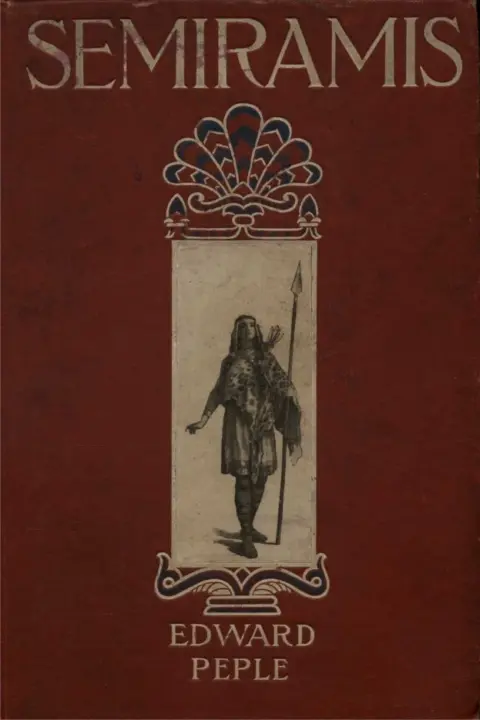
Semiramis: A Tale of Battle and of Love
Edward Peple
THE CLASSIC COLLECTION · 1914
"The Littlest Rebel" by Edward Peple is a novel written in the early 20th century. The story revolves around a young girl named Virginia "Virgie" Cary, who navigates the complexities and harsh realities of life during the Civil War, particularly the impact that the conflict has on her family and home. With a blend of childhood innocence and the burdens of war, the novel touches on themes of loyalty, bravery, and the spirit of humanity amidst strife. At the start of the narrative, we are introduced to Mrs. Cary and her daughter Virgie, who are struggling to maintain a semblance of normalcy despite the looming war. Virgie's playful imagination brings a moment of levity as she and her playmate, Sally Ann, engage in a game based on the story of Blue Beard. However, the play is interrupted by the harsh realities of war and its effects on their lives. Through Mrs. Cary and Uncle Billy, we learn about the family's challenges, including poverty and the looming threat of Union soldiers, while Virgie's innocent and spirited responses highlight her resilience in the face of adversity. As the chapter unfolds, we sense the growing tension and uncertainty that permeates their lives, setting the stage for the conflicts to come.
Introduction adapted from the source catalogue; source summaries may be automatically generated.
Free to read · English · 43,847 words · No account needed
MAKE TIME FOR A GOOD BOOK
On by default. Untick to stop anonymous reading totals. Each page counts after 10 seconds in view. How this works.
Anonymous counting is on unless you have switched it off.
With a sigh, Mrs. Cary turned away toward the house. "Well, James, are
you coming?"
But Jeems Henry, completely abashed before this miracle of kindness which he did not deserve, decided that it was time for him to be a man.
"Thank you, Miss Hallie," he gulped, "but f'um now on I reckon I gwine
take keer of myse'f."
Mrs. Cary, pausing on the bottom step, raised her eyes heavenward in a short prayer that children such as these might somehow be protected from themselves.
"Well, James," she said, when she saw there was nothing more to be done. "I hope you'll be happy and contented. If you are not--come back to us. Perhaps, when the war is over, you'll find things a little more--comfortable. Good-by, James," and she held out her hand.
But this last touch of gentleness was too much for the young mulatto. Although he made an obedient step forward, his feelings overcame him and with an audible snuffle and his hand over his eyes he retreated--then turned his back and plunged through the hedge.
Mrs. Cary sank down on the step and looked as if she, too, would like to
cry.
Manfully, Uncle Billy came to her rescue. "Now don't you care, Miss Hallie. He wan' no 'count for plowin' no how."
"Oh, it isn't that, Uncle Billy," Mrs. Cary replied with a low cry of regret. "It isn't the actual loss of help, tho' we need it, goodness knows. But it makes me sad to see them leaving, one by one. They are such children and so helpless--without a master hand."
"Yas'm," agreed Uncle Billy readily. "An' de marster's han' ought to have a hick'ry stick in it fer dat nigger. Yas, bless Gawd. But you got me, Miss Hallie," he announced proudly. "I ain't runned away to de blue-bellies yet."
"No, you dear old thing," Mrs. Cary cried with laughing relief, and her hand rested on his shoulder in a gentle caress. "I'd as soon think of the skies falling. It is just such faithful friends as you who help me to fight the best."
"Um?" said Uncle Billy promptly, not quite understanding.
"I mean a woman's battles, Uncle Billy--the waiting battles--that we fight alone." Mrs. Gary rose to her feet and turned sadly away.
"Yas'm," agreed Uncle Billy. "I dunno what yo' talkin' 'bout but I spec'
you's right. Yas'm."
"Dear Uncle Billy," repeated Mrs. Gary, while her eyes filled with tears. "The most truthful--the most honest--"
Mrs. Cary stopped and looked sharply at something lying on the ground beside the steps. Then she turned and swept the old man with an accusing glance which made him quail.
Your reading position is saved on this browser. Take it to another device with a library code. Reading pages adapt to text, rather than matching a printed edition.
BEHIND THE BOOK
This eBook is for the use of anyone anywhere in the United States and most other parts of the world at no cost and with almost no restrictions whatsoever. You may copy it, give it away or re-use it under the terms of the Project Gutenberg License included with this eBook or online at www.gutenberg.org. If you are not located in the United States, you will have to check the laws of the country where you are located before using this eBook. Read the source licence.
The original source file, including credits and licence, is retained by this library. Request an original-format copy at no charge. Please include the book title and Project Gutenberg identifier #15414.
KEEP YOUR CURIOSITY GOING
Cécile Tormay

Moritz Busch
Coulson Kernahan
John L. Ransom

Maurice Baring
Frances Wright