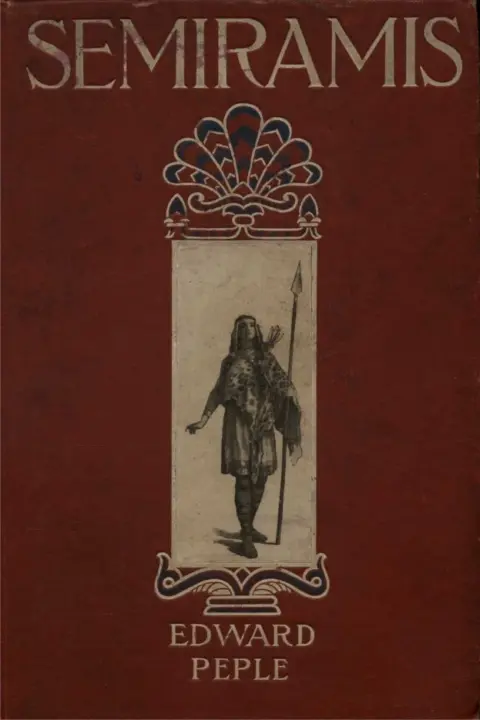
Semiramis: A Tale of Battle and of Love
Edward Peple
THE CLASSIC COLLECTION · 1914
"The Littlest Rebel" by Edward Peple is a novel written in the early 20th century. The story revolves around a young girl named Virginia "Virgie" Cary, who navigates the complexities and harsh realities of life during the Civil War, particularly the impact that the conflict has on her family and home. With a blend of childhood innocence and the burdens of war, the novel touches on themes of loyalty, bravery, and the spirit of humanity amidst strife. At the start of the narrative, we are introduced to Mrs. Cary and her daughter Virgie, who are struggling to maintain a semblance of normalcy despite the looming war. Virgie's playful imagination brings a moment of levity as she and her playmate, Sally Ann, engage in a game based on the story of Blue Beard. However, the play is interrupted by the harsh realities of war and its effects on their lives. Through Mrs. Cary and Uncle Billy, we learn about the family's challenges, including poverty and the looming threat of Union soldiers, while Virgie's innocent and spirited responses highlight her resilience in the face of adversity. As the chapter unfolds, we sense the growing tension and uncertainty that permeates their lives, setting the stage for the conflicts to come.
Introduction adapted from the source catalogue; source summaries may be automatically generated.
Free to read · English · 43,847 words · No account needed
MAKE TIME FOR A GOOD BOOK
On by default. Untick to stop anonymous reading totals. Each page counts after 10 seconds in view. How this works.
Anonymous counting is on unless you have switched it off.
"Report at my quarters this evening--at nine," he said curtly. And the young Irishman, thankful to be well out of the mess, quickly clambered over the wall and disappeared though not without a soft voiced farewell from Virgie.
"Good-by, Mr. Knapsack Man," called the child. "Thank you for the
biscuits."
Then Cary came forward and gripped the other's hand.
"Colonel," he said earnestly, with full appreciation of what was passing through Morrison's mind, "I hope no trouble will come of this. If I had only known the vindictiveness of this man--"
He was interrupted by a genially objecting hand and a laugh which Morrison was somehow able to make lighthearted.
"Oh, that will be all right. Harris will get him--never fear."
"And so," he said, addressing Miss Virginia, "that bad man took your
pass?"
"Yes, sir. He did," Virgie answered, and caught his hand in hers. "He ran right away with it--mean old thing."
"Well, then--we'll have to write you out another one. A nice, clean, white one this time. Come on, little sweetheart. We'll do it together," and he took out a note book and pencil.
"I say, Morrison," Cary murmured, glancing apprehensively at the troopers idling in the road and very plainly interested in what the small group were doing, "do you really think you'd better--on your own account?"
Again Morrison's hand was raised in polite objection. He had taken a sporting chance when he wrote the pass which had been stolen but because he had probably lost was no reason why he shouldn't play the game out bravely to the end. So he only smiled at Virgie, who came and sat beside him, and began to write the few short sentences of his second safe-conduct. But while he wrote he was talking in low tones which the troopers in the road could not hear.
"There's a line of your pickets about three miles up the road, Cary," said he. "If I loaned you a horse, do you think Virgie could ride behind you?"
"Me?" pouted Virgie. "Why, Daddy says that when I was bornded, I came
ridin' in on a stork."
Morrison burst out laughing and dropped his hand down on the small paw
resting on his knee.
"Then, by St. George and the Dragon we'll send you home to Jefferson Davis on a snorting Pegasus!"
Again Cary spoke to him in warning tones, which at the same time thanked him unendingly for the kindly thought.
"You needn't trouble about the mount. Why, man," he said huskily, "you're in trouble enough, as it is! And if our lines are as close as you say they are--"
Once more the Union officer checked him.
Your reading position is saved on this browser. Take it to another device with a library code. Reading pages adapt to text, rather than matching a printed edition.
BEHIND THE BOOK
This eBook is for the use of anyone anywhere in the United States and most other parts of the world at no cost and with almost no restrictions whatsoever. You may copy it, give it away or re-use it under the terms of the Project Gutenberg License included with this eBook or online at www.gutenberg.org. If you are not located in the United States, you will have to check the laws of the country where you are located before using this eBook. Read the source licence.
The original source file, including credits and licence, is retained by this library. Request an original-format copy at no charge. Please include the book title and Project Gutenberg identifier #15414.
KEEP YOUR CURIOSITY GOING
Cécile Tormay

Moritz Busch
Coulson Kernahan
John L. Ransom

Maurice Baring
Frances Wright