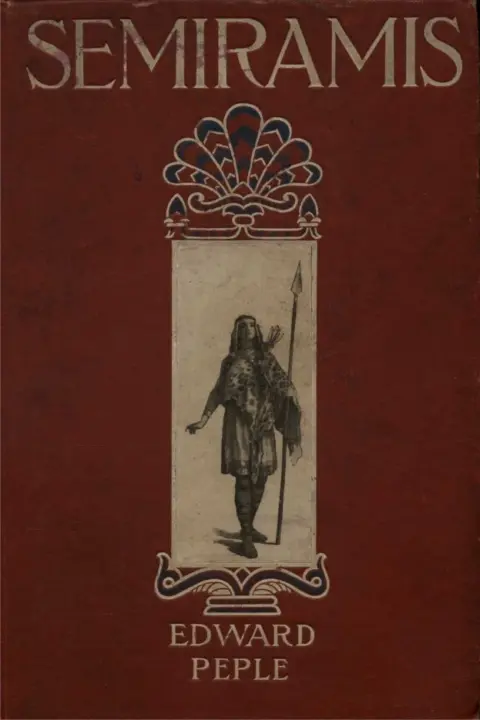
Semiramis: A Tale of Battle and of Love
Edward Peple
THE CLASSIC COLLECTION · 1914
"The Littlest Rebel" by Edward Peple is a novel written in the early 20th century. The story revolves around a young girl named Virginia "Virgie" Cary, who navigates the complexities and harsh realities of life during the Civil War, particularly the impact that the conflict has on her family and home. With a blend of childhood innocence and the burdens of war, the novel touches on themes of loyalty, bravery, and the spirit of humanity amidst strife. At the start of the narrative, we are introduced to Mrs. Cary and her daughter Virgie, who are struggling to maintain a semblance of normalcy despite the looming war. Virgie's playful imagination brings a moment of levity as she and her playmate, Sally Ann, engage in a game based on the story of Blue Beard. However, the play is interrupted by the harsh realities of war and its effects on their lives. Through Mrs. Cary and Uncle Billy, we learn about the family's challenges, including poverty and the looming threat of Union soldiers, while Virgie's innocent and spirited responses highlight her resilience in the face of adversity. As the chapter unfolds, we sense the growing tension and uncertainty that permeates their lives, setting the stage for the conflicts to come.
Introduction adapted from the source catalogue; source summaries may be automatically generated.
Free to read · English · 43,847 words · No account needed
MAKE TIME FOR A GOOD BOOK
On by default. Untick to stop anonymous reading totals. Each page counts after 10 seconds in view. How this works.
Anonymous counting is on unless you have switched it off.
"Hey, there! That's my room--an' don't you-all bother any of my
things, either!"
This one command, at least, was implicitly obeyed, for in a moment the disappointed squad returned. The carbine butts were grounded; the troopers stood at orderly attention, while their officer stepped toward the table.
"What's your name, little monkey?"
Virgie raised her eyes in swift reproach.
"I don't like to be called a monkey. It--it isn't respectful."
The Union soldier laughed.
"O-ho! I see." He touched his hat and made her a sweeping bow. "A thousand pardons, Mademoiselle." He shot his sword into its scabbard, and laughed again. "Might I inquire as to what you are called by your--er--justly respectful relatives and friends?"
"Virgie," she answered simply.
"Ah," he approved, "and a very pretty name! Virgie what?"
"My whole name is Miss Virginia Houston Gary."
The soldier started, glanced at his troopers, then back to the child
again:
"Is Herbert Cary your father?"
He waited for her answer, and got it, straight from a baby's shoulder:
"Mister Herbert Cary is--yes, sir."
The enemy smiled and made her another bow.
"I stand corrected. Where is your father now?"
Virgie hesitated.
"I--I don't know."
The voice of her inquisitor took on a sterner tone:
"Is he here?--hiding somewhere? Tell me!"
Her little heart was pounding, horribly, and the hot blood came into her cheeks; but she looked him squarely in the face, and lied--for General Lee:
"No, sir. Daddy was here--but he's gone away."
The enemy was looking at her, intently, and his handsome, piercing eyes, grew most uncomfortable. She hung for an instant between success and sobbing failure, till a bubble from Mother Eve rose up in her youthful blood and burst into a spray of perfect feminine deceit. She did not try to add to her simple statement, but began to eat her berries, calmly, as though the subject were completely closed.
"Which way did he go?" the officer demanded, and she pointed with her
spoon.
"Down by the spring--through the blackberry patch."
The soldier was half-convinced. He stood for a moment, looking at the floor, then asked her sharply, suddenly:
"If your father had gone, then why did you lock that door?"
She faltered, but only for an instant.
"'Cause I thought you might be--niggers."
The man before her clenched his hands, as he thought of that new-born, hideous danger menacing the South.
"I see," he answered gently; "yes, I see." He turned away, but, even as he turned, his eye was caught by the double-doored cupboard against the wall. "What do you keep in there?" he asked; and the child smiled faintly, a trifle sadly, in reply:
Your reading position is saved on this browser. Take it to another device with a library code. Reading pages adapt to text, rather than matching a printed edition.
BEHIND THE BOOK
This eBook is for the use of anyone anywhere in the United States and most other parts of the world at no cost and with almost no restrictions whatsoever. You may copy it, give it away or re-use it under the terms of the Project Gutenberg License included with this eBook or online at www.gutenberg.org. If you are not located in the United States, you will have to check the laws of the country where you are located before using this eBook. Read the source licence.
The original source file, including credits and licence, is retained by this library. Request an original-format copy at no charge. Please include the book title and Project Gutenberg identifier #15414.
KEEP YOUR CURIOSITY GOING
Cécile Tormay

Moritz Busch
Coulson Kernahan
John L. Ransom

Maurice Baring
Frances Wright