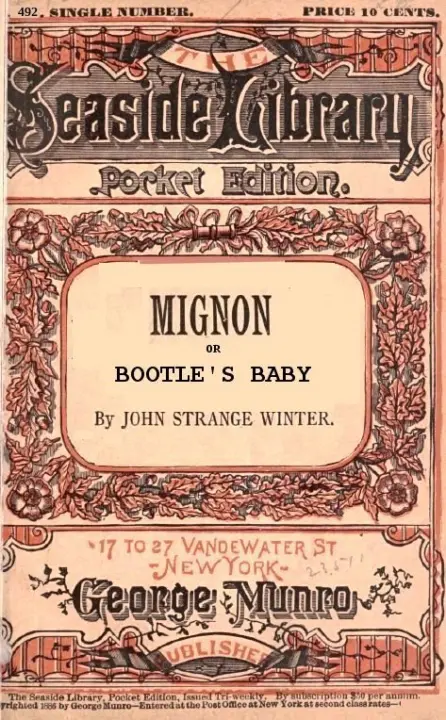
Mignon; or, Bootles’ Baby
John Strange Winter
THE CLASSIC COLLECTION · 1904
"The Little Vanities of Mrs. Whittaker: A Novel" by John Strange Winter is a novel written in the early 20th century. The story follows Regina Brown, a young woman who, feeling dissatisfied with her seemingly mundane life, embarks on a journey of self-discovery that leads her to marriage and motherhood, eventually transforming into Mrs. Alfred Whittaker. The narrative explores themes of female ambition, societal expectations, and the pursuit of individuality against the backdrop of evolving gender roles. The opening of the novel introduces Regina Brown, who grapples with her desire for a more purposeful life in a time when women often faced limited opportunities. As she transitions into a young adult, she becomes determined to gain a higher education and eventually takes the bold step of marrying Alfred Whittaker. The narrative showcases her character's strength and her struggle with societal constraints, highlighting her ambitions while foreshadowing her evolution into Mrs. Whittaker, where she further navigates the complexities of parenthood and self-fulfillment amidst her husband’s expectations and societal norms.
Introduction adapted from the source catalogue; source summaries may be automatically generated.
Free to read · English · 72,343 words · No account needed
MAKE TIME FOR A GOOD BOOK
On by default. Untick to stop anonymous reading totals. Each page counts after 10 seconds in view. How this works.
Anonymous counting is on unless you have switched it off.
"It isn't that I did not like it, or that I grudged your amusing yourself in your own way, or making your life interests in your own way, but when I see you looking so worn and harried, so pulled down and fagged out--well, I naturally begin to wonder where it is going to end."
"I'm getting older," said Regina.
"Nonsense, nonsense, fiddle-faddle! we're all getting older, as a matter of fact, but you are still a young woman in the very prime of life. When you have had a good change and a little sea air, when you give yourself a little more ease and a little more personal indulgence, you'll look ten years younger, my dear child, ten years younger."
Regina only replied by a smile. At that moment Margaret came back carrying, with the care of a thoroughly well-trained parlor-maid, the bottle of champagne in which they were to drink, as Alfred put it five minutes later, to the degeneration of Mrs. Whittaker.
"They'll be very angry, they'll never replace you," he went on, leaning back in his chair and nursing his stomach in the manner peculiar to elderly gentlemen who do not despise their dinner; "I think they ought to give you a diamond star to show their appreciation of the star you have been to them."
"I hope not," said Regina, decidedly.
"Don't fuss yourself," put in Julia, whose fears for her mother were somewhat allayed; "they won't. I notice that when women give things to women it is generally something they've got cheap. They'll give you an illuminated address, no doubt, and you can frame it and hang it in the hall."
"Not in the hall," said Regina, who was not strong in the point of humor, "not in the hall, Julia darling."
After that the evening passed over very quietly. Julia ran over to the house of Marksby and was seen no more till bed-time. Alfred sat down in his own special easy-chair in the cool, pleasant drawing-room, and, over a pretence of reading the newest art journal, gently dosed off into slumber, and Regina, in her corresponding chair in the big bow window, sat and thought she would leave nothing to chance. As for fate, she would brave it. Like her husband, she was making a pretence of reading, and as she sat thinking things over she became conscious that she was looking at the portrait of a very beautiful woman, exquisite in face, elegant in figure, luxuriously gowned. The journal she was holding in her hand was one devoted to feminine interests, and this was an interview with a lady very highly placed in Society. Some impulse made Regina turn to the beginning of the article and read it. "Devoted mother, idolized wife, adored chatelaine, the lady bountiful of her village, her highest aim is gratified in being her husband's countess." There was a portrait of the husband, who, in Regina's eyes, was not to be named in the same twelvemonth with the noble Alfred sleeping on the other side of the room. There were pictures of the children, of her ladyship's boudoir, of her village school and her cottage hospital. "The world has but little attraction for the beautiful subject of our sketch," the article ended; "she is seen occasionally at Court and at great functions, as a part of her duties, but that is all. Her heart is in her beautiful country home with her husband and her children, and there she shares the joys and sorrows of all who are brought in touch with the great historic name which she bears."
Your reading position is saved on this browser. Take it to another device with a library code. Reading pages adapt to text, rather than matching a printed edition.
John Strange Winter
BEHIND THE BOOK
This eBook is for the use of anyone anywhere in the United States and most other parts of the world at no cost and with almost no restrictions whatsoever. You may copy it, give it away or re-use it under the terms of the Project Gutenberg License included with this eBook or online at www.gutenberg.org. If you are not located in the United States, you will have to check the laws of the country where you are located before using this eBook. Read the source licence.
The original source file, including credits and licence, is retained by this library. Request an original-format copy at no charge. Please include the book title and Project Gutenberg identifier #35414.
KEEP YOUR CURIOSITY GOING
Coulson Kernahan

Maurice Baring
Frances Wright
Cécile Tormay

Frederic Jesup Stimson

W. H. P. (William Henry Pope) Jarvis