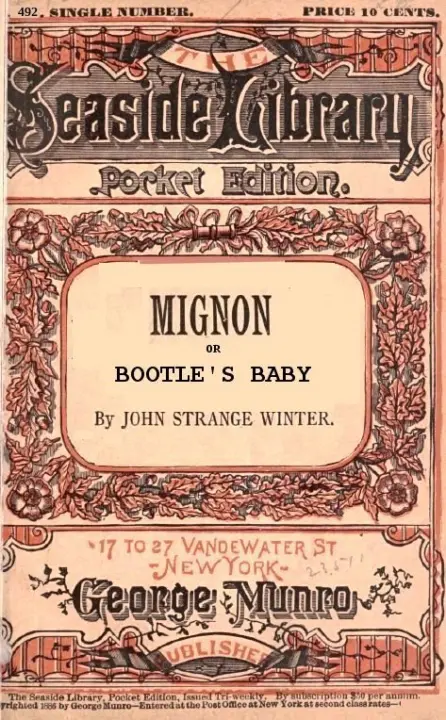
Mignon; or, Bootles’ Baby
John Strange Winter
THE CLASSIC COLLECTION · 1904
"The Little Vanities of Mrs. Whittaker: A Novel" by John Strange Winter is a novel written in the early 20th century. The story follows Regina Brown, a young woman who, feeling dissatisfied with her seemingly mundane life, embarks on a journey of self-discovery that leads her to marriage and motherhood, eventually transforming into Mrs. Alfred Whittaker. The narrative explores themes of female ambition, societal expectations, and the pursuit of individuality against the backdrop of evolving gender roles. The opening of the novel introduces Regina Brown, who grapples with her desire for a more purposeful life in a time when women often faced limited opportunities. As she transitions into a young adult, she becomes determined to gain a higher education and eventually takes the bold step of marrying Alfred Whittaker. The narrative showcases her character's strength and her struggle with societal constraints, highlighting her ambitions while foreshadowing her evolution into Mrs. Whittaker, where she further navigates the complexities of parenthood and self-fulfillment amidst her husband’s expectations and societal norms.
Introduction adapted from the source catalogue; source summaries may be automatically generated.
Free to read · English · 72,343 words · No account needed
MAKE TIME FOR A GOOD BOOK
On by default. Untick to stop anonymous reading totals. Each page counts after 10 seconds in view. How this works.
Anonymous counting is on unless you have switched it off.
I doubt if even a universal entente cordiale will ever make the French mind and the English mind think alike.
Now it happened before Regina and her husband left Paris that Madame de la Barre intimated through the girls that she would like to have a little confidential chat with her pupils' mother.
"Mother," said Julia to Regina, "Madame wants to see you."
"She has seen me," said Regina.
"Yes, yes, mother, but she wants to see you toute seule. I suppose she wants to tell you some delinquencies of ours, or something."
"I hope not," said Regina.
"Well, dear, you must expect us to be human, like other girls. We have never been in any trouble since we came here, and I don't know why she wants to see you, but, anyway, she asks if you will do her the favor of taking tea with her to-morrow afternoon at four o'clock."
"I will," said Regina.
"She doesn't speak one word of English, you know," said Julia.
"We shall communicate somehow," said Regina, with a superb air.
"I don't know how," said Julia, "since you can't speak two words of
French--"
"Excuse me," said Regina, pointedly.
"Well, excuse me too, mother--I didn't mean to be rude. But your French isn't equal to your Latin, is it?"
"I will be there," said Regina, with a distinct accession of dignity.
And so, punctual to the moment, Regina appeared in the salon of the schoolmistress. Their mode of communication was original, it was also a little difficult, but both being determined women, they overcame the difficulties of the situation with a supreme indifference to the effect the one might have upon the other. As a matter of fact, Julia had been a little wide of the mark when she had declared to her mother that Madame did not speak one word of English. Madame spoke a little more English than Regina spoke French, and by a series of contortions, gesticulations, and other efforts which I need not attempt to reproduce here, Madame de la Barre contrived to make known to Mrs. Whittaker her object in seeking for the interview. And her object in seeking the interview was that she should explain to her that she considered the taste in dress of the demoiselles Whittaker to be something too atrocious for words.
"C'est affreux! c'est affreux," she exclaimed, when she found that Regina was a little dense of understanding. "Horreeble--horreeble!"
"I have never," said Regina, speaking very slowly and distinctly, and with an indulgent air as if she were communicating with someone a little short of being an idiot, "I have never trained my children to care about those matters."
Your reading position is saved on this browser. Take it to another device with a library code. Reading pages adapt to text, rather than matching a printed edition.
John Strange Winter
BEHIND THE BOOK
This eBook is for the use of anyone anywhere in the United States and most other parts of the world at no cost and with almost no restrictions whatsoever. You may copy it, give it away or re-use it under the terms of the Project Gutenberg License included with this eBook or online at www.gutenberg.org. If you are not located in the United States, you will have to check the laws of the country where you are located before using this eBook. Read the source licence.
The original source file, including credits and licence, is retained by this library. Request an original-format copy at no charge. Please include the book title and Project Gutenberg identifier #35414.
KEEP YOUR CURIOSITY GOING
Coulson Kernahan

Maurice Baring
Frances Wright
Cécile Tormay

Frederic Jesup Stimson

W. H. P. (William Henry Pope) Jarvis