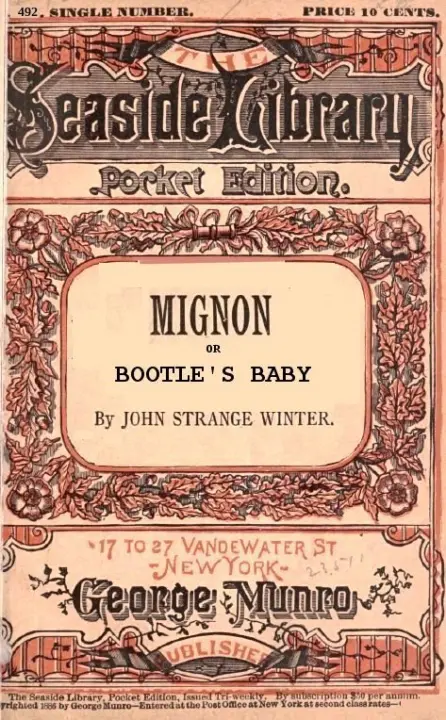
Mignon; or, Bootles’ Baby
John Strange Winter
THE CLASSIC COLLECTION · 1904
"The Little Vanities of Mrs. Whittaker: A Novel" by John Strange Winter is a novel written in the early 20th century. The story follows Regina Brown, a young woman who, feeling dissatisfied with her seemingly mundane life, embarks on a journey of self-discovery that leads her to marriage and motherhood, eventually transforming into Mrs. Alfred Whittaker. The narrative explores themes of female ambition, societal expectations, and the pursuit of individuality against the backdrop of evolving gender roles. The opening of the novel introduces Regina Brown, who grapples with her desire for a more purposeful life in a time when women often faced limited opportunities. As she transitions into a young adult, she becomes determined to gain a higher education and eventually takes the bold step of marrying Alfred Whittaker. The narrative showcases her character's strength and her struggle with societal constraints, highlighting her ambitions while foreshadowing her evolution into Mrs. Whittaker, where she further navigates the complexities of parenthood and self-fulfillment amidst her husband’s expectations and societal norms.
Introduction adapted from the source catalogue; source summaries may be automatically generated.
Free to read · English · 72,343 words · No account needed
MAKE TIME FOR A GOOD BOOK
On by default. Untick to stop anonymous reading totals. Each page counts after 10 seconds in view. How this works.
Anonymous counting is on unless you have switched it off.
Have you noticed, dear reader, how frequent it is to set down those who are too sharp for you as "queer?" Well, it was just so at Northampton Park, and what the girl didn't choose to put into plain words, she stigmatized as queer.
"And what do you mean by queer?" the mother asked.
"Well, they are queer. I think their mother must be queer, too, because their dress is so funny."
"Is it?"
"Oh, awfully. They always wear brown."
"What are they like?"
"Well, Maudie is fairish and Julia is darkish. Maudie has quite a straight nose and Julia's turns up--oh, it isn't an ugly turn-up nose, I didn't mean that. But they are such guys, and what is worse, they don't care a bit."
"Really? What sort of guys?" asked the mother, who was immensely amused.
"Well, they never have anything like anybody else. They've got long, pokey frocks made of tough brown stuff, like--er--like--er--pictures of Dutch children. And over them they wear long holland pinafores."
"It sounds very sensible," remarked the mother. "And when they come out
of school?"
"In the winter they've got long brown coats, with little bits here--you
know."
"You mean a yoke?"
"I don't know what you call it, mother--little bits, and skirts from it, and poke bonnets, and brown wool gloves; brown stockings and brown shoes, and little brown muffs. Oh, they really are awfully queer!"
"And in the summer?"
"In the summer? Well, in the summer they wear brown holland things. They're queer, mother, I can't tell you any more--they're queer."
"I see," said the mother. "But in themselves," she persisted, "what are they like in themselves?"
"Oh, I don't know. Nobody likes them much."
"Poor children! I wish you would be a little kind to them."
"Do you?" said the girl, rather wistfully. "Well, I will if you like, but it would be an awful bore, and they wouldn't thank us."
"I see," said the mother. But she was wrong; she only thought she saw.
So time sped on, and these two children grew more and more long-legged, more and more definite in character, and as they progressed towards what Mrs. Whittaker fondly believed to be originality and unconventionalism, so did her mother's heart bound and yearn within her.
"I am amply satisfied with the result of our scheme of education," she was wont to say. "No, it is not easy--it is much easier to bring up children in the conventional way. But the result--oh, my dear lady, the result, when you feel a thrill of pride that your children are different to others, is worth the sacrifice."
Your reading position is saved on this browser. Take it to another device with a library code. Reading pages adapt to text, rather than matching a printed edition.
John Strange Winter
BEHIND THE BOOK
This eBook is for the use of anyone anywhere in the United States and most other parts of the world at no cost and with almost no restrictions whatsoever. You may copy it, give it away or re-use it under the terms of the Project Gutenberg License included with this eBook or online at www.gutenberg.org. If you are not located in the United States, you will have to check the laws of the country where you are located before using this eBook. Read the source licence.
The original source file, including credits and licence, is retained by this library. Request an original-format copy at no charge. Please include the book title and Project Gutenberg identifier #35414.
KEEP YOUR CURIOSITY GOING
Coulson Kernahan

Maurice Baring
Frances Wright
Cécile Tormay

Frederic Jesup Stimson

W. H. P. (William Henry Pope) Jarvis