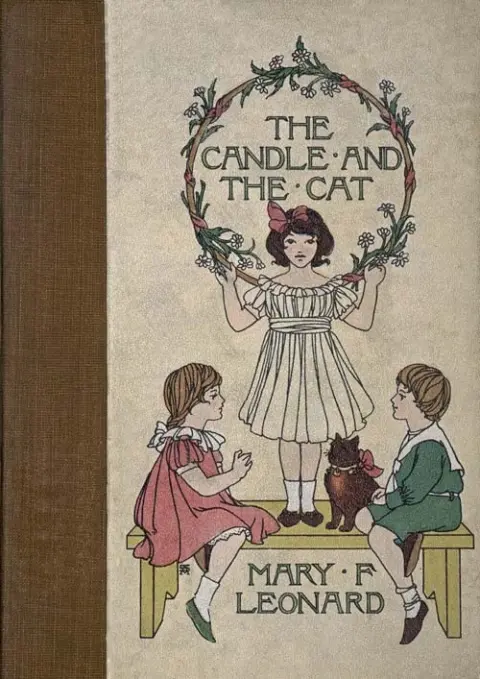
The Candle and the Cat
Mary Finley Leonard
THE CLASSIC COLLECTION · 1914
"The Little Red Chimney: Being the Love Story of a Candy Man" by Mary Finley Leonard is a novel written in the early 20th century. The story revolves around the titular "Candy Man," a character whose life intertwines with a charming young woman named Miss Bentley, also referred to as "the Girl of All Others." Their interactions and the influence of various supporting characters suggest themes of love, class differences, and the pursuit of happiness within an urban setting. At the start of the story, the Candy Man is introduced while he tends to his Candy Wagon on a rainy day in October. He witnesses a near-accident involving Miss Bentley, which sparks an immediate connection between them. She is briefly flustered but expresses gratitude, leading him to recall her delightful presence. As he goes about his day, he reflects on this encounter, pondering the complexities of social status and his own humble position. The narrative hints at the unfolding romance and adventures tied to the "Little Red Chimney," where Miss Bentley resides, as well as the interesting lives surrounding both the Candy Man and Miss Bentley, including an old miser and a lively child named Virginia.
Introduction adapted from the source catalogue; source summaries may be automatically generated.
Free to read · English · 30,353 words · No account needed
MAKE TIME FOR A GOOD BOOK
On by default. Untick to stop anonymous reading totals. Each page counts after 10 seconds in view. How this works.
Anonymous counting is on unless you have switched it off.
In which Margaret Elizabeth is discussed at the Breakfast Table; in which also, later on, she and Virginia and Uncle Bob talk before the fire, and in which finally Margaret Elizabeth seeks consolation by relating to Uncle Bob her adventure in the park.
"No, she is not regularly beautiful," remarked Dr. Prue in her diagnostician manner as she poured her father's second cup of coffee, "but there is much that is captivating about her. Her hair grows prettily on her forehead, the firmness of her chin, the line of her lips in repose----"
"Mercy on us! You talk like a novel," interrupted Uncle Bob, who was longing to get in an oar. "Now I like her best when she laughs."
"But I was speaking of her face in repose."
"And any way," persisted Uncle Bob, "if she isn't a beauty, I don't know what you call it. She has the witchingest ways!"
"We were speaking of features, not ways. If you dissect her----"
"Good Heavens, Prue! Find another word."
"If you dissect her," the doctor repeated firmly, "you will find nothing remarkable in her separate features."
"But I insist," Uncle Bob spoke in a loud tone, and brought his fist down so emphatically his coffee spilled over into the saucer, "that beauty is a complex thing consisting of ways as well as features." The sentence was concluded in a milder tone, owing to the coffee.
"Nancy, give Mr. Vandegrift another saucer," said Dr. Prue.
"My dear, there is no need. I can pour this back," he protested. Then, a fresh saucer having been substituted, he went on: "Take a landscape----"
"I haven't time for landscapes this morning, father. I am due at the hospital at nine. You'll have to excuse me."
"Well, what I was going to say is, that it is the combination of all her separate qualities and characteristics, manifested in ways and otherwise, that is beautiful--that constitutes beauty. The something that makes her Margaret Elizabeth, that subtle--" Uncle Bob was talking against time.
"Now, father," Dr. Prue pushed back her chair and rose, "there is nothing subtle about Margaret Elizabeth, and you know it. She is a thoroughly nice, quite pretty girl, and that is all there is to it. If those Penningtons don't spoil her." With this the doctor disappeared.
"Miss Prue and her pa do argufy to beat the band," Nancy remarked to Jenny the cook as she waited for hot cakes.
"That's all, Nancy. I shan't want any more," her master told her when she carried them into the dining-room. "You needn't wait." As the door closed behind her he smiled to himself. He always enjoyed the leisurely comfort of those last cakes.
Your reading position is saved on this browser. Take it to another device with a library code. Reading pages adapt to text, rather than matching a printed edition.
Mary Finley Leonard
Mary Finley Leonard
Mary Finley Leonard
Mary Finley Leonard
BEHIND THE BOOK
This eBook is for the use of anyone anywhere in the United States and most other parts of the world at no cost and with almost no restrictions whatsoever. You may copy it, give it away or re-use it under the terms of the Project Gutenberg License included with this eBook or online at www.gutenberg.org. If you are not located in the United States, you will have to check the laws of the country where you are located before using this eBook. Read the source licence.
The original source file, including credits and licence, is retained by this library. Request an original-format copy at no charge. Please include the book title and Project Gutenberg identifier #15406.
KEEP YOUR CURIOSITY GOING
Coulson Kernahan

Maurice Baring
Frances Wright
Cécile Tormay

Frederic Jesup Stimson

W. H. P. (William Henry Pope) Jarvis