THE CLASSIC COLLECTION✦An outlaw’s diary: the CommuneCLASSIC FREE BOOKS
An outlaw’s diary: the Commune
Cécile Tormay
THE CLASSIC COLLECTION · 1598
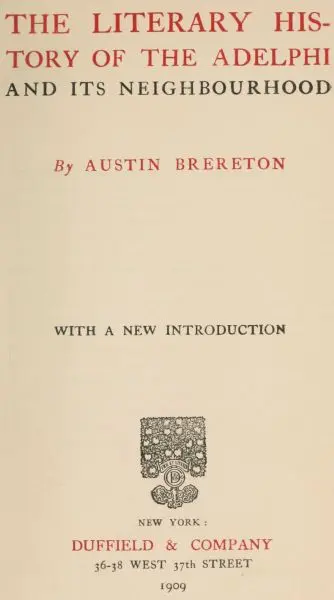
"The Literary History of the Adelphi and Its Neighbourhood" by Austin Brereton is a historical account written in the early 20th century. The work explores the rich literary and cultural history of the Adelphi area of London, detailing its significance through various illustrious figures and events over centuries. The narrative seeks to unveil the storied past of this intriguing locality, shedding light on its transformation and the notable individuals who have left their mark on it. The opening of the book sets the stage by presenting an overview of the Adelphi's historical significance, emphasizing its connections to various notable figures, including kings, queens, literary giants, and other influential personalities throughout history. Brereton mentions various important locations within the Adelphi, such as Durham House, which once served as a residence for many prominent figures and has been a site of significant events. The chapter introduces readers to the colorful history of the neighborhood, highlighting the various stories and anecdotes that define its character, thus engaging those interested in both literary history and the broader context of London's past.
Introduction adapted from the source catalogue; source summaries may be automatically generated.
Free to read · English · 71,958 words · No account needed
MAKE TIME FOR A GOOD BOOK
On by default. Untick to stop anonymous reading totals. Each page counts after 10 seconds in view. How this works.
Anonymous counting is on unless you have switched it off.
Exchange, the New, the laying of the foundation stone, 21;
the Earl of Salisbury proprietor, 21;
opposition of the City, 22;
its interior, 22;
opened by James I. as "Britain's Burse," 22;
Stow's description, 23-24;
the Venetian Ambassador writes about it to the Doge and State of
Venice, 24;
the Earl of Salisbury, 25-26;
Tobie Matthew, 26;
its most flourishing period, 27;
various allusions to it by the dramatists of Charles II. period,
and others, 27-30;
the first edition of Othello published here, 28;
Henry Herringman, the publisher, 29;
Dryden, Otway, Etherege, 29;
Samuel Pepys, 29, 37, 38, 39, [see also Appendix];
Addison, 30;
Rules for the New Exchange, 30-35;
murder here, 44-48;
the "White Milliner," 49-63;
Douglas Jerrold's play on the subject, 57-63;
"Nan" Clarges, Duchess of Albemarle, 63-71;
Gay's Trivia, 71;
quack doctors, 71;
overcrowding of the Exchange, 73;
order of the Inner Star Chamber, 74.
Fairfax, General, 226-229.
Fair Penitent, The, 141, 247.
Farren, William, 58.
Fatal Falsehood, The, 159.
Fergusson, James, 95-96.
Fire at Northumberland House, 263.
FitzHerbert, Mrs, 212.
Flaxman, John, 242.
Foote, Samuel, 41.
Forbes, William, 154.
Fox, C.J., 147, 212.
"Fox-under-the-Hill," the, 186-187.
Franklin, Benjamin, 269.
Fuller, Thomas, 5.
Fuseli, Henry, 242.
Garrick, David, wine merchant in the Adelphi, 40;
purchases No. 5 Adelphi (then Royal) Terrace, 123;
his London home, 1773, until his death in 1779, 123-141;
his last appearance on the stage, 125;
helps in the production of Percy, 126;
his friendship for Hannah More, 126, 128, 129;
eulogised by Edmund Burke and Fox, 127;
Hannah More writes to Garrick, 129-131;
his answer, 131;
her thanks, 132;
Garrick presents her with his "Felix Buckles," 133;
he writes to her again and encourages her in regard to her
tragedy, 134-135;
"Mr Garrick's study, Adelphi, ten at night," 136;
the "sour crout party," 138;
Garrick carries Hannah More's dinner from the Adelphi to the
Turk's Head, 138;
his illness and death, 139-141;
his burial in Westminster Abbey, 141, 145-148;
his funeral, 145-148, Appendix;
Johnson's praise of him, 148-152;
Johnson's lament--"two such friends," 158;
Shakespeare's gloves presented to him, 167-169;
he solicits the brothers Adam on behalf of Andrew Becket, the
bookseller, 171;
a doubtful anecdote, 171;
"Anthony Pasquin's" misstatement, 248.
Garrick, Mrs, 128-132, 138-144;
her famous dinner party, 153-158;
her life in Adelphi Terrace, 158-161;
her consideration for Hannah More, 161;
"a great dinner" at her house, 162;
her last letter to Hannah More, 163;
her death and burial in the Abbey, 164;
memoir of, 165-166;
bequeath's Shakespeare's gloves to Mrs Siddons, 166.
Gay, John, 71.
George III., 125, 212.
George IV., 212.
George Court, 21, 72.
Gerbier, Sir Balthazar, 222, 224.
Gibbon, Edward, 181.
Gilbert Gurney, 182.
Glanville v. Courtney, 19.
Goldsmith, Oliver, 121, 122;
his pathetic letters to Garrick, 167-169, 258-262.
Goodman, Bishop, 16.
Goodman, Godfrey, 225.
Gordon, Lord George, 212.
Graham, James ("Dr"), 172-181.
Grand Hotel, 268.
Great Exhibition of 1851, 268.
Grenville, Lord, 212.
Grey, Lady Jane, 15.
Guns in the Adelphi, 188.
Hackman, James, 270.
Hamilton, Lady (Emma Lyon), 176-178.
Hamilton, Mrs, 162.
Hanway, Jonas, 103.
Hardy, Thomas, 216.
Harley, Robert, 244.
Hastings, Lord, 15.
Hatfield, Thomas, Bishop of Durham, 7, 9.
Hawkins, Sir John, 260.
Haydon, Benjamin, 102.
Haymarket Theatre, 174.
Hazlitt, William, 183.
Heath, Archbishop of York, 8, 219.
Your reading position is saved on this browser. Take it to another device with a library code. Reading pages adapt to text, rather than matching a printed edition.
BEHIND THE BOOK
This eBook is for the use of anyone anywhere in the United States and most other parts of the world at no cost and with almost no restrictions whatsoever. You may copy it, give it away or re-use it under the terms of the Project Gutenberg License included with this eBook or online at www.gutenberg.org. If you are not located in the United States, you will have to check the laws of the country where you are located before using this eBook. Read the source licence.
The original source file, including credits and licence, is retained by this library. Request an original-format copy at no charge. Please include the book title and Project Gutenberg identifier #57372.
KEEP YOUR CURIOSITY GOING
Cécile Tormay

Moritz Busch
John L. Ransom
Frances Wright
Cécile Tormay

Mabel Potter Daggett