THE CLASSIC COLLECTION✦An outlaw’s diary: the CommuneCLASSIC FREE BOOKS
An outlaw’s diary: the Commune
Cécile Tormay
THE CLASSIC COLLECTION · 1598
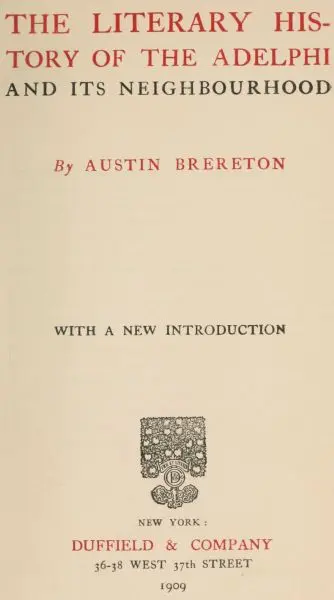
"The Literary History of the Adelphi and Its Neighbourhood" by Austin Brereton is a historical account written in the early 20th century. The work explores the rich literary and cultural history of the Adelphi area of London, detailing its significance through various illustrious figures and events over centuries. The narrative seeks to unveil the storied past of this intriguing locality, shedding light on its transformation and the notable individuals who have left their mark on it. The opening of the book sets the stage by presenting an overview of the Adelphi's historical significance, emphasizing its connections to various notable figures, including kings, queens, literary giants, and other influential personalities throughout history. Brereton mentions various important locations within the Adelphi, such as Durham House, which once served as a residence for many prominent figures and has been a site of significant events. The chapter introduces readers to the colorful history of the neighborhood, highlighting the various stories and anecdotes that define its character, thus engaging those interested in both literary history and the broader context of London's past.
Introduction adapted from the source catalogue; source summaries may be automatically generated.
Free to read · English · 71,958 words · No account needed
MAKE TIME FOR A GOOD BOOK
On by default. Untick to stop anonymous reading totals. Each page counts after 10 seconds in view. How this works.
Anonymous counting is on unless you have switched it off.
Algernon Percy, the tenth Earl of Northumberland, who was called by Lord Clarendon "the proudest man alive," became guardian of the two youngest children of Charles I. in 1645, and was one of the commissioners appointed to negotiate with the King at Newport in 1648. He took no part in public affairs during the Commonwealth and Protectorate. In the spring of 1660, George Monk--afterwards the Duke of Albemarle, and the husband of "Nan" Clarges--was invited, with the Earl of Manchester, Sir William Waller, and others to Northumberland House, and here, "in secret confidence with them," says Clarendon, "some of those measures were concerted which led to the speedy restoration of the Monarchy." Algernon Percy, who was a privy councillor after the Restoration, died in 1668. His son and successor, Josceline Percy, dying in 1670, without male issue, the property passed to his daughter, the Lady Elizabeth Percy (1667-1722). This lady had a strange matrimonial career. At the age of twelve she was "married" to Henry Cavendish, Earl of Ogle (son and heir of Henry, Duke of Newcastle), but he died in his youth. Two years later--that is to say, in 1681--she espoused Thomas Thynne, of Longleat, Wilts.
Thynne, who was nicknamed "Tom of Ten Thousand," in consequence of his great wealth, was the Issachar of Absalom and Achitophel. Lady Elizabeth, soon after the death of Lord Ogle, had been given in marriage by her grandmother to Thynne, who, however, had agreed, on account of the youth of his bride, that the marriage should not be consummated until a year had elapsed. The lady, however, took such a dislike to Thynne that she fled for protection to Lady Temple at the Hague. "In the meantime, the famous Count Königsmark--noted for his beauty and intrigues in most of the Courts of Europe--had accidentally met Lady Ogle in public, and had either fallen in love with her person, or with the vast fortune of which she was the mistress. That the feeling was reciprocal there is not the least reason to suppose. Königsmark, however, equally daring and unprincipled, determined by foul, if not by fair means, to make her his wife, and, as the first step, projected the assassination of the unfortunate Thynne. The persons whom he hired to commit the crime were three foreigners--one Captain Vratz, a German; a Lieutenant Stern, a Swede; and one George Borotski, a Pole. The two former seem to have been as daring and reckless adventurers as any age could produce. Borotski, on the other hand, was a quiet, uneducated man, who appears to have acted entirely from a feeling of retainership, without any thought of the gold which had induced his accomplices to undertake to commit the crime. The night of Sunday, the 12th of February 1682, was fixed upon for the perpetration of the foul deed. Accordingly, having had their several parts assigned to them, between seven and eight o'clock the three assassins, mounted on horseback, posted themselves in a part of Pall Mall, nearly opposite to the present Opera Colonnade, through which they had ascertained the equipage of Thynne was likely to pass. As soon as the coach appeared in sight, they all three rode up to the window, and, by their imposing attitude, compelled the coachman to halt. One shot only was fired, which was from a musketoon, carried by Borotski. So true, however, was the aim, that as many as five bullets entered the body of his victim. Thynne was forthwith carried to his own residence, where he lingered till about six o'clock the following morning, when he expired."[64] Königsmark attempted to escape, but he was arrested at Gravesend at the very moment that he was about to set foot on a foreign vessel. He was immediately brought to trial, and, after some delay, acquitted. His accomplices were condemned to death, and, on March 10, executed in Pall Mall, on the spot where they had committed the atrocious crime. Thynne was buried in Westminster Abbey, and a monument in white marble, representing the tragedy in bas-relief, was erected to his memory.
Your reading position is saved on this browser. Take it to another device with a library code. Reading pages adapt to text, rather than matching a printed edition.
BEHIND THE BOOK
This eBook is for the use of anyone anywhere in the United States and most other parts of the world at no cost and with almost no restrictions whatsoever. You may copy it, give it away or re-use it under the terms of the Project Gutenberg License included with this eBook or online at www.gutenberg.org. If you are not located in the United States, you will have to check the laws of the country where you are located before using this eBook. Read the source licence.
The original source file, including credits and licence, is retained by this library. Request an original-format copy at no charge. Please include the book title and Project Gutenberg identifier #57372.
KEEP YOUR CURIOSITY GOING
Cécile Tormay

Moritz Busch
John L. Ransom
Frances Wright
Cécile Tormay

Mabel Potter Daggett