THE CLASSIC COLLECTION✦An outlaw’s diary: the CommuneCLASSIC FREE BOOKS
An outlaw’s diary: the Commune
Cécile Tormay
THE CLASSIC COLLECTION · 1598
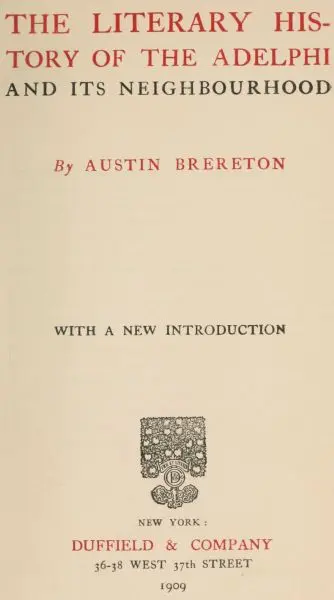
"The Literary History of the Adelphi and Its Neighbourhood" by Austin Brereton is a historical account written in the early 20th century. The work explores the rich literary and cultural history of the Adelphi area of London, detailing its significance through various illustrious figures and events over centuries. The narrative seeks to unveil the storied past of this intriguing locality, shedding light on its transformation and the notable individuals who have left their mark on it. The opening of the book sets the stage by presenting an overview of the Adelphi's historical significance, emphasizing its connections to various notable figures, including kings, queens, literary giants, and other influential personalities throughout history. Brereton mentions various important locations within the Adelphi, such as Durham House, which once served as a residence for many prominent figures and has been a site of significant events. The chapter introduces readers to the colorful history of the neighborhood, highlighting the various stories and anecdotes that define its character, thus engaging those interested in both literary history and the broader context of London's past.
Introduction adapted from the source catalogue; source summaries may be automatically generated.
Free to read · English · 71,958 words · No account needed
MAKE TIME FOR A GOOD BOOK
On by default. Untick to stop anonymous reading totals. Each page counts after 10 seconds in view. How this works.
Anonymous counting is on unless you have switched it off.
York House fell from its high estate on coming into the possession of General Fairfax. On November 27, 1655, Evelyn "went to see York House and gardens, belonging to the former greate Buckingham, but now much ruin'd thro' neglect." In 1661, Baron de Batteville, the Spanish Ambassador, was lodged there, a fact which affords us, through the pages of Samuel Pepys, a curious peep into the past. On May 19, 1661 (Lord's Day), this delightful chronicler walked in the morning towards Westminster, and, seeing many people at York House, he went down from the Strand "and found them at masse, it being the Spanish Ambassador's; and so I got into one of the galleries, and there heard two masses done, I think not in so much state as I have seen them heretofore. After that, into the garden, and walked an hour or two, but found it not so fine a place as I took it for by the outside." In September of the same year, Pepys witnessed a strange encounter between the retainers of the ambassadors of Spain and France, which terminated at York House: "This morning, up by moonshine, at five o'clock, to Whitehall, to meet Mr More at the Privy Seale, and ther I heard of a fray between the two embassadors of Spaine and France, and that this day being the day of the entrance of an embassador from Sweeden, they intended to fight for the precedence. Our king, I heard, ordered that no Englishman should meddle in the business, but let them do what they would. And to that end, all the soldiers in town were in arms all the day long, and some of the train bands in the city, and a great bustle through the city all the day. Then we took coach (which was the business I came for) to Chelsey, to my Lord Privy Seale, and there got him to seal the business. Here I saw by daylight two very fine pictures in the gallery, that a little while ago I saw by night; and did also go all over the house, and found it to be the prettiest contrived house that I ever saw in my life. So back again; and Whitehall light, and saw the soldiers and people running up and down the streets. So I went to the Spanish embassadors and the French, and there saw great preparations on both sides; but the French made the most noise and ranted most, but the other made no stir almost at all; so that I was afraid the other would have too great a conquest over them. Then to the wardrobe and dined there; and then abroad, and in Cheapside hear, that the Spanish hath got the best of it, and killed three of the French coachhorses and several men, and is gone through the city next to our King's coach: at which it is strange to see how all the city did rejoice. And, indeed, we do naturally all love the Spanish and hate the French. But I, as I am in all things curious, presently got to the water-side, and there took oars to Westminster Palace, and ran after them through all the dirt, and the streets full of people; till at last, in the Mews [Charing Cross], I saw the Spanish coach go with fifty drawn swords at least to guard it, and our soldiers shouting for joy. And so I followed the coach, and then met it at Yorke House, where the embassador lies; and there it went in with great state. So then I went to the French house, where I observe still, that there is no men in the world of a more insolent spirit where they do well, nor before they begin a matter, and more abject if they do miscarry, than these people are; for they all look like dead men, and not a word among them, but shake their heads. The truth is, the Spaniards were not only observed to fight more desperately, but also they did outwitt them; first in lining their own harnesse with chains of iron that they could not be cut, then in setting their coach in the most advantageous place, and to appoint men to guard every one of their horses, and others for to guard the coach, and others the coachman. And, above all, in setting upon the French horses and killing them, for by that means the French were not able to stir. There were several men slaine of the French, and one or two of the Spaniards, and one Englishman by a bullet. Which is very observable, the French were at least four to one in number, and had near one hundred cases of pistols among them, and the Spaniards had not one gun among them, which is for their honour for ever, and the others' disgrace. So having been very much daubed with dirt, I got a coach and home; where I vexed my wife in telling her of this story, and pleading for the Spaniards against the French."
Your reading position is saved on this browser. Take it to another device with a library code. Reading pages adapt to text, rather than matching a printed edition.
BEHIND THE BOOK
This eBook is for the use of anyone anywhere in the United States and most other parts of the world at no cost and with almost no restrictions whatsoever. You may copy it, give it away or re-use it under the terms of the Project Gutenberg License included with this eBook or online at www.gutenberg.org. If you are not located in the United States, you will have to check the laws of the country where you are located before using this eBook. Read the source licence.
The original source file, including credits and licence, is retained by this library. Request an original-format copy at no charge. Please include the book title and Project Gutenberg identifier #57372.
KEEP YOUR CURIOSITY GOING
Cécile Tormay

Moritz Busch
John L. Ransom
Frances Wright
Cécile Tormay

Mabel Potter Daggett