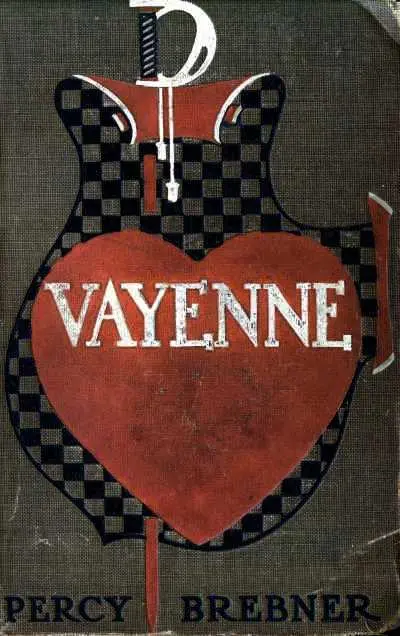
Vayenne
Percy James Brebner
THE CLASSIC COLLECTION · 1911
"The Light That Lures" by Percy James Brebner is a historical novel written in the early 20th century. Set during the tumultuous times of the American Revolutionary War and the French Revolution, the story follows Richard Barrington, a young man who idolizes the heroic figure of Marquis de Lafayette and dreams of fighting for freedom and justice, inspired by the conflict of his era. The opening of the novel introduces Richard as a contemplative boy on a hummock by Chesapeake Bay, enamored by lofty dreams of heroism and adventure, contrasting sharply with the serene beauty surrounding him. As the narrative unfolds, he encounters the Marquis de Lafayette, who becomes a mentor and a source of inspiration. Lafayette's conversation with Richard reveals themes of duty, honor, and the significance of one's path in life, foreshadowing Richard’s journey from Virginia to France amidst conflict. The scene shifts dramatically as we then meet Richard as a man, traveling with his companion Seth to Paris, where they become embroiled in a web of intrigue and danger as they help a mysterious woman, Jeanne St. Clair, navigate a revolution that threatens their very lives.
Introduction adapted from the source catalogue; source summaries may be automatically generated.
Free to read · English · 85,164 words · No account needed
MAKE TIME FOR A GOOD BOOK
On by default. Untick to stop anonymous reading totals. Each page counts after 10 seconds in view. How this works.
Anonymous counting is on unless you have switched it off.
There are few fairer spots in this world than Beauvais. He who has dreamed of an earthly paradise and sought it out, might well rest here contented, satisfied. It lies at the top of a long, ascending valley which twists its way upward from the Swiss frontier into the hills, a rough and weary road to travel, yet with a new vista of beauty at every turn. Here are wooded slopes where a dryad might have her dwelling; yonder some ragged giant towers toward heaven, his scarred rocky shoulders capped with snow. Below, deep down from the road cut in the hillside, undulate green pastures, the cattle so small at this distance that they might be toys set there after a child's fancy; while a torrent leaping joyously from ledge to ledge might be a babbling brook but for the sound of its full music which comes upward on the still air, telling of impetuous force and power. Here eternity seems to have an habitation, and time to be a thing of naught. The changing seasons may come and go, storm and tempest may spend their rage, and summer heat and winter frost work their will, yet that rocky height shall still climb into cloudland, and those green pastures shall flourish. Centuries ago, eyes long blinded by the dust of death looked upon this fair scene and understood something of its everlasting nature; centuries hence, other eyes shall behold its beauty and still dream of a distant future. We are but children of a day, brilliant ephemera flashing in a noontide sun; these silent, watching hills have known generations of others like us, as brilliant and as short-lived; shall know generations more, unborn as yet, unthought of.
At the head of this valley, rising suddenly from a stretch of level land, is a long hill lying like a wedge, its thin edge resting on the plain. The sides, as they get higher, become more precipitous, but from the thin edge there ascends a road about which houses cluster, irregular and pointed roofs rising one above the other in strange confusion until they are crowned at the summit by the château standing like their protector to face and defy the world. To the right, dominating the whole of this region, is the great double peak, snow-clad and often cloud-bound, which seems to stand sentinel for the surrounding mountains as the castle does to the valley; God's work and the work of man. He who first built his castle there knew well that in might lay right, and chose his place accordingly. Now houses stretch down to the level of the plain, but it was not always so. Halfway through the village the road passes through a gateway of solid stone, flanked by towers pierced for defense, and the wall through which this gate gives entrance remains, broken in places, lichen-covered, yet still eloquent of its former strength and purpose. Within the gate the village widens into an open square rising toward the château, and this square is surrounded by old houses picturesque and with histories. Many a time Beauvais has stood siege, its lord holding it against some neighbor stirred by pride or love tragedy to deadly feud. In these ancient houses his retainers lived, his only so long as he was strong enough to make himself feared, fierce men gathered from all points of the compass, soldiers of fortune holding their own lives and the lives of others cheaply. From such men, brilliant in arms, have sprung descendants who have made their mark in a politer epoch, men and women who have become courtiers, companions of kings, leaders of men, pioneers of learning. Carved into these ancient houses in Beauvais are crests and mottoes which are the pride of these descendants now scattered over Europe. Such is the village of Beauvais, asleep for many years, the home of peasants chiefly, mountaineers and tenders of cattle, still with the fighting spirit in them, but dormant, lacking the necessity. A fair place, but to the exile, only through a veil does the fairest land reveal its beauty. Its sunlit hills, its green pastures, the silver sheen of its streams, the blue of its sky, he will see through a mist of regret, through tears perchance. No beauty can do away with the fact that it is only a land of exile, to be endured and made the best of for a while, never to be really loved. There is coming an hour in which he may return home, and he is forever looking forward, counting the days. The present must be lived, but reality lies in the future.
Your reading position is saved on this browser. Take it to another device with a library code. Reading pages adapt to text, rather than matching a printed edition.
Percy James Brebner
Percy James Brebner
Percy James Brebner
Percy James Brebner
BEHIND THE BOOK
This eBook is for the use of anyone anywhere in the United States and most other parts of the world at no cost and with almost no restrictions whatsoever. You may copy it, give it away or re-use it under the terms of the Project Gutenberg License included with this eBook or online at www.gutenberg.org. If you are not located in the United States, you will have to check the laws of the country where you are located before using this eBook. Read the source licence.
The original source file, including credits and licence, is retained by this library. Request an original-format copy at no charge. Please include the book title and Project Gutenberg identifier #13312.
KEEP YOUR CURIOSITY GOING
Cécile Tormay

Moritz Busch
Coulson Kernahan
John L. Ransom

Maurice Baring
Frances Wright