THE CLASSIC COLLECTION✦An outlaw’s diary: the CommuneCLASSIC FREE BOOKS
An outlaw’s diary: the Commune
Cécile Tormay
THE CLASSIC COLLECTION · 1916
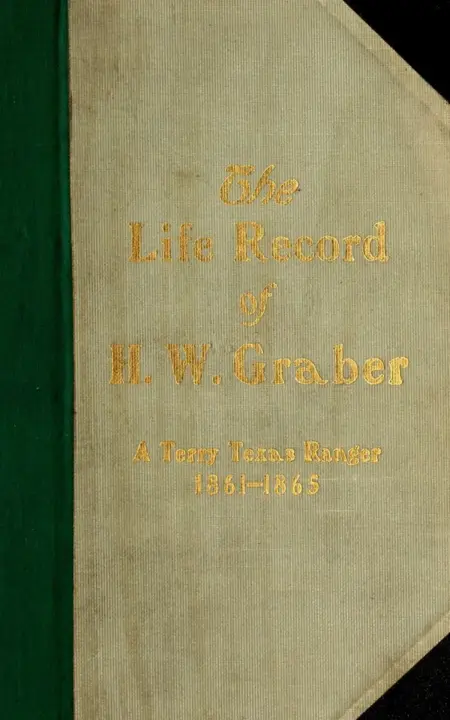
"The Life Record of H. W. Graber" by H. W. Graber is a personal memoir written in the early 20th century. The work recounts the author’s experiences during the tumultuous years of the American Civil War and his life in Texas, touching upon various adventures, hardships, and reflections on his military service. It promises an intimate and historical glimpse into the life of a soldier and settler amid significant national turmoil. The opening of this memoir introduces H. W. Graber, who shares his earliest memories of life in Germany before moving to Texas. He describes the challenges his family faced, including the loss of his parents and the responsibilities he assumed as the eldest sibling. Graber’s narrative journeys through his childhood, working various jobs, and the formative experiences that led him to serve in the war. Early chapters set the stage for his later military endeavors, showcasing his resilience and adaptability in a rapidly changing world as he navigates both his family obligations and the dangers of frontier life.
Introduction adapted from the source catalogue; source summaries may be automatically generated.
Free to read · English · 105,816 words · No account needed
MAKE TIME FOR A GOOD BOOK
On by default. Untick to stop anonymous reading totals. Each page counts after 10 seconds in view. How this works.
Anonymous counting is on unless you have switched it off.
I was then taken to their regular hospital, located on Barren River, about a mile and a half from town, where I was very kindly received by the surgeon in charge, who turned out to be a very sympathetic, kind-hearted man. I was furnished a cot, the same as their other sick, in the principal ward, and had a guard detailed to stay with me all the time. This guard consisted of two men, who were on duty every alternate six hours.
Under the care of this doctor and good nurses, I soon began to recover my strength and began to hope that I would be permitted to stay there until able to travel on foot, having no doubt I could make my escape out of there, when ready.
Unfortunately the Rebel ladies of Bowling Green, learning there was a wounded Texas Ranger at the hospital, would get permission from the provost marshal to visit the sick, he supposing that they meant the Federal sick. When admitted to the wards they would come directly to my cot and deposit flowers, fruit and cake, and encourage me in the belief that I would soon get well again.
My generous, kind-hearted surgeon would sometimes send and get fish or oysters for me, evidently in the belief that he was doing a last kind act for me, as he expected me to be court martialed and sentenced to death, having frankly told me so, trying to persuade me to take the oath, which I refused to do.
As soon as I was able to sit up and talk without effort and overtaxing my strength, we had several discussions about the conduct of the war and the merits of the two armies. On one occasion I said to him, “I’m going to make an assertion, Doctor, and before I make it, I want to qualify it by stating that you have many good, patriotic men in your army and you are one of them; but, taking your army as a whole, they are an army of hirelings, fighting for their bounties and their pay, and would not hold together thirty days if their pay was stopped.” He spurned the idea, telling me that I was sadly mistaken, while there might be a few men that could be classed as hirelings, the bulk of their army were prompted only by patriotic motives and were not considering gain or pay. I said, “Doctor, I will prove my assertion right here in your presence,” and called up some convalescents. Addressing one, I asked him, “What induced you to join the army and what are you fighting for?” He said, “I am fighting for the flag and the Union,” but I said, “As a matter of fact, were you not paid a bounty?” He admitted that he had been paid six hundred dollars by his State. Then again, “What pay do you receive?” He said, “Twelve dollars per month.” “What do you do with your money?” He said, “I send it home, for safety.” “Why don’t you spend it?” “I have nothing to spend it for.” “Does your Government furnish you everything you need?” “Everything,” he said. I interrogated a second one, whose answers were about the same. I then detailed the treatment our Government had been forced to accord our army, who were frequently without pay, often without rations or clothing, especially without shoes, sometimes forced them to go barefooted, leaving their bloody tracks on the road. “Now, boys, if your Government treated you in such manner, what would you do?” They replied, “We wouldn’t fight for any such d—— Government; we would go home and stay there.” I said to the doctor, “Withdraw your pay and rations from your army and you wouldn’t hold them together for sixty days,” on which point we could not agree and he said, “Graber, you are too good a man to be engaged in such a cause.” I replied, “Doctor, that is just my opinion of you; you ought to wear the gray in place of the blue,” all of which he took in the kindliest spirit. I frequently conversed with the ward master and some of the nurses, who seemed to have taken a great fancy for me on account of my bold, outspoken sentiments, and they sympathized with me in my helpless condition.
Your reading position is saved on this browser. Take it to another device with a library code. Reading pages adapt to text, rather than matching a printed edition.
BEHIND THE BOOK
This eBook is for the use of anyone anywhere in the United States and most other parts of the world at no cost and with almost no restrictions whatsoever. You may copy it, give it away or re-use it under the terms of the Project Gutenberg License included with this eBook or online at www.gutenberg.org. If you are not located in the United States, you will have to check the laws of the country where you are located before using this eBook. Read the source licence.
The original source file, including credits and licence, is retained by this library. Request an original-format copy at no charge. Please include the book title and Project Gutenberg identifier #68143.
KEEP YOUR CURIOSITY GOING
Cécile Tormay

Moritz Busch
John L. Ransom
Frances Wright
Cécile Tormay

Mabel Potter Daggett