The Life and Love of the Insect
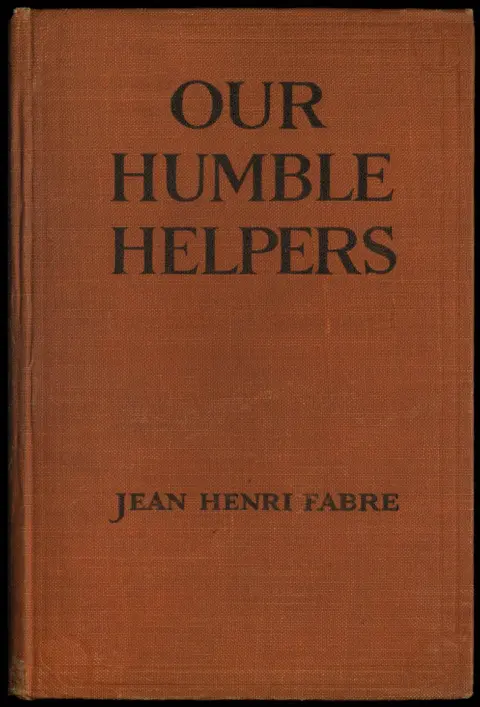
Jean-Henri Fabre
THE CLASSIC COLLECTION · 1917
"The Life of the Grasshopper" by Jean-Henri Fabre is a scientific publication written in the late 19th century. This work delves into the biology and behavior of grasshoppers and related insects, highlighting their fascinating life cycles, interactions, and the folklore surrounding them. Fabre emphasizes empirical observation and offers a detailed exploration of the natural world through the lens of entomology. The beginning of the work introduces the fable of the Cicada and the Ant, challenging common misconceptions about these insects. Fabre critiques the traditional narrative that characterizes the Cicada as a frivolous singer who suffers for lack of foresight, asserting instead that it is the Ant that engages in theft while the Cicada provides hospitality. This opening sets the stage for a deeper investigation into the lives of these insects, blending anecdotal observations with scientific inquiry as the author prepares to examine the Cicada's fascinating metamorphosis and its place in the ecosystem.
Introduction adapted from the source catalogue; source summaries may be automatically generated.
Free to read · English · 87,366 words · No account needed
MAKE TIME FOR A GOOD BOOK
On by default. Untick to stop anonymous reading totals. Each page counts after 10 seconds in view. How this works.
Anonymous counting is on unless you have switched it off.
[65] “My snug little home is a place of delight: If you want to live happy, live hidden from sight!”
[66] My friend, who is always accurate in his descriptions, is here speaking, if I be not mistaken, of the Swallow-tail.—Author’s Note.
[67] For the translation of these and the other verses in this chapter I am indebted to my friend Mr. Stephen McKenna.—Translator’s Note.
[68] For the author’s only essay on Ants, cf. The Mason-bees: chap.
vi.—Translator’s Note.
[69] Or Burying-beetle.—Translator’s Note.
[70] Cf. The Hunting Wasps: chaps. iv to vii.—Translator’s Note.
[71] “Then tripping to the woods the wanton hies And wishes to be seen before she flies.”
—Virgil, Pastorals: book i.; Dryden’s translation.
[72] “Safe under covert of the silent night And guided by the imperial galley’s light.”
—Virgil, Æneid: book ii.; Dryden’s translation.
[73] The enclosed piece of waste land, adjoining his house at Sérignan, in which the author used to study his insects in their natural state. Cf. The Life of the Fly: chap. i.—Translator’s Note.
[74] Alphonse Tousserel (1803–1885), author of a number of interesting and valuable works on ornithology.—Translator’s Note.
[75] Also known as the Stone-chat, Fallow-chat, Whin-chat, Fallow-finch and White-tail, which last corresponds with the Cul-blanc of the Provençal dialect. The French name for this Saxicola is the Motteux, or Clod-hopper.—Translator’s Note.
[76] Wormlike Millepedes.—Translator’s Note.
[77] General Eugène Daumas (1803–1871), the author of several works on Algeria.—Translator’s Note.
[78] More correctly the Locust, not to be confused with the true Grasshopper, who carries a sabre.—Author’s Note.
[79] The Blessed Virgin Mary.—Author’s Note.
[80] Omar, the second caliph and the first to assume the title of Commander of the Faithful, reigned from 634 to his death in 644. The Alexandrian library was burnt in 640.—Translator’s Note.
[81] Cf. The Mason-bees: passim.—Translator’s Note.
[82] 2.34 by .312 inches.—Translator’s Note.
[83] The big Grey Locust is sometimes subject to the same
aberration.—Author’s Note.
[84] .312 to .351 inch.—Translator’s Note.
[85] Kirby and other English naturalists refer to Aphrophora spumaria as the Frothy Froghopper; but this is rather because the insect’s outline and hopping-powers suggest those of a Frog.—Translator’s Note.
[86] The larva of the Lily-beetle (Crioceris merdigera), the essay on which insect has not yet been translated into English.—Translator’s Note.
Your reading position is saved on this browser. Take it to another device with a library code. Reading pages adapt to text, rather than matching a printed edition.
Jean-Henri Fabre
Jean-Henri Fabre
Jean-Henri Fabre
Jean-Henri Fabre
BEHIND THE BOOK
This eBook is for the use of anyone anywhere in the United States and most other parts of the world at no cost and with almost no restrictions whatsoever. You may copy it, give it away or re-use it under the terms of the Project Gutenberg License included with this eBook or online at www.gutenberg.org. If you are not located in the United States, you will have to check the laws of the country where you are located before using this eBook. Read the source licence.
The original source file, including credits and licence, is retained by this library. Request an original-format copy at no charge. Please include the book title and Project Gutenberg identifier #66650.
KEEP YOUR CURIOSITY GOING

John Muir

Asa Gray
Asa Gray

Florence Nightingale
Elizabeth Robins Pennell
Denison Olmsted