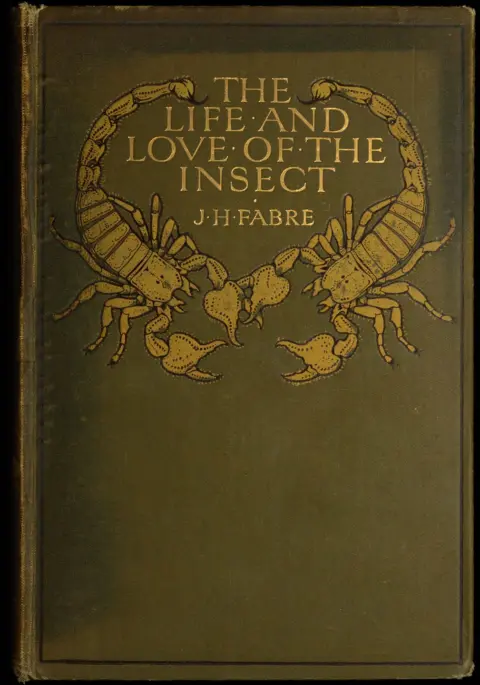
The Life and Love of the Insect
Jean-Henri Fabre
THE CLASSIC COLLECTION · 1912
"The Life of the Caterpillar" by Jean-Henri Fabre is a scientific publication written in the late 19th century. This work delves into the fascinating life cycles and behaviors of various caterpillars, particularly focusing on the Pine Processionary caterpillar. Fabre's meticulous observations and narrative style aim to bring to light the extraordinary yet often overlooked lives of these insects, exploring their habits, social behaviors, and interactions with their environment. At the start of the book, Fabre introduces the Pine Processionary caterpillar, sharing insights on its reproduction and early development stages. He sets the scene for observation by highlighting his location and the significance of studying these creatures in their natural habitat rather than in isolation. Fabre describes the process of laying eggs, the structure of the egg clusters, and even the caterpillar's subsequent hatching and early behaviors, detailing how they spin shelters and find food. The opening chapters establish an intimate connection with these insects, showcasing Fabre's passion for entomology and his intent to unravel the mysteries of their existence through dedicated observation and thoughtful reflection.
Introduction adapted from the source catalogue; source summaries may be automatically generated.
Free to read · English · 71,582 words · No account needed
MAKE TIME FOR A GOOD BOOK
On by default. Untick to stop anonymous reading totals. Each page counts after 10 seconds in view. How this works.
Anonymous counting is on unless you have switched it off.
[19] The highest mountain in the neighbourhood of Sérignan. Cf. The Hunting Wasps, by J. Henri Fabre, translated by Alexander Teixeira de Mattos: chap. xi.—Translator’s Note.
[20] Geotrupes stercorarius, a large Dung-beetle. Cf. The Life and Love of the Insect, by J. Henri Fabre, translated by Alexander Teixeira de Mattos: chap. ix.—Translator’s Note.
[21] .975 by .351 inch.—Translator’s Note.
[22] Cf. The Hunting Wasps: chaps. xiv to xvii.—Translator’s Note.
[23] A Bacon-beetle.—Translator’s Note.
[24] A species of Grasshopper.—Translator’s Note.
[25] Psyche unicolor, Hufn.; P. graminella, Schiffermüller.—Author’s
Note.
[26] As far as can be judged from the case only, Psyche febretta, Boyer de Fonscolombe.—Author’s Note.
[27] Fumea comitella and F. intermediella, Bruand.—Author’s Note.
[28] A fictitious character, a sort of dolt, created by some wit in a French regiment quartered in Brabant about the year 1792. Cadet Roussel’s entertaining exploits were perpetuated in a contemporary ballad.—Translator’s Note.
[29] Cf. Chapter XI. of the present volume.—Translator’s Note.
[30] For other instances of what Fabre calls “the insect’s mental incapacity in the presence of the accidental” I would refer the reader to one essay inter alia, entitled, Some Reflections upon Insect Psychology, which forms chap. vii. of The Mason-bees.—Translator’s Note.
[31] Thursday is the weekly holiday in French schools.—Translator’s
Note.
[32] The Abbé Lazaro Spallanzani (1729–99), an early experimenter in natural history and author of a number of important works on the circulation of the blood, on digestion, on generation and on microscopic animals. Cf. The Hunting Wasps: chap. xix.—Translator’s Note.
[33] Cf. The Mason-Bees, passim.—Translator’s Note.
[34] Rabasso is the Provençal for truffle. Hence the word rabassier to denote a truffle-hunter.—Author’s Note.
[35] For some account of Fabre’s drawings of the fungi of his district, cf. The Life of the Fly, by J. Henri Fabre, translated by Alexander Teixeira de Mattos: chap. xvii.—Translator’s Note.
[36] One of the Dung-beetles. Cf. The Life and Love of the Insect: chap. v.—Translator’s Note.
[37] Cf. The Life of the Fly: chap. xviii.—Translator’s Note.
[38] Cf. The Life and Love of the Insect: chap. ix.—Translator’s Note.
[39] A Dung-beetle. Cf. The Life and Love of the Insect: chap.
x.—Translator’s Note.
[40] 7.8 inches.—Translator’s Note.
[41] Since writing the above lines, I have found him eating one of the true Tuberaceæ, Tuber Requienii, Tul., the size of a cherry.—Author’s Note.
[42] Carrion-beetles proper.—Translator’s Note.
[43] Bacon-beetles—Translator’s Note.
[44] Burying-beetles proper.—Translator’s Note.
[45] A species of small carnivorous Beetles.—Translator’s Note.
[46] A species of Weevils found on thistle-heads.—Translator’s Note.
[47] .078 inch.—Translator’s Note.
Your reading position is saved on this browser. Take it to another device with a library code. Reading pages adapt to text, rather than matching a printed edition.
Jean-Henri Fabre
Jean-Henri Fabre
Jean-Henri Fabre
Jean-Henri Fabre
BEHIND THE BOOK
This eBook is for the use of anyone anywhere in the United States and most other parts of the world at no cost and with almost no restrictions whatsoever. You may copy it, give it away or re-use it under the terms of the Project Gutenberg License included with this eBook or online at www.gutenberg.org. If you are not located in the United States, you will have to check the laws of the country where you are located before using this eBook. Read the source licence.
The original source file, including credits and licence, is retained by this library. Request an original-format copy at no charge. Please include the book title and Project Gutenberg identifier #66762.
KEEP YOUR CURIOSITY GOING

John Muir

Asa Gray
Asa Gray

Florence Nightingale
Elizabeth Robins Pennell
Denison Olmsted