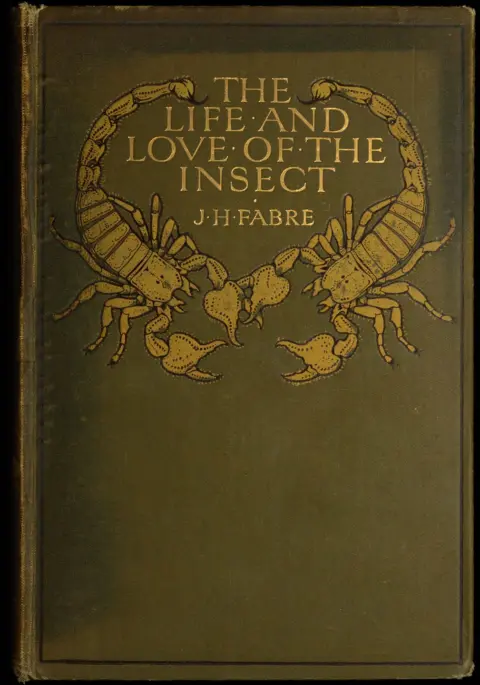
The Life and Love of the Insect
Jean-Henri Fabre
THE CLASSIC COLLECTION · 1912
"The Life of the Caterpillar" by Jean-Henri Fabre is a scientific publication written in the late 19th century. This work delves into the fascinating life cycles and behaviors of various caterpillars, particularly focusing on the Pine Processionary caterpillar. Fabre's meticulous observations and narrative style aim to bring to light the extraordinary yet often overlooked lives of these insects, exploring their habits, social behaviors, and interactions with their environment. At the start of the book, Fabre introduces the Pine Processionary caterpillar, sharing insights on its reproduction and early development stages. He sets the scene for observation by highlighting his location and the significance of studying these creatures in their natural habitat rather than in isolation. Fabre describes the process of laying eggs, the structure of the egg clusters, and even the caterpillar's subsequent hatching and early behaviors, detailing how they spin shelters and find food. The opening chapters establish an intimate connection with these insects, showcasing Fabre's passion for entomology and his intent to unravel the mysteries of their existence through dedicated observation and thoughtful reflection.
Introduction adapted from the source catalogue; source summaries may be automatically generated.
Free to read · English · 71,582 words · No account needed
MAKE TIME FOR A GOOD BOOK
On by default. Untick to stop anonymous reading totals. Each page counts after 10 seconds in view. How this works.
Anonymous counting is on unless you have switched it off.
I am fortunate at this moment in having a highly-cultured visitor, versed in the profundities of philosophic thought. I make way for him before the apparatus wherein the Microgaster is at work. For an hour and more, standing lens in hand, he, in his turn, looks and sees what I have just seen; he watches the layers who go from one egg to the other, make their choice, draw their slender lancet and prick what the stream of passers-by, one after the other, have already pricked. Thoughtful and a little uneasy, he puts down his lens at last. Never had he been vouchsafed so clear a glimpse as here, in my finger-wide tube, of the masterly brigandage that runs through all life down to that of the very smallest.
[1] René Antoine Ferchault de Réaumur (1683–1757), inventor of the Réaumur thermometer and author of Mémoires pour servir à l’histoire naturelle des insectes.—Translator’s Note.
[2] For the Cicada or Cigale, an insect remotely akin to the Grasshopper and found more particularly in the south of France, cf. Social Life in the Insect World, by J. H. Fabre, translated by Bernard Miall: chaps. i to iv.—Translator’s Note.
[3] The harmas was the enclosed piece of waste ground in which the author used to study his insects in their natural state.—Translator’s Note.
[4] The eponymous hero of Voltaire’s story of “the little great man,” published in 1752 in imitation of Gulliver’s Travels.—Translator’s Note.
[5] .039 inch.—Translator’s Note.
[6] About three-quarters of an inch.—Translator’s Note.
[7] .117 to .156 inch.—Translator’s Note.
[8] In the course of an essay on aberration of instinct in a certain Mason-wasp which is not yet translated into English.—Translator’s Note.
[9] A predatory insect, akin to the Locusts and Crickets, which, when at rest, adopts an attitude resembling that of prayer. Cf. Social Life in the Insect World: chaps. v to vii.—Translator’s Note.
[10] The order of insects embracing the Bees, Wasps, Ants, Saw-flies, Ichneumon-flies, etc.—Translator’s Note.
[11] Cf. The Mason-bees, by J. Henri Fabre, translated by Alexander Teixeira de Mattos, passim.—Translator’s Note.
[12] White Ants.—Translator’s Note.
[13] Book IV., chap. viii.—Translator’s Note.
[14] Jean Buridan (circa 1300–circa 1360), a famous scholastic doctor, who was several times rector of the university of Paris and subsequently founded the university of Vienna. He forms the subject of many legends, including that of the argument known by his name, of which no trace is to be found in any of his works.—Translator’s Note.
[15] 3½ inches.—Translator’s Note.
[16] 3½ inches.—Translator’s Note.
[17] 4 feet 5 inches.—Translator’s Note.
[18] A large carnivorous Beetle.—Translator’s Note.
Your reading position is saved on this browser. Take it to another device with a library code. Reading pages adapt to text, rather than matching a printed edition.
Jean-Henri Fabre
Jean-Henri Fabre
Jean-Henri Fabre
Jean-Henri Fabre
BEHIND THE BOOK
This eBook is for the use of anyone anywhere in the United States and most other parts of the world at no cost and with almost no restrictions whatsoever. You may copy it, give it away or re-use it under the terms of the Project Gutenberg License included with this eBook or online at www.gutenberg.org. If you are not located in the United States, you will have to check the laws of the country where you are located before using this eBook. Read the source licence.
The original source file, including credits and licence, is retained by this library. Request an original-format copy at no charge. Please include the book title and Project Gutenberg identifier #66762.
KEEP YOUR CURIOSITY GOING

John Muir

Asa Gray
Asa Gray

Florence Nightingale
Elizabeth Robins Pennell
Denison Olmsted