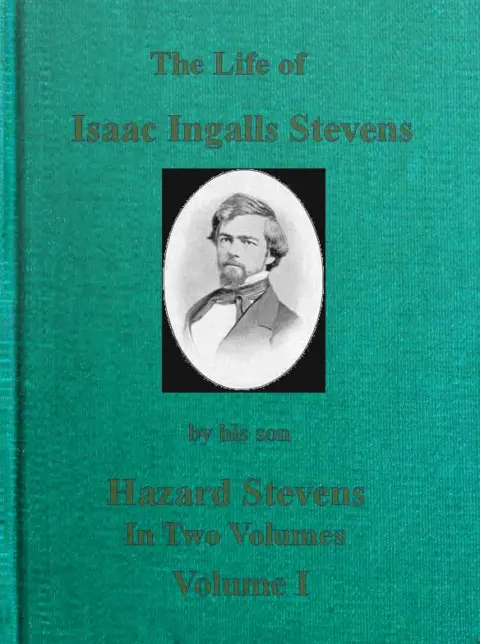
The Life of Isaac Ingalls Stevens, Volume 1 (of 2)
Hazard Stevens
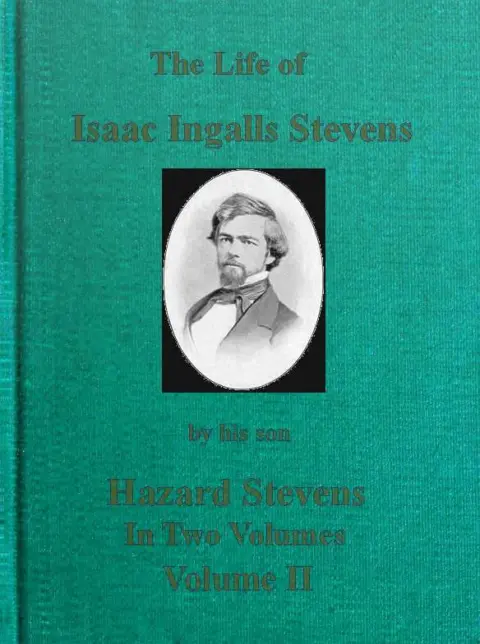
THE CLASSIC COLLECTION · 1900
"The Life of Isaac Ingalls Stevens, Volume 2 (of 2)" by Hazard Stevens is a historical account written in the late 19th century. This biography explores the life and political career of Isaac Ingalls Stevens, focusing particularly on his role as a governor and his negotiations with Native American tribes in the Pacific Northwest. The work delves into Stevens' efforts to establish treaties and maintain peace amid rising tensions between white settlers and Indigenous communities. The opening of the book details the Chehalis Council, where Governor Stevens convenes a meeting with several Indian tribes to negotiate treaties. The narrative paints a vivid picture of the council's atmosphere, showcasing the interactions between Stevens, his team, and the Native American leaders. Key events include the colorful arrival of tribes, the adaptations made by both parties during the negotiations, and the challenges faced due to misunderstandings and resistance from some tribal leaders. Through these initial interactions, the text sets the stage for the complex dynamics at play in Stevens' quest for cooperation and peace in a time of significant cultural change and conflict.
Introduction adapted from the source catalogue; source summaries may be automatically generated.
Free to read · English · 170,639 words · No account needed
MAKE TIME FOR A GOOD BOOK
On by default. Untick to stop anonymous reading totals. Each page counts after 10 seconds in view. How this works.
Anonymous counting is on unless you have switched it off.
In 1836 Rev. H.H. Spalding with his wife was sent out by the Presbyterians, and settled as a missionary on the Lapwai, a branch on the southern side of the Kooskooskia, twelve miles above its confluence with the Snake. Here he was preceded by William Craig, a Virginian, one of the best type of mountain men, who had married a Nez Perce maiden and made his home among her people. Aided by Craig's knowledge of the Nez Perce tongue and character, and of the Indians themselves, Mr. Spalding taught the whole tribe a simple Christian faith, made a dictionary of their language, and translated and had printed in the native tongue a hymn-book, catechism, and New Testament, taught a number of the young men to read and write their own language, built a saw and grist mill, and labored to induce them, not without success, to till the soil. Yet, after all this achievement, he was in the end led to abandon his mission. In an unhappy hour he opened a store and went to trading with the Indians. In their experience a trader was the personification of greed and falsehood. To them the union of the trader, all selfishness and fraud, and the preacher of morality and truth was monstrous, nay, impossible. Mr. Spalding, too, was hard and exacting in his dealings, and offended in that way. With all his zeal and energy, he evidently lacked knowledge of Indian nature, perhaps of human nature. What wonder that some of the Nez Perces, seeing that the trading-post was a fact, concluded that his preaching was a fraud, and warned him out of their country! The massacre of the devoted missionary, Dr. Marcus Whitman, and his family, by the Cuyuses, in 1847, had just occurred, and Mr. Spalding, fearing a like fate if he remained after the warning, abandoned the mission where he had done so much. The majority of the Nez Perces, however, desired him to remain; and when he decided upon going, they formed a strong party of warriors, and escorted him with his family and effects unharmed through the hostile Indians to the frontier settlement. They magnanimously refused the large reward offered them, saying, "We will not sell Mr. Spalding; he left our country of his own free will, and we escorted him as his friends." In the war which ensued they remained the firm friends of the whites, and the officers of the Oregon volunteers engaged in it presented them with a fine, large American flag, in which they took great pride. It was their boast that "We are the friends of the white man. The white man is our brother. His blood has never stained our hands." Craig remained among them in perfect safety, and was treated with undiminished kindness. Although abandoned by Mr. Spalding, they by no means discarded the good he had taught them. They maintained, unaided, their simple religious worship, and held services regularly every Sabbath, with preaching, singing of hymns, and reading of the Bible, all in their own language, with the books translated and printed for them by the devoted missionary. They prided themselves upon their superior intelligence, upon having young men who could read and write, and upon their ancient and fast friendship with the whites. This friendship indeed was not merely a matter of sentiment. They were shrewd enough to turn it to good account. Large emigrations crossed the plains to Oregon during the period from 1843 to 1855; and the Nez Perces used to go down to the emigrant road on the Grande Ronde or Umatilla, with bands of fat, sleek, handsome ponies, and exchange them with the emigrants for their worn-out horses, oxen, and sometimes a cow, clothing, groceries, ammunition, etc. The Pikes, as the Missourians who comprised the majority of the emigrants were called, "allowed that the Nez Perces could beat a Yankee on a trade." By these means they were beginning to obtain cattle as well as horses, were learning to wear blankets and shirts instead of skins, and individuals were even beginning to set out fruit trees, and plant corn and potatoes, and in a word the Nez Perces were making rapid strides toward civilization. There is no more interesting and instructive example of the amelioration of a savage tribe by the introduction of domestic animals, and its steady growth from abject barbarism, than that afforded by the Nez Perces. But little more than a century ago they were a tribe of naked savages, engaged in a perpetual struggle against starvation. Their country afforded but little game, and they subsisted almost exclusively on salmon, berries, and roots. The introduction of the horse enabled them to make long journeys to the buffalo plains east of the Rocky Mountains, where they could lay in great abundance of meat and furs; furnished them with a valuable animal for trading with other less favored tribes; soon raised them to comparative affluence, and developed in their hunting and trading expeditions a manly, enterprising, shrewd, and intelligent character. They had improved and profited still more from their intercourse with the whites, until there seemed every prospect that, with the introduction of cattle, they might lay aside their nomadic habits, and become a pastoral and then an agricultural people.
Your reading position is saved on this browser. Take it to another device with a library code. Reading pages adapt to text, rather than matching a printed edition.
BEHIND THE BOOK
This eBook is for the use of anyone anywhere in the United States and most other parts of the world at no cost and with almost no restrictions whatsoever. You may copy it, give it away or re-use it under the terms of the Project Gutenberg License included with this eBook or online at www.gutenberg.org. If you are not located in the United States, you will have to check the laws of the country where you are located before using this eBook. Read the source licence.
The original source file, including credits and licence, is retained by this library. Request an original-format copy at no charge. Please include the book title and Project Gutenberg identifier #43590.
KEEP YOUR CURIOSITY GOING
Cécile Tormay

Moritz Busch
John L. Ransom
Frances Wright
Cécile Tormay

Mabel Potter Daggett