THE CLASSIC COLLECTION✦An outlaw’s diary: the CommuneCLASSIC FREE BOOKS
An outlaw’s diary: the Commune
Cécile Tormay
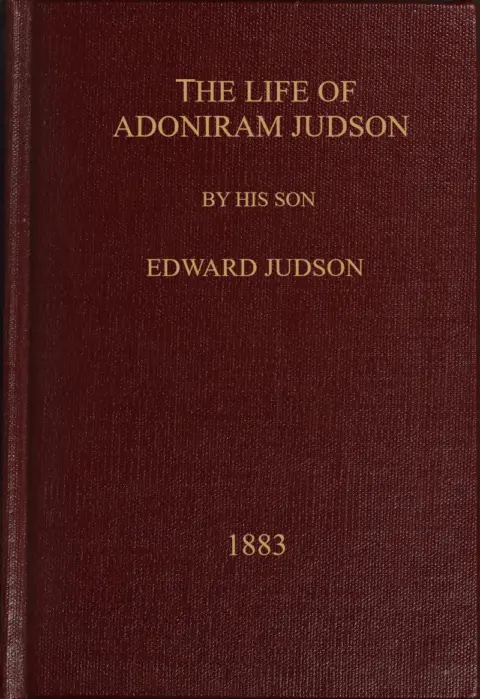
THE CLASSIC COLLECTION · 1883
"The Life of Adoniram Judson" by Edward Judson is a historical account written in the late 19th century. This biography chronicles the life and achievements of Adoniram Judson, a pioneering American missionary known for his extensive work in Burma (now Myanmar). The text explores Judson's early years, education, conversion to Christianity, and eventual dedication to missionary work, providing insight into his character and the significant impact he had on American foreign missionary endeavors. The opening of the biography presents a transcriber's note explaining the formatting of the text, followed by Edward Judson's dedication to the children of missionaries. In the initial chapters, the focus is on Adoniram Judson's early years, highlighting his precociousness, ambition, and formative familial relationships. The narrative recounts his academic achievements, struggles with skepticism, and eventual commitment to missionary work, influenced by a pivotal sermon he encountered during his studies. It sets the stage for Judson's eventual consecration to missionary life, foreshadowing his journey to the East and the trials he would face while spreading Christianity in Burma.
Introduction adapted from the source catalogue; source summaries may be automatically generated.
Free to read · English · 222,953 words · No account needed
MAKE TIME FOR A GOOD BOOK
On by default. Untick to stop anonymous reading totals. Each page counts after 10 seconds in view. How this works.
Anonymous counting is on unless you have switched it off.
“I ought to have stated before that the keeper, to whose share Mr. Judson’s old pillow fell on the day they were so unceremoniously thrust into the inner prison, had afterward exchanged it for a better one, wondering, no doubt, at the odd taste of the white man. When he was again robbed of his clothes and bedding, on the day he was driven away to Oung-pen-la, one of the ruffians deliberately untied the mat which was used as a cover to the precious pillow, and threw the apparently worthless roll of hard cotton away. Some hours after, Moung Ing, stumbling upon this one relic of the vanished prisoners, carried it to the house as a token; and, several months from that time, the manuscript which now makes a part of the Burmese Bible was found within, uninjured.
“They remained at Oung-pen-la six months, when Mr. Judson was, for the first time, released from his irons, to be employed as translator and interpreter to the Burmans. From the first, he had been particularly careful not to take any part in political affairs; for, however the war might end, he did not wish the Burmans to receive an impression that he was in the interests of the English. He felt that it would be wrong to endanger his influence as a religious teacher by taking any step which would be likely to render him obnoxious even to a conquered people. But now he had no choice. His own wishes in the matter were not consulted, any more than they had been when he was first thrown into prison. He was probably selected for the office because there was no one who could be better trusted, although it was evident that not the slightest confidence was reposed in him. He was carried to Ava under guard, kept in prison two days, and then, without being permitted to visit his own house but a few moments, was sent to Maloun. Here he remained about six weeks, when, in consequence of the advance of the English from Prome, he was hurriedly sent back to Ava. It was late in the night when he arrived, and he was taken through the streets directly past his own door. A feeble light glimmered within, assuring him that it was not altogether deserted; but yet what might not have occurred in those six weeks! He entreated permission to enter but for five minutes; he threatened, he bribed, he appealed to their humanity, for he knew that even they, hard as they seemed, must have humanity somewhere; but all without success. His conductors, with some show of feeling, assured him that they had orders to take him directly to the court-house, and that they dared not disobey. He crouched down in an outbuilding until morning, when, after a slight examination, he was placed under guard in an out-of-the-way shed, which served as a temporary prison. At night of the same day, Moung Ing found him in this obscure place, where he had been all day without food. While conversing with the faithful Burman, Mr. Judson once or twice fancied there was something in his words or manner, or perhaps both, a little puzzling; but the impression was only momentary, and the very sight of this messenger from his wife relieved him of a burden of apprehension. He immediately dispatched Moung Ing to the friendly governor, for aid in his new difficulties, instructing him carefully as to his words and behavior, and, in the joy of his heart, bade him tell the tsayah-ga-dau to keep up courage one day more; it was almost certain he should be with her on the next. As soon as the messenger was gone, Mr. Judson’s thoughts immediately recurred to the singularity of his behavior, scarcely observable at the time, but now assuming much importance. His wife was doubtless well, though Moung Ing had certainly not been very explicit when inquired of; she must be well, for had she not sent several messages, and herself suggested the application to the governor? The child, too, was well; he had said that unhesitatingly. Why had he hesitated in the other case? Could it be, could it really be, that anything serious had befallen her, and they had concealed it from him? But no; those messages! He remembered, however (it all came to him too clearly now), how ostentatiously the good-natured Burman had paraded one of those messages whenever he asked a question; and yet, think as he would, they all resolved themselves into two—she longed to see him, and she recommended an application to the governor. The messenger had certainly behaved strangely, and he had been strangely blinded. These two simple phrases had been repeated so often, and in such variety of style, that they had been made to appear a dozen, and to contain a world of meaning; and for the time he was fully satisfied. ‘She must be living,’ he repeated to himself; ‘there is ample proof of that.’ ‘She must have been living,’ answered a withering doubt within, ‘when she gave the directions to Moung Ing.’ After that one thought, he had no disposition to sleep. The tedious night at length dragged itself away; and, though the governor sent for him as early as could reasonably be expected in the morning, a strange, vague apprehension seemed to concentrate whole ages in those few early hours. The kind old man had become his security with the Government, and set him free. With a step more fleet than for the last two years he had practiced, and in spite of the maimed ankles, which sometimes almost refused their office, he hurried along the street to his beloved home. The door stood invitingly open, and, without having been seen by any one, he entered. The first object which met his eye was a fat, half-naked Burman woman, squatting in the ashes beside a pan of coals, and holding on her knees a wan baby, so begrimed with dirt that it did not occur to the father it could be his own. He gave but one hasty look, and hurried to the next room. Across the foot of the bed, as though she had fallen there, lay a human object, that, at the first glance, was scarcely more recognizable than his child. The face was of a ghastly paleness, the features sharp, and the whole form shrunken almost to the last degree of emaciation. The glossy black curls had all been shorn from the finely-shaped head, which was now covered by a close-fitting cotton cap, of the coarsest and—unlike anything usually coming in contact with that head—not the cleanest kind. The whole room presented an appearance of the very extreme of wretchedness, more harrowing to the feelings than can be told. There lay the devoted wife, who had followed him so unweariedly from prison to prison, ever alleviating his distresses, without even common hireling attendance. He knew, by the very arrangement of the room, and by the expression of sheer animality on the face of the woman who held his child, that the Bengalee cook had been her only nurse. The wearied sleeper was awakened by a breath that came too near her cheek. Perhaps a falling tear might have been added; for, steady as were those eyes in difficulties, dauntless in dangers, and stern when conscience frowned, they were well used to tender tears.
Your reading position is saved on this browser. Take it to another device with a library code. Reading pages adapt to text, rather than matching a printed edition.
BEHIND THE BOOK
This eBook is for the use of anyone anywhere in the United States and most other parts of the world at no cost and with almost no restrictions whatsoever. You may copy it, give it away or re-use it under the terms of the Project Gutenberg License included with this eBook or online at www.gutenberg.org. If you are not located in the United States, you will have to check the laws of the country where you are located before using this eBook. Read the source licence.
The original source file, including credits and licence, is retained by this library. Request an original-format copy at no charge. Please include the book title and Project Gutenberg identifier #70894.
KEEP YOUR CURIOSITY GOING
Cécile Tormay

Moritz Busch
John L. Ransom
Frances Wright
Cécile Tormay

Mabel Potter Daggett