THE CLASSIC COLLECTION✦An outlaw’s diary: the CommuneCLASSIC FREE BOOKS
An outlaw’s diary: the Commune
Cécile Tormay
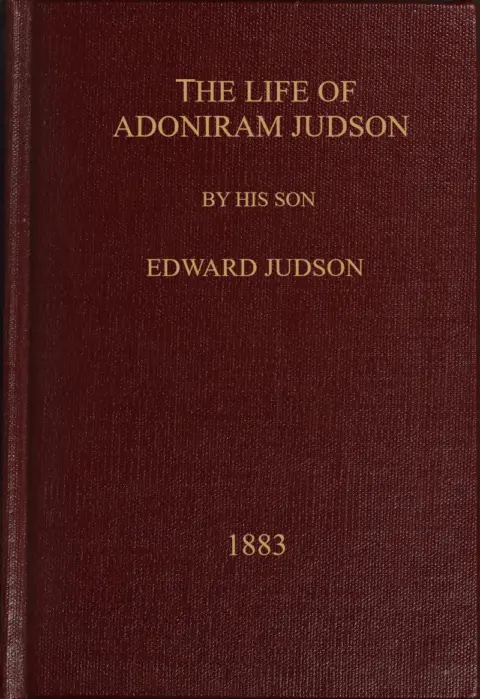
THE CLASSIC COLLECTION · 1883
"The Life of Adoniram Judson" by Edward Judson is a historical account written in the late 19th century. This biography chronicles the life and achievements of Adoniram Judson, a pioneering American missionary known for his extensive work in Burma (now Myanmar). The text explores Judson's early years, education, conversion to Christianity, and eventual dedication to missionary work, providing insight into his character and the significant impact he had on American foreign missionary endeavors. The opening of the biography presents a transcriber's note explaining the formatting of the text, followed by Edward Judson's dedication to the children of missionaries. In the initial chapters, the focus is on Adoniram Judson's early years, highlighting his precociousness, ambition, and formative familial relationships. The narrative recounts his academic achievements, struggles with skepticism, and eventual commitment to missionary work, influenced by a pivotal sermon he encountered during his studies. It sets the stage for Judson's eventual consecration to missionary life, foreshadowing his journey to the East and the trials he would face while spreading Christianity in Burma.
Introduction adapted from the source catalogue; source summaries may be automatically generated.
Free to read · English · 222,953 words · No account needed
MAKE TIME FOR A GOOD BOOK
On by default. Untick to stop anonymous reading totals. Each page counts after 10 seconds in view. How this works.
Anonymous counting is on unless you have switched it off.
“‘That glorious God, so kind,
Has sent His Son to save
Our ruined race from sin and death,
And raise them from the grave.
“‘And to that gracious God
My darling I commend;
Be Thou the helpless orphan’s stay,
Her Father and her Friend.
“‘Inspire her infant heart
The Saviour’s love to know,
And guide her through this dreary world,
This wilderness of woe.
“‘Thou sleep’st again, my lamb, Nor heed’st nor song nor prayer: Go, sleeping in thy mother’s arms, Safe in a mother’s care.
“‘And when, in future years, Thou know’st thy father’s tongue, These lines will show thee how he felt, How o’er his babe he sung.
‘To Maria Eliza Butterworth Judson, born at Ava, January 26, 1825.’”
The following versification of the Lord’s Prayer was composed a few weeks later. It illustrates the nature of the subjects which occupied the thoughts of the missionary during this long-protracted agony. It is comprised in fewer words than the original Greek, and contains only two more than the common translation:
“Our Father God, who art in heaven,
All hallowed be Thy name;
Thy kingdom come; Thy will be done
In earth and heaven the same.
“Give us, this day, our daily bread;
And, as we those forgive
Who sin against us, so may we
Forgiving grace receive.
“Into temptation lead us not;
From evil set us free;
The kingdom, power, and glory, Lord,
Ever belong to Thee.
“Prison, Ava, March, 1825.”
“The foreigners had spent about seven months in prison, when suddenly a change came. One day a band of men rushed into the prison-yard, and while some seized the white prisoners, and added two more pairs of fetters to the three they already wore, others began tearing down Mrs. Judson’s little bamboo room, snatching up pillows and mattresses, and whatever other articles came within their reach. At last the prisoners, after having half the clothing torn from their persons, were thrust into the common prison, and, with a bamboo between their legs, again stretched upon the bare floor. Here were more than a hundred miserable wretches, shut from every breath of air except such as could find its way between the crevices in the boards, groaning with various tortures, and rattling their chains, as they groped in the gray light, and writhed and twisted themselves, as much as was in their power, from side to side, in the vain endeavor to obtain some ease by change of position. It was the commencement of the hot season, and the heat was not lessened by the fevered breaths of that crowd of sufferers, nor the close air purified by the exhalations which arose from their bodies. Night came, but brought with it no rest. A whisper had passed around the prison, whether through malice or accident, that the foreigners would be led out to execution at three in the morning; and the effect on the little band was not so much in accordance with natural temperament as the transforming principle of faith. Bold men were cowards, and weak men grew strong. At first Mr. Judson felt a pang of regret that he was to go at last without saying farewell to his unsuspecting wife and child. But gradually the feeling changed, and he would not have had it different if he could. She had left him in comparative comfort that day; she would come the next, and find him beyond her care. It would be a terrible shock at first; but she would be spared much anxious suffering, and he could almost fancy that she would soon learn to rejoice that he was safe in glory. As for herself, the Burmans had always treated her with some respect; she seemed to have gained immunity from personal insult, while her intrepidity had won their admiration; and he did not believe that even the rudest of them would dare to do her harm. No; fruitful in resources as she had proved herself, she would get an appointment to carry some message of peace to the English, and so place herself under their protection. It would be a blessing to her and to his child if he was removed from them; and he thanked God that his time was so near at hand. He felt thankful, too, that the execution was to take place in the morning. He should pass his own door on the way. There he might breathe his silent farewell, while she was spared the parting agony. He thought of Burmah, too, even then. The English would most likely be conquerors; and then there would be nothing to hinder the propagation of Christianity. He even recollected—so calm and dispassionate were his thoughts—some passages in his translation capable of a better rendering; and then he speculated on the pillow he had lost that day, weighing the probabilities of its ever falling into his wife’s hands, so that the manuscript would be recovered. And then he imagined that she did not find it, and went off into a visionary scene of its being brought to light years afterward, which he smiled at when he gave a sketch of these emotions, and did not fully describe. At length the fatal hour drew nigh. They had no means of ascertaining it precisely, but they knew that it could not be very far distant. They waited with increased solemnity. Then they prayed together, Mr. Judson’s voice for all of them, and then he, and probably each of the others, prayed separately. And still they waited, in awful expectancy. The hour passed by—they felt it must be passed—and there was no unusual movement in the prison. Still they expected and waited, till finally there woke a glimmering of hope, a possibility that they had been deceived. And so, hoping, and doubting, and fearing, they lingered on, till the opening of the door assured them of what they had long suspected. It was morning. Then the jailer came; and, in answer to their questions, chucked them mockingly under the chin, and told then, Oh, no; he could not spare his beloved children yet, just after—kicking the bamboo as he spoke, till all the chains rattled, and the five rows of fetters dashed together, pinching sharply the flesh that they caught between them—just after he had taken so much trouble to procure them fitting ornaments.
Your reading position is saved on this browser. Take it to another device with a library code. Reading pages adapt to text, rather than matching a printed edition.
BEHIND THE BOOK
This eBook is for the use of anyone anywhere in the United States and most other parts of the world at no cost and with almost no restrictions whatsoever. You may copy it, give it away or re-use it under the terms of the Project Gutenberg License included with this eBook or online at www.gutenberg.org. If you are not located in the United States, you will have to check the laws of the country where you are located before using this eBook. Read the source licence.
The original source file, including credits and licence, is retained by this library. Request an original-format copy at no charge. Please include the book title and Project Gutenberg identifier #70894.
KEEP YOUR CURIOSITY GOING
Cécile Tormay

Moritz Busch
John L. Ransom
Frances Wright
Cécile Tormay

Mabel Potter Daggett