THE CLASSIC COLLECTION✦An outlaw’s diary: the CommuneCLASSIC FREE BOOKS
An outlaw’s diary: the Commune
Cécile Tormay
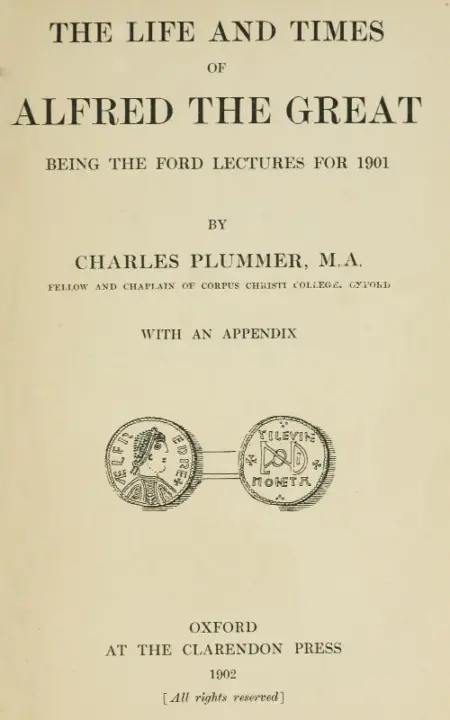
THE CLASSIC COLLECTION · 1902
"The Life and Times of Alfred the Great" by Charles Plummer is a historical account written in the early 20th century. This work presents a detailed examination of the life and legacy of King Alfred the Great, highlighting his contributions as a military leader, administrator, and promoter of education in a time of Viking invasions. Plummer’s account aims to clarify misconceptions about Alfred's character and actions while presenting a comprehensive view of his historical context. At the start of the text, the author introduces the lectures and expresses gratitude to historical figures who influenced his work. Plummer outlines his goal to address the existing confusions and oversimplifications surrounding King Alfred by critically surveying the sources available. He emphasizes the challenges historians face when interpreting the limited and often incomplete historical records about Alfred and remarks on the importance of a careful and nuanced understanding of this pivotal figure in English history. Through a methodical approach, Plummer sets the stage for a deep dive into Alfred's campaigns, governance, cultural contributions, and lasting impact on England.
Introduction adapted from the source catalogue; source summaries may be automatically generated.
Free to read · English · 77,156 words · No account needed
MAKE TIME FOR A GOOD BOOK
On by default. Untick to stop anonymous reading totals. Each page counts after 10 seconds in view. How this works.
Anonymous counting is on unless you have switched it off.
Carloman, king of Aquitaine and Burgundy, name correct in Asser, 17; called ‘Carl’ in Chron., 17; called ‘king of the Western Franks’ in Asser, 40, 41.
Ceolwulf, king of the Mercians, set up by the Danes, 66, 88, 100;
exactions of, 66;
stripped of part of Mercia, 102.
Cered, receives land from Burgred of Mercia, 13;
Werthryth, widow of, 13;
Cuthwulf, kinsman of, 13.
Charles the Great, Emperor, Eadburh offends, 17;
Liutgarde, wife of, 17 n.;
Pippin and Charles, sons of, 17;
his fondness for ancient poetry, 38 n.;
begins a Frankish grammar, 38 n.;
called ‘king of the Franks’ by Asser, 40;
crowns Louis the Pious, 80 n.;
divides his dominions, 85;
Frisians serve in navy of, 120 n.;
his administration of justice, 125;
his legislation, 126 n.;
his liberality to foreign Christians, 129 n.;
king of Persia sends a clock to, 131 n.;
relations of, with Irish princes, 131 n.;
Pippin, father of, 131;
founds a hospice and library at Jerusalem, 133;
Court school of, 135;
his intercourse with strangers, 160;
his fondness for the De Ciuitate Dei, 191-2;
comparison of, with Alfred, 200-1;
Einhard’s life of, see Einhard.
Charles, son of Charles the Great, unmarried, 17 n.
Charles the Bald, king of the Franks, 40;
receives Æthelwulf, 17, 76, 78;
Judith, daughter of, 78;
character of, 78;
investiture of, by Louis the Pious, 196 n.
Charles the Fat, king of the Franks, 40;
deposed by Arnulf, 17, 41 n.;
called ‘king of the Alamanni,’ 41;
grants West Friesland to Guthfrith, 120 n.
Charters, fewness of, belonging to Alfred’s reign, 13;
destruction of, by Danes, 13;
Frankish elements in, 18.
Chaucer, his Monk’s Tale founded on Boccaccio, 178 n.
Chelsea, Middlesex, conference at, 111.
Chester, Danes fortify themselves at, but evacuate, 117.
Chichester, Sussex, abortive Danish attack on, 117.
Chippenham, Wilts., Danes try to seize Alfred at, 59, 61, 102, 162;
captured by Alfred, 103.
Chronicle, Anglo-Saxon, relation of Alfred to, 11, 145-6;
value of, for reign of Alfred, 11-13;
reticence of, as to Alfred, 12, 13;
relation of, to Asser, 14, 48-51, 93 n.;
to Ethelwerd, 51 n., 60;
to Henry of Huntingdon, 60, 61;
to William of Malmesbury, 62;
to Anglo-Saxon translation of Orosius, 146, 157-8;
chronological error in, 50, 104 n., 108, 110, 112.
Cirencester, Glouc., Danes retire to, 104.
Clovis, king of the Franks, receives consular insignia from
Constantinople, 72, 73.
Colne, R., Herts, Danes blockaded on, 114-5.
Constantinople, Clovis receives consular insignia from, 72.
Copenhagen, bombardment of, by Nelson, 163.
Cornwall, episcopal supervision of, 18-20;
kings of, 19 (see Dumgarth);
St. Guerier and St. Neot buried in, 26;
not included in Saxonia, 38;
St. Neot settles in, 56.
Corvey, Westphalia, John the Old Saxon, a monk of, 137.
Croyland, Lincs, monastery of, 66, 67;
abbot of, see Ingulf;
monk of, see Tolius.
Cuthbert, St., part played by, in the legends of Alfred, 62.
Cuthred, joint king of the West Saxons, baptised by Birinus, 72.
Cuthwulf, kinsman of Cered, 13;
buys land of Cered’s widow, Werthryth, 13;
charter granted to, 13.
Cynwit, Devon, fort of, surveyed by Asser, 16;
besieged by the Danes, 44;
Danes defeated at, 104.
Your reading position is saved on this browser. Take it to another device with a library code. Reading pages adapt to text, rather than matching a printed edition.
BEHIND THE BOOK
This eBook is for the use of anyone anywhere in the United States and most other parts of the world at no cost and with almost no restrictions whatsoever. You may copy it, give it away or re-use it under the terms of the Project Gutenberg License included with this eBook or online at www.gutenberg.org. If you are not located in the United States, you will have to check the laws of the country where you are located before using this eBook. Read the source licence.
The original source file, including credits and licence, is retained by this library. Request an original-format copy at no charge. Please include the book title and Project Gutenberg identifier #56557.
KEEP YOUR CURIOSITY GOING
Cécile Tormay

Moritz Busch
John L. Ransom
Frances Wright
Cécile Tormay

Mabel Potter Daggett