THE CLASSIC COLLECTION✦An outlaw’s diary: the CommuneCLASSIC FREE BOOKS
An outlaw’s diary: the Commune
Cécile Tormay
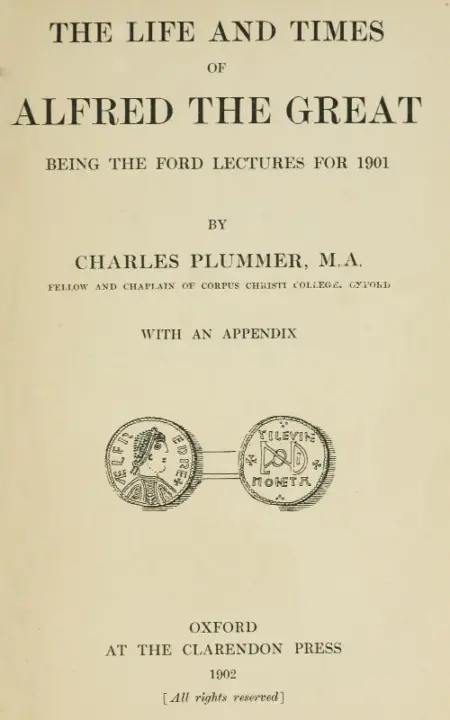
THE CLASSIC COLLECTION · 1902
"The Life and Times of Alfred the Great" by Charles Plummer is a historical account written in the early 20th century. This work presents a detailed examination of the life and legacy of King Alfred the Great, highlighting his contributions as a military leader, administrator, and promoter of education in a time of Viking invasions. Plummer’s account aims to clarify misconceptions about Alfred's character and actions while presenting a comprehensive view of his historical context. At the start of the text, the author introduces the lectures and expresses gratitude to historical figures who influenced his work. Plummer outlines his goal to address the existing confusions and oversimplifications surrounding King Alfred by critically surveying the sources available. He emphasizes the challenges historians face when interpreting the limited and often incomplete historical records about Alfred and remarks on the importance of a careful and nuanced understanding of this pivotal figure in English history. Through a methodical approach, Plummer sets the stage for a deep dive into Alfred's campaigns, governance, cultural contributions, and lasting impact on England.
Introduction adapted from the source catalogue; source summaries may be automatically generated.
Free to read · English · 77,156 words · No account needed
MAKE TIME FOR A GOOD BOOK
On by default. Untick to stop anonymous reading totals. Each page counts after 10 seconds in view. How this works.
Anonymous counting is on unless you have switched it off.
Augustine, St., bishop of Hippo, his Soliloquies, 194;
Alfred’s translation of, 10, 11, 128, 191-6;
relation of, to the Boethius translation, 194-5;
not identical with Alfred’s Handbook, 141, 192;
his De Ciuitate Dei, 157;
used by Alfred, 191;
a favourite book with Charles the Great, 191-2;
his De Videndo Deo, used by Alfred, 191.
Augustine, archbishop of Canterbury, complaints of, in regard to Welsh
baptisms, 42.
Bardney, Lincs, St. Oswald’s body removed from, 35.
Basing, Hants, battle of, 93, 95.
Bede, the Venerable, his Eccl. Hist., 8, 157; style of, influenced by Gregory’s Dialogues, 170 n.; his bitterness on the Easter Controversy, 173; Anglo-Saxon translation of, 8, 166-75; relation of, to the Orosius translation, 156-9; to the translation of the Dialogues, 169, 170.
Bel, see Elias.
Benfleet, Essex, Danes fortify themselves at, 113-4;
captured by the English, 115.
Beorhtric, king of the West Saxons, 39 n.;
Eadburh, wife of, 16, 17;
dies, 802, 17 n.
Beornred, king of the Mercians, annexes monastic property, 66.
Bergues, dép. Nord, France, St. Winnoc’s body translated to, 35.
Berhtwulf, king of the Mercians, 109.
Berkshire, ealdorman of, see Æthelwulf.
Bernard, Frankish monk, pilgrimage of, to Jerusalem, 132-4.
Bernard of Morlaix, his rhythm De Contemptu Mundi, 178 n.
Berry, Jehan, duc de, former owner of the Latin-Saxon psalter, 148.
Birinus, bishop of the West Saxons, baptises Cuthred of Wessex, 72.
Boccaccio, his treatise De Casibus illustrium uirorum, 178 n.
Boethius, his treatment by Theodoric, 178-9;
his Christianity superficial, 180;
his De Consolatione Philosophiae, 8, 177-80;
Alfred’s translation of, 8, 10, 135, 177, 180-5;
its relation to the Orosius translation, 159;
to the Soliloquies, 194-5;
wrongly assigned to Werferth, 185 n.;
mentioned by Ethelwerd, 185;
question as to Alfred’s authorship of the verse translation of the
Metra in, 185-91, 194 n.
Boniface, St., the apostle of Germany, 137.
Boulogne, dép. Pas-de-Calais, Danes embark at, 112.
Brecheiniog, South Welsh kingdom, nearly identical with Brecknockshire; kings of, see Helised, Teudyr.
Bridgenorth, Shropshire, Danes winter at, 118.
Bristol Channel, not a barrier between the Welsh and Cornishmen, 19;
ravaged by Danes, 103.
Britannia, ambiguous use of term by Asser, 36, 37.
Brixton Deverill, Wilts., Alfred musters his forces at, 102.
Brochmail, son of Mouric, joint king of Gwent, submits to Alfred, 42, 44.
Burgred, king of the Mercians, grants land to Cered, 13;
Æthelwulf reduces Wales under, 37, 85, 88;
brother-in-law of Alfred, 53, 88;
asks help of Æthelred and Alfred, 88;
expelled by Danes, 53, 100;
dies at Rome, 98 n., 100, cf. 199;
reason for his failure to help Wessex, 99;
imposes taxes to buy off the Danes, 100.
Burgs, construction of, by Alfred, 110, 111.
Burgundy, king of, see Carloman;
count of Upper, see Rudolf.
Buttington, Montgomery, Danes blockaded at, 116.
Cambridge, Danes winter at, 100.
Camden, William, his connexion with the Oxford interpolation in Asser,
24.
Canterbury, archbishops of, see Ælfheah, Æthelred, Augustine, Dunstan, Parker, Matthew, Plegmund.
Canute, king of England, called ‘king of Germania,’ 41; reconciled with the English at Oxford, 67; one of the creators of England’s greatness, 200 n.
Carl, see Carloman.
Your reading position is saved on this browser. Take it to another device with a library code. Reading pages adapt to text, rather than matching a printed edition.
BEHIND THE BOOK
This eBook is for the use of anyone anywhere in the United States and most other parts of the world at no cost and with almost no restrictions whatsoever. You may copy it, give it away or re-use it under the terms of the Project Gutenberg License included with this eBook or online at www.gutenberg.org. If you are not located in the United States, you will have to check the laws of the country where you are located before using this eBook. Read the source licence.
The original source file, including credits and licence, is retained by this library. Request an original-format copy at no charge. Please include the book title and Project Gutenberg identifier #56557.
KEEP YOUR CURIOSITY GOING
Cécile Tormay

Moritz Busch
John L. Ransom
Frances Wright
Cécile Tormay

Mabel Potter Daggett