THE CLASSIC COLLECTION✦An outlaw’s diary: the CommuneCLASSIC FREE BOOKS
An outlaw’s diary: the Commune
Cécile Tormay
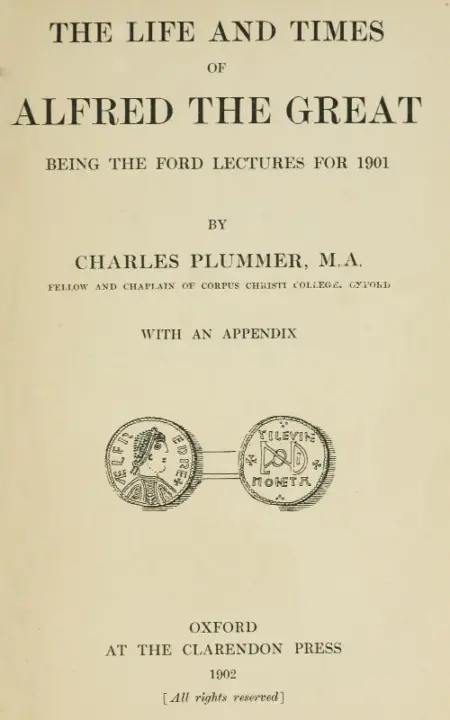
THE CLASSIC COLLECTION · 1902
"The Life and Times of Alfred the Great" by Charles Plummer is a historical account written in the early 20th century. This work presents a detailed examination of the life and legacy of King Alfred the Great, highlighting his contributions as a military leader, administrator, and promoter of education in a time of Viking invasions. Plummer’s account aims to clarify misconceptions about Alfred's character and actions while presenting a comprehensive view of his historical context. At the start of the text, the author introduces the lectures and expresses gratitude to historical figures who influenced his work. Plummer outlines his goal to address the existing confusions and oversimplifications surrounding King Alfred by critically surveying the sources available. He emphasizes the challenges historians face when interpreting the limited and often incomplete historical records about Alfred and remarks on the importance of a careful and nuanced understanding of this pivotal figure in English history. Through a methodical approach, Plummer sets the stage for a deep dive into Alfred's campaigns, governance, cultural contributions, and lasting impact on England.
Introduction adapted from the source catalogue; source summaries may be automatically generated.
Free to read · English · 77,156 words · No account needed
MAKE TIME FOR A GOOD BOOK
On by default. Untick to stop anonymous reading totals. Each page counts after 10 seconds in view. How this works.
Anonymous counting is on unless you have switched it off.
[794] I have shown above, p. 145, that there are certain words characteristic of the earlier recension of the Dialogues which the reviser systematically alters into others, semninga into færinga, tid into tima, ongitan to oncnawan, &c. In the Bede I have noticed 32 instances of semninga, not one of færinga; 90 of tid, none of tima; 10 of ongitan, 2 of oncnawan. I do not pretend that my observations are exhaustive. The following words occur, so far as I know, only in the Bede and in the Dialogues (the references are to the pages and lines of Hecht’s and Miller’s editions respectively):—ágendlíce = proprie, D 264, 26; B 30, 10 (in the sense of ‘arbitrarily’ it occurs C. P. p. 144); allíc = catholicus, D 237, 20; B 312, 31; ancerlíf, D 210, 26; B 364, 30; brícsian, D 343, 37; B 244, 22; camphád, D 298, 8; B 480, 11; drihtenlíc, D 309, 26; B 158, 10; eardunghús, D 185, 16; B 366, 16; efenceasterwaran, D 205, 1; B 62, 20; fordémedness, D 235, 14; B 34, 5; forsettan (in sense of ‘obstruct’) D 258, 28; B 212, 16; fremsumlíce, D 242, 10; B 184, 23; gefeolan, D 336, 23; B 450, 28; gefremedness, D 318, 15; B 32, 7; gewinfullíc, D 222, 9; B 56, 9; gýmeléasness, D 208, 4; B 242, 28; ungebrosnendlíc, D 233, 15; B 378, 4; ungeæhtendlic, D 282, 21; B 84, 12. This list too might be easily extended; and the whole subject of the relation of the two works is well worthy of further examination. No doubt the resemblance is partly due to the similarity of their subject matter. The likeness of the two originals is also very strong in parts; so much so indeed that I think that Bede must, consciously or unconsciously, have modelled his style in the Hist. Eccl. on the Dialogues of Gregory. Still the likeness between the two translations is, I think, greater than one would expect in the case of two perfectly independent translators, and points to their having been produced under similar influences.
[795] e.g. 114, 29; 180, 15; 216, 9; the references are to the E. E. T. S. edition by Dr. Miller.
[796] e.g. 38, 24; 50, 1; 226, 30; 274, 10.
[797] e.g. 36, 17; 122, 33; 190, 22. 30; 266, 32; 294, 23; 406, 21.
[798] e.g. 32, 7; 172, 28; 270, 33.
[799] Instead of the passive the impersonal active form is ordinarily used in Anglo-Saxon; not ‘the land is called Kent,’ but, ‘one calls the land Kent.’ In the Celtic languages the so-called passive really is, in origin, an impersonal active form, which explains the (at first sight) strange phenomenon that the ‘passive’ always takes an accusative after it, see Zimmer, Keltische Studien, No. 8.
Your reading position is saved on this browser. Take it to another device with a library code. Reading pages adapt to text, rather than matching a printed edition.
BEHIND THE BOOK
This eBook is for the use of anyone anywhere in the United States and most other parts of the world at no cost and with almost no restrictions whatsoever. You may copy it, give it away or re-use it under the terms of the Project Gutenberg License included with this eBook or online at www.gutenberg.org. If you are not located in the United States, you will have to check the laws of the country where you are located before using this eBook. Read the source licence.
The original source file, including credits and licence, is retained by this library. Request an original-format copy at no charge. Please include the book title and Project Gutenberg identifier #56557.
KEEP YOUR CURIOSITY GOING
Cécile Tormay

Moritz Busch
John L. Ransom
Frances Wright
Cécile Tormay

Mabel Potter Daggett