THE CLASSIC COLLECTION✦An outlaw’s diary: the CommuneCLASSIC FREE BOOKS
An outlaw’s diary: the Commune
Cécile Tormay
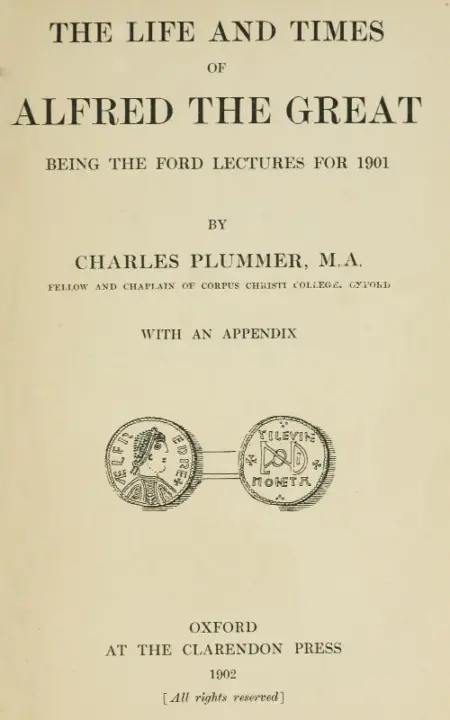
THE CLASSIC COLLECTION · 1902
"The Life and Times of Alfred the Great" by Charles Plummer is a historical account written in the early 20th century. This work presents a detailed examination of the life and legacy of King Alfred the Great, highlighting his contributions as a military leader, administrator, and promoter of education in a time of Viking invasions. Plummer’s account aims to clarify misconceptions about Alfred's character and actions while presenting a comprehensive view of his historical context. At the start of the text, the author introduces the lectures and expresses gratitude to historical figures who influenced his work. Plummer outlines his goal to address the existing confusions and oversimplifications surrounding King Alfred by critically surveying the sources available. He emphasizes the challenges historians face when interpreting the limited and often incomplete historical records about Alfred and remarks on the importance of a careful and nuanced understanding of this pivotal figure in English history. Through a methodical approach, Plummer sets the stage for a deep dive into Alfred's campaigns, governance, cultural contributions, and lasting impact on England.
Introduction adapted from the source catalogue; source summaries may be automatically generated.
Free to read · English · 77,156 words · No account needed
MAKE TIME FOR A GOOD BOOK
On by default. Untick to stop anonymous reading totals. Each page counts after 10 seconds in view. How this works.
Anonymous counting is on unless you have switched it off.
[760] 178, 9 ff. For Regulus, cf. also Boethius, xvi. § 2 (p. 37).
[761] 190, 17 ff.; 224, 24 ff.
[762] 242, 19. 20. 30 ff.
[763] 34, 34 ff.
[764] 224, 24 ff.
[765] 54, 16 ff. (Phalaris); cf. Boeth. xvi. § 2 (p. 37, Busiris).
[766] 296, 1 ff.; the ironical remark on the loyalty (hlafordhyldo) shown by Rufinus and Stilicho to their master’s children.
[767] 136, 27 ff.
[768] Another change from similar motives is 52, 35 ff.
[769] Below, § 110.
[770] 32, 13 ff.; 58, 7 ff.; see Schilling, p. 56.
[771] The two Scipios, 224, 24 ff.; Sextus Julius Caesar and the Praetor Cneius Pompeius, are confused with the two great rivals of later days, and the whole account of the treatment of the former pair by the Senate is extraordinarily funny, 234, 21 ff.
[772] The most remarkable instance of this is in the account of Alexander’s successors and the territories which fell to their lot, 142, 26 ff. (Oros. iii. 23, 7 ff.).
[773] e.g. 190, 29; 218, 10; 264, 4 (this last may be due to a wrong reading in the Latin text); 271, 17.
[774] 246, 16 ff.
[775] ibid. 32 ff.
[776] 250, 10 ff.
[777] Dr. Schilling has remarked (p. 59) that Alfred in the Orosius never mastered the fact that a Roman might have not merely two but three names. So when there are two consuls with three names each, he either makes three persons out of them with two names each, e.g. 176, 32; 182, 5 &c., or he omits the two last names altogether, e.g. 202, 18; 204, 23 &c. By the time he reached the Boethius he had overcome this difficulty. In two places he says that Marcus was called by another name Tullius, and by a third name Cicero, xviii. § 2, xli. § 3 (pp. 43, 143).
[778] p. 61.
[779] Above, p. 160.
[780] Paul und Braune’s Beiträge, iv. 127.
[781] Ed. 2, p. 196.
[782] Introduction (1890); Dr. Miller further enforced his view in a monograph on the Place Names in the English Bede, Quellen und Forschungen (1896). For a copy of this I was indebted to the writer.
[783] Above, § 98.
[784] Homilies, ed. Thorpe, ii. 116-118.
[785] ibid. 358.
[786] ibid. i. 2.
[787] Prof. Schipper, Gegenwärtiger Stand, &c., p. 6.
‘He nom þa Englisce boc,
þa makede Seint Beda.’
Laȝamon, i. 2.
[789] ‘liber quem composuit in lingua Saxonica de Gestis Anglorum … cuius copiam habui in Prioratu Canonicorum de Suthwyk,’ Anglia Sacra, i. 183. This is interesting as showing that Saxon studies were not quite extinct even in the fifteenth century. It is also interesting, because we can almost certainly point to the very ‘copia’ used by Rudborne. It is the Cotton MS. Otho B. XI. This is now terribly injured, owing to the great Cottonian fire of 1731. But Wanley (p. 219), who saw it when complete, describes it as ‘exemplum antiquum primitus Eccles. Beatae Mariae de Suwika’ (Southwick, Hants); cited, ed. Miller, I. xvi. Rudborne also cites Alfred’s will, p. 206, though this does not agree with our copies.
[790] In vol. iv of Grein-Wülker’s Bibliothek der angelsächsischen Prosa,
1897-1899.
[791] Gegenwärtiger Stand, &c., u. s. pp. 4, 5.
[792] Ed. Miller, p. xxiii; ed. Schipper, p. xxix.
[793] Above, § 88.
Your reading position is saved on this browser. Take it to another device with a library code. Reading pages adapt to text, rather than matching a printed edition.
BEHIND THE BOOK
This eBook is for the use of anyone anywhere in the United States and most other parts of the world at no cost and with almost no restrictions whatsoever. You may copy it, give it away or re-use it under the terms of the Project Gutenberg License included with this eBook or online at www.gutenberg.org. If you are not located in the United States, you will have to check the laws of the country where you are located before using this eBook. Read the source licence.
The original source file, including credits and licence, is retained by this library. Request an original-format copy at no charge. Please include the book title and Project Gutenberg identifier #56557.
KEEP YOUR CURIOSITY GOING
Cécile Tormay

Moritz Busch
John L. Ransom
Frances Wright
Cécile Tormay

Mabel Potter Daggett