THE CLASSIC COLLECTION✦An outlaw’s diary: the CommuneCLASSIC FREE BOOKS
An outlaw’s diary: the Commune
Cécile Tormay
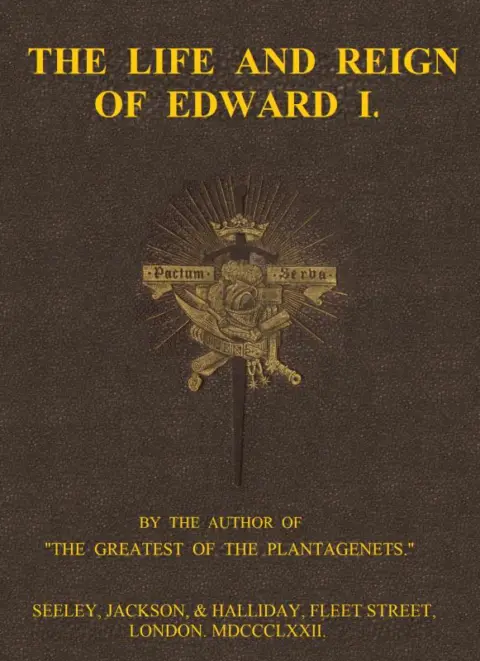
THE CLASSIC COLLECTION · 1872
"The Life and Reign of Edward I." by Robert Benton Seeley is a historical account written in the late 19th century. The work focuses on the life and governance of Edward I of England, tracing his personal and political development against the backdrop of significant events during his reign. The author aims to present a comprehensive picture of Edward's character, emphasizing his contributions to English law and society. The opening of the text provides insight into Edward's early life, beginning with his birth in 1239 and the joys surrounding it in England's capital. It highlights the historical context of his time, particularly the transition from Norman rule to a sense of English identity. The narrative illustrates the affectionate relationship Edward had with his father, Henry III, while also hinting at the challenges he would face as a ruler. The opening sets the stage for exploring Edward's maturation into a principled monarch who sought to improve the state of England through effective governance, ultimately laying the groundwork for future discussions on his reign's impact on legal and social frameworks.
Introduction adapted from the source catalogue; source summaries may be automatically generated.
Free to read · English · 110,512 words · No account needed
MAKE TIME FOR A GOOD BOOK
On by default. Untick to stop anonymous reading totals. Each page counts after 10 seconds in view. How this works.
Anonymous counting is on unless you have switched it off.
[157] Sharon Turner says, “On every supposition, it was still the destruction of a competitor by the person who was to be most benefited by the crime; and from this suspicious atrocity the memory of Bruce cannot be vindicated.”
[158] Palgrave’s Documents, p. cxxxix.
[159] Pearson’s History, vol. i., p. 351.
[160] “Bruce was so beaten by ill‐fortune, that he was left alone to take passage to the Isles with two mariners in a boat, who asked him ‘if he had any tidings of Robert Bruce?’”—Scala Chronica, App. p. 287.
[161] Tytler’s Hist., vol. i., p. 222.
[162] Matthew of Westminster.
[163] Palgrave’s Documents, p. clxxxix.
[164] Tytler, vol. i., p. 235.
[165] See Appendix.
[166] Matthew of Westminster, 1307.
[167] This was evidently the date of the erection of the tomb. The king had died in July, 1307, and had been buried in Westminster in October. The tomb was naturally completed in the following year.
[168] Sir Walter Scott’s History of Scotland, vol. i., p. 87. Sir Walter forgot here that, before six months had passed, Bruce sent messengers to the young prince to ask if his submission would be accepted.
[169] Wallace Documents, Maitland Club, Glasgow, 1841, p. 48.
[170] History of Scotland, vol. i., p. 68.
[171] Robert III. died of a broken heart; James I. was murdered; James II. accidentally killed; James III. murdered; James IV. died on Flodden‐field; James V. of a broken heart. Then followed Mary, who died on the scaffold, James’s troubled reign, Charles’s bloody death, and, finally, the expulsion of the family.
[172] Rossetti’s translation.
[173] Rapin’s History, vol. i., p. 385.
[174] Thus, in the most popular of our school histories, Mrs. Markham’s, the scholar is told of Edward’s “violent acts,” of his fatal thirst of conquest, of his “mad ferocity,” of his “injustice and violence,” of the “infinite misery” he inflicted on “many thousands” of people.
[175] “The Greatest of the Plantagenets.”
[176] The professor had suggested some apology for Wallace’s
violence and cruelty.
[177] “Proceedings of Oxford Historical Society, Trinity term, 1864.”
[178] Prof. Stubbs’ Select Charters, 1870, p. 35, 51.
[179] Yonge’s History of England, p. 113.
[180] Creasy’s History of England, p. 485.
[181] Historical Essays, by E. A. Freeman, D.C.L., late Fellow of Trinity College, Oxford, 1871.
[182] During the last thirty years a dozen Histories of England have been published in London, all of which servilely followed Hume, describing Edward as “unscrupulous,” “perfidious,” and “unprincipled.” But in the course of the last seven years, all the writers whom we have just quoted have re‐examined the subject, and they all unite in declaring the king to have been honest, just, truthful, and disinterested.
Your reading position is saved on this browser. Take it to another device with a library code. Reading pages adapt to text, rather than matching a printed edition.
BEHIND THE BOOK
This eBook is for the use of anyone anywhere in the United States and most other parts of the world at no cost and with almost no restrictions whatsoever. You may copy it, give it away or re-use it under the terms of the Project Gutenberg License included with this eBook or online at www.gutenberg.org. If you are not located in the United States, you will have to check the laws of the country where you are located before using this eBook. Read the source licence.
The original source file, including credits and licence, is retained by this library. Request an original-format copy at no charge. Please include the book title and Project Gutenberg identifier #50866.
KEEP YOUR CURIOSITY GOING
Cécile Tormay

Moritz Busch
John L. Ransom
Frances Wright
Cécile Tormay

Mabel Potter Daggett