THE CLASSIC COLLECTION✦An outlaw’s diary: the CommuneCLASSIC FREE BOOKS
An outlaw’s diary: the Commune
Cécile Tormay
THE CLASSIC COLLECTION · 1872
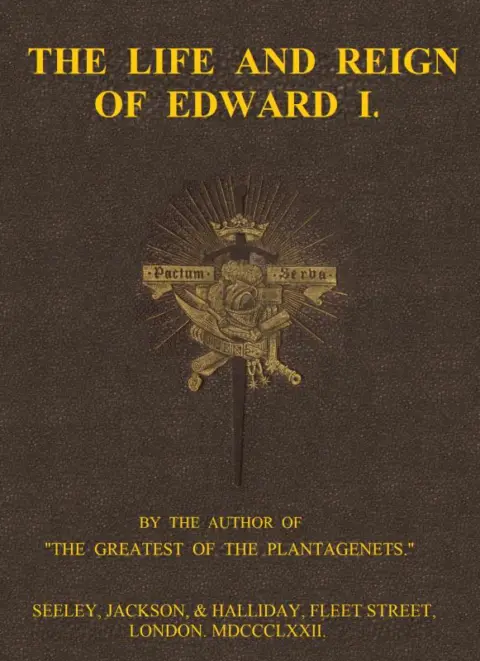
"The Life and Reign of Edward I." by Robert Benton Seeley is a historical account written in the late 19th century. The work focuses on the life and governance of Edward I of England, tracing his personal and political development against the backdrop of significant events during his reign. The author aims to present a comprehensive picture of Edward's character, emphasizing his contributions to English law and society. The opening of the text provides insight into Edward's early life, beginning with his birth in 1239 and the joys surrounding it in England's capital. It highlights the historical context of his time, particularly the transition from Norman rule to a sense of English identity. The narrative illustrates the affectionate relationship Edward had with his father, Henry III, while also hinting at the challenges he would face as a ruler. The opening sets the stage for exploring Edward's maturation into a principled monarch who sought to improve the state of England through effective governance, ultimately laying the groundwork for future discussions on his reign's impact on legal and social frameworks.
Introduction adapted from the source catalogue; source summaries may be automatically generated.
Free to read · English · 110,512 words · No account needed
MAKE TIME FOR A GOOD BOOK
On by default. Untick to stop anonymous reading totals. Each page counts after 10 seconds in view. How this works.
Anonymous counting is on unless you have switched it off.
We cannot measure or balance the king of whom we have been writing, with such characters as these. He is altogether of another class. Casting our eyes among men of honour,—men of conscience, men worthy of our respect, in our search for a superior or an equal, we have not yet succeeded in our quest. We relinquish the task, therefore, here, and hand it over to our readers.
Footnotes:
[139] Many of our popular histories of England, disregarding this distinction, fall into a variety of errors. Thus Oliver Goldsmith, in his larger history, says, that in 1306, the competitor, “being old and infirm, was obliged to give up the ambition of being the deliverer of his people to his son.” The fact being that the competitor had died eleven years before, and his son two years before the time of which Goldsmith was speaking. In his abridged history, which for many years was the lesson‐book in all our great schools, the statement was thus altered:—“Bruce, who had been one of the competitors for the crown, but was long kept a prisoner in London, escaping from his guards, resolved to strike for his country’s freedom.” The fact being, that neither of the Bruces had ever been “a prisoner in London,” and that the competitor, here spoken of, had died in 1295—eleven years before the period at which we have now arrived. Even Sir Walter Scott falls into a like inaccuracy, saying, “Bruce, the competitor, after Dunbar, 1296, hinted to Edward his hope of being preferred to the kingdom.” Whereas, “the competitor” had died a year or two previous.
[140] Tytler’s History of Scotland, vol i., p. 204.
[141] Fordun, p. 981. He also sat, as an English baron, in the parliament of Lincoln. (See p. 220.)
[142] Fordun, p. 778. Wyntoun, vol. ii., p. 498.
[143] “The countess herself, riding up, and with gentle violence taking hold of his horse’s reins, Bruce suffered himself to be led away in a kind of triumph to Turnberry.”—Tytler’s Scottish Worthies, p. 292.
[144] See p. 124. This sum would be equal to £600 in the present day.
[145] “Scala Chronica,” Leland, vol. i., p. 540.
[146] “The vision of a crown could not but haunt him.”—Burton’s History of Scotland, vol. ii., p. 286.
[147] Tytler’s History, vol. i., pp. 129, 206.
[148] Tytler’s History, vol. i., p. 209.
[149] Halliwell’s Royal Letters, vol. i., p. 22.
[150] Chalmers’ Caledonia, vol. i., p. 671.
[151] Chambers, in his “Lives of Eminent Scotsmen,” says: “John Comyn was the son of Margery, the sister of Baliol, and, setting Baliol aside, was the heir of the pretensions of their common ancestor.”
[152] Tytler, vol. i., p. 213.
[153] Macpherson’s Chronykyl of Andrew Wyntoun, vol. ii., p. 501.
[154] Barbour, i., 590; Wyntoun, viii., 18.
[155] Barbour i., 647.
[156] Lingard, vol. ii., p. 615.
Your reading position is saved on this browser. Take it to another device with a library code. Reading pages adapt to text, rather than matching a printed edition.
BEHIND THE BOOK
This eBook is for the use of anyone anywhere in the United States and most other parts of the world at no cost and with almost no restrictions whatsoever. You may copy it, give it away or re-use it under the terms of the Project Gutenberg License included with this eBook or online at www.gutenberg.org. If you are not located in the United States, you will have to check the laws of the country where you are located before using this eBook. Read the source licence.
The original source file, including credits and licence, is retained by this library. Request an original-format copy at no charge. Please include the book title and Project Gutenberg identifier #50866.
KEEP YOUR CURIOSITY GOING
Cécile Tormay

Moritz Busch
John L. Ransom
Frances Wright
Cécile Tormay

Mabel Potter Daggett